
Beirut Is Not a Backdrop
Why Cities Need Cultural Strategy
By Mohamad Makouk for Core Art Strategies
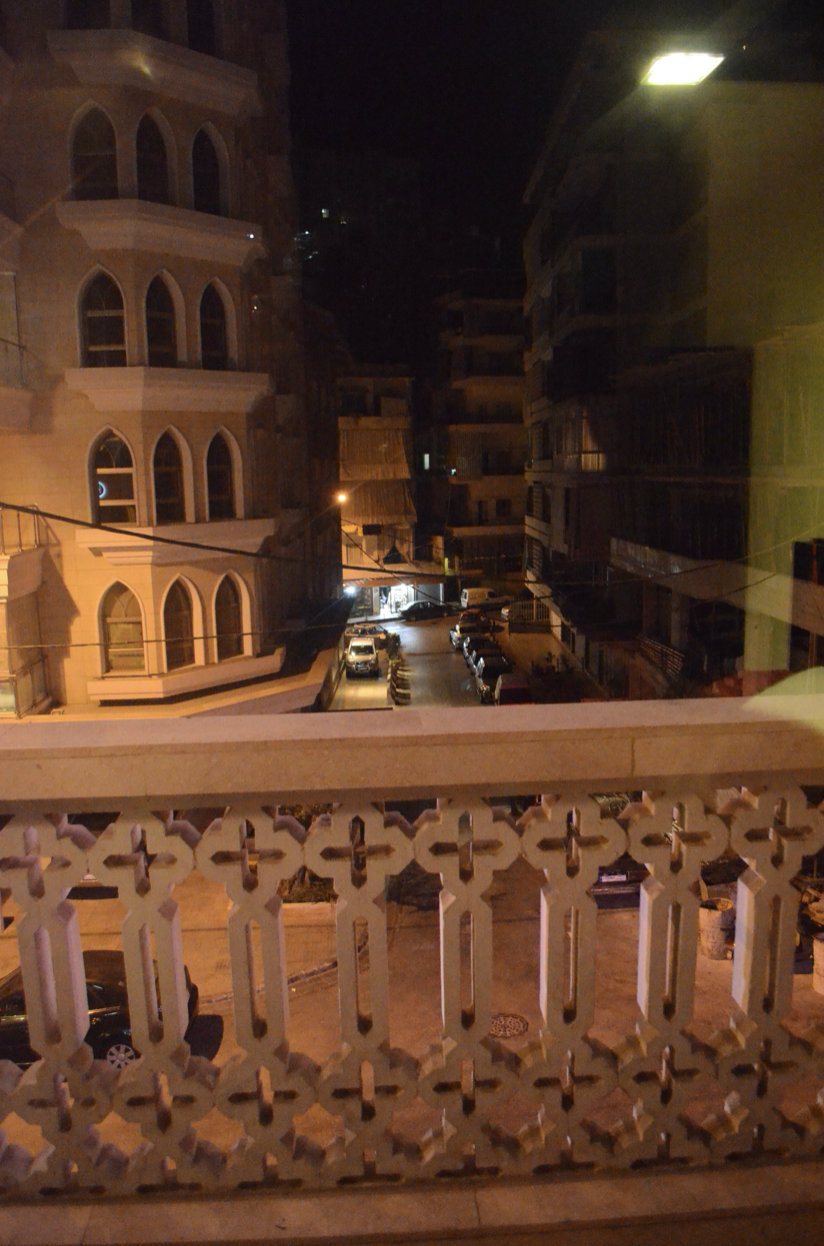
Hamra Street, Beirut. Photo: Yesar Almaleki, Wikimedia Commons, CC BY-SA 2.0. Suggested alt text: “Night view from a balcony over Hamra Street in Beirut, showing residential buildings, street lights, and layered urban density.”
Beirut has become a visual habit. Say its name and the same inventory appears: broken balconies, neon bars, sea light, bullet-scarred facades, old tiles, new towers, martyr posters, late dinners, cigarettes under fig trees, exhausted glamour, collapsed infrastructure, astonishing people. The city is constantly described as cinematic. That may be the problem.
A cinematic city is too easy to consume. It gives the visitor atmosphere before it gives the resident rights. It allows architecture to become décor, trauma to become texture, and public failure to become a kind of seductive patina. Beirut has been overused as image and under-read as system. It has been framed as backdrop for fashion shoots, music videos, lifestyle essays, political nostalgia, humanitarian appeals, and real estate fantasy. It is everywhere visually, yet too often missing conceptually.
For Core Art Strategies, Beirut is not a postcard of beautiful damage. It is a working case study in why cities need cultural strategy before they need cultural decoration. Cultural strategy is not a slogan attached to a development, nor a mural commissioned after the contractor leaves. It is the process of reading a city’s visible and invisible systems before deciding what art, institution, archive, public program, acquisition, commission, or spatial intervention should exist there.
This matters because art in cities is never neutral. A sculpture in a lobby, a mural on a wall, a cultural center in a rehabilitated house, a memorial in a square, a hotel art program, a residency in an old building, a pop-up in a port neighborhood, all of these are decisions about who gets to speak, who gets to remember, who gets displaced, and who gets turned into atmosphere. In Beirut, those questions are not theoretical. They are the city’s daily grammar.
The argument is simple: before art is placed in a city, the city must be read. Beirut teaches this with unusual violence and clarity.
A city is not an aesthetic. mood board. It is a system of land, memory, power, movement, ownership, grief, commerce, public space, private survival, and visual control
The Decorative Misuse of Beirut
The global language of “placemaking” has made cities vulnerable to a softer kind of extraction. Instead of only taking land, it takes mood. It packages local life into brand language. It turns neighborhoods into consumable scenes. It asks artists to produce “identity” while the deeper conditions that created that identity, old housing, local economies, pedestrian habits, informal gathering spaces, small workshops, family-owned cafés, street-level contradiction, are priced out or ignored.
Beirut is especially vulnerable to this because its surface is already dramatic. The city gives immediate visual returns. It photographs well because it is unresolved. Its buildings expose layers of class, war, neglect, faith, capital, migration, and improvisation. A wall in Beirut can hold a political poster, an electricity cable, a restaurant sign, a broken cornice, a satellite dish, a saint, a graffiti tag, and a real estate notice. That wall is not “cool.” It is a compressed archive.
When Beirut is used as backdrop, the archive is flattened. The same happens in many cities, but Beirut makes the ethical problem visible. It shows how easily cultural language can become a cosmetic operation. One can stage a dinner in a heritage building and call it preservation. One can install art in a private development and call it public engagement. One can sponsor an exhibition and call it recovery. One can commission a mural and call it urban healing. The words are always softer than the structures behind them.
Cultural strategy begins by resisting that softness. It asks what is being shown, what is being hidden, who benefits from the image, and what the project leaves behind after the photograph circulates. This is why Beirut is essential for any serious art consultancy, curator, developer, or cultural institution working in the Arab world. The city exposes lazy thinking immediately.
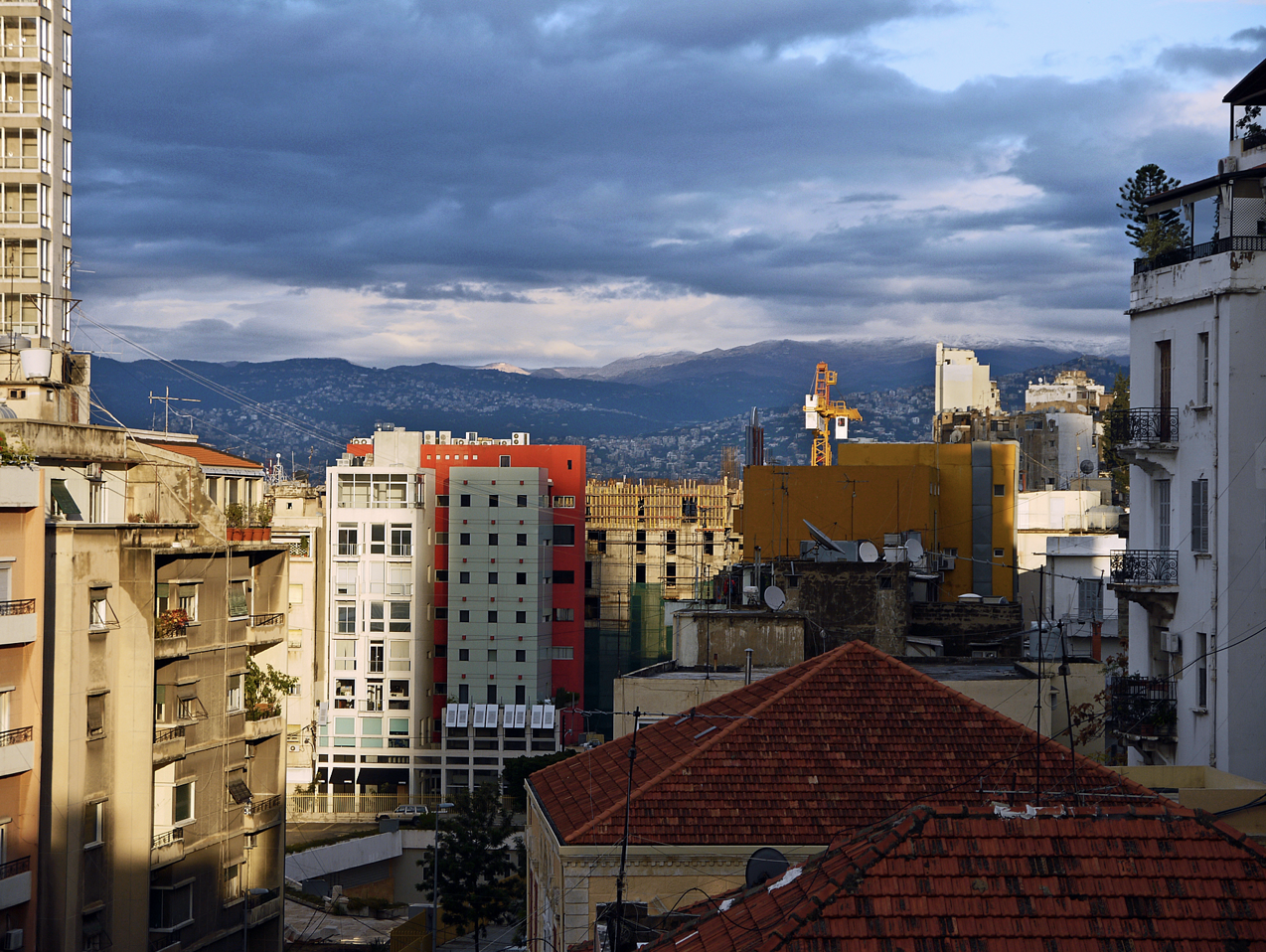
Gemmayze, Beirut. Photo: Raini Svensson, Wikimedia Commons, Public Domain Mark. Suggested alt text: “View over Gemmayze in Beirut with layered roofs, mountains, construction cranes, and mixed architectural fabric.”
A City Is a Living System, Not a Scenic Surface
Urban culture is not only what happens inside museums. It is the sum of rituals, routes, images, economies, institutions, habits, and disputes that give a city its intelligence. UNESCO’s global report on culture and sustainable urban development argues that culture must sit at the heart of urban policies and strategies, not appear later as an ornamental supplement. The report frames culture as a resource for safe, inclusive, resilient, and sustainable cities, and links heritage, contemporary design, creative industries, governance, and urban renewal as part of one field. [1]
This is where Beirut becomes more than a subject. It becomes a method. The city forces us to read culture spatially. Where do people gather when formal public space is weak? Which buildings become cultural infrastructure by accident? Which cafés carry more memory than official institutions? Which staircases function as theaters? Which balconies perform privacy and publicness at once? Which streets become galleries without asking permission? Which walls carry the state’s absence better than a policy document?
UN-Habitat’s Beirut City Profile was produced as a multisectoral and spatial analysis for recovery and reconstruction after the port explosion, precisely because Beirut’s crisis could not be understood through one lens. Housing, infrastructure, heritage, economy, governance, services, and spatial vulnerability intersect. [2] That is also how cultural strategy must work. It cannot treat art as separate from land. It cannot treat heritage as separate from housing. It cannot treat public art as separate from public access.
A city is a living system. Beirut’s system is damaged, inventive, unequal, and culturally overcharged. To work in it responsibly, one must map more than sites. One must map pressure.
Visual Noise as Urban Archive
Beirut’s visual field is not chaotic because Lebanese people lack order. It is chaotic because many orders compete in public without a shared civic frame. Political parties use walls as territorial declarations. Religious institutions shape skylines and soundscapes. Real estate billboards sell a cleaner Beirut to people already insulated from the existing one. Cafés and bars produce lifestyle identity. Galleries produce symbolic capital. NGOs produce emergency visibility. Families produce domestic extensions onto balconies. The city’s surface becomes a negotiation table with no moderator.
This is why Beirut’s “visual noise” should be studied as evidence. It is not simply ugly or beautiful. It is a record of who has the power to mark space. The city can feel visually aggressive because it is being authored by many forces at once: sectarian, commercial, informal, artistic, nostalgic, speculative, religious, domestic, touristic, and survival-based. Cultural strategy should not erase this noise. It should decode it.
The danger is that developers and cultural commissioners often respond to visual noise with aesthetic sterilization. They want clean walls, controlled lighting, curated heritage, polished Arabic typography, a tasteful reference to memory, and a local artist near the entrance. This is not strategy. It is sedation.
Beirut does not need to be made tasteful for external comfort. It needs to be read with enough intelligence that new interventions do not insult its complexity. Art consultancy in such a context should operate like urban translation. The work is not to make the city look better. The work is to understand what the city is already saying, then decide where art can add meaning, pressure, dignity, friction, or form.
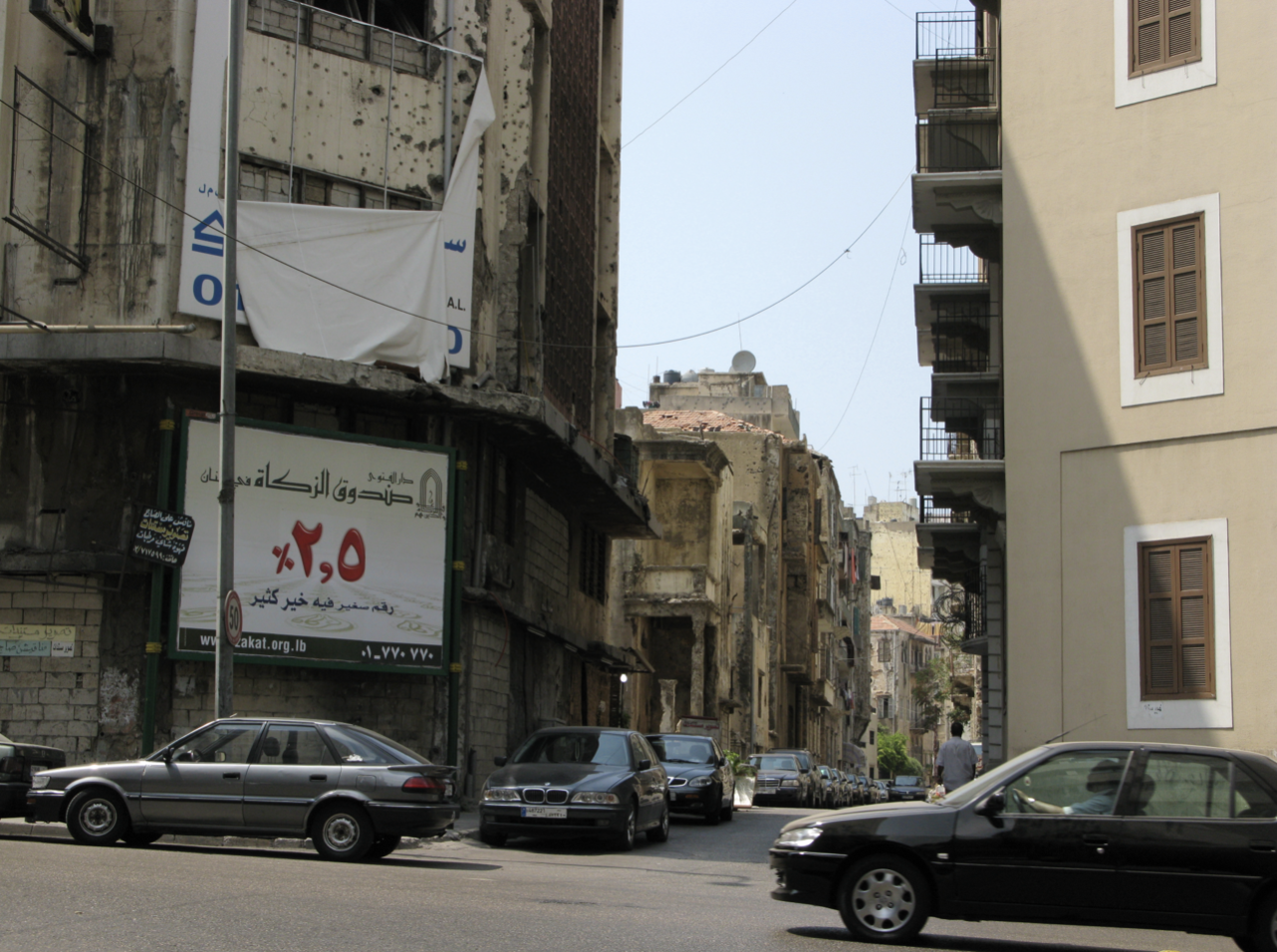
Street close to Beirut’s former Green Line. Photo: Vyacheslav Argenberg, Wikimedia Commons, CC BY 4.0. Suggested alt text: “Street in Beirut near the former Green Line showing aging buildings, traffic, signs, and layered urban traces.”
Land, Memory, and the False Neutrality of Art
Any serious discussion of Beirut must pass through land. Beirut’s cultural problem is not only that it lacks enough museums, art centers, or public art programs. It is that land has repeatedly been treated as a financial instrument before being treated as a social contract. Beirut Urban Lab’s Beirut Land Dialogues brought together stakeholders to reconsider urban land in the context of economic collapse, with the clear premise that land is a central node of the crisis and that any recovery strategy must conceptualize its role. [3]
That statement matters for cultural work. If land is the operating system, culture cannot be an app installed later. Public art placed on privatized land performs a different function than public art in a truly accessible square. A restored house used as an exclusive venue carries a different meaning than a restored house used as a public cultural resource. A heritage façade preserved while its social life is displaced is not heritage preservation. It is architectural taxidermy.
Beirut’s postwar downtown remains one of the region’s most instructive examples of this tension. It shows how reconstruction can produce order while draining public spontaneity. It shows how urban elegance can become socially cold. It shows how a city center can look complete and still feel evacuated. The lesson is not that reconstruction is bad. The lesson is that cultural identity cannot be engineered only through property, security, cleanliness, and stone.
The question for cultural strategy is blunt: who is the city being made legible to? Residents, visitors, investors, tourists, institutions, artists, displaced communities, future buyers, or history itself? Every art program answers that question, even when it pretends not to.
After the Blast: Culture Is Not Recovery Unless It Builds Capacity
The 2020 port explosion made visible what was already structurally present: neglect, impunity, institutional weakness, urban vulnerability, and the fragility of cultural heritage under conditions of political and economic collapse. The Sursock Museum became one of the clearest cultural symbols of that moment. UNESCO announced the completion of its rehabilitation project for the museum after the 4 August 2020 blast, supported by Italian funding, and described the project as part of placing education, culture, and heritage at the heart of recovery. [4] The museum itself noted that it reopened in May 2023 after almost three years of forced closure, repair, and rehabilitation. [5]
This is not only a museum story. It is an argument about cultural infrastructure. A museum is not merely a building with exhibitions. It is an archive of civic continuity. When such a building is damaged, the loss is not only material. It is symbolic, educational, emotional, and urban. When it returns, the return should not be reduced to resilience branding. It should ask what kind of cultural ecosystem can survive repeated shocks.
The word “resilience” has become dangerous in Beirut because it is often used to praise people for surviving conditions they should not have been forced to survive. In cultural language, resilience can become a polite way of avoiding accountability. The more responsible word is infrastructure. Cultural infrastructure includes museums, schools, archives, independent spaces, studios, bookstores, libraries, public squares, affordable workspaces, residencies, fabrication networks, and maintenance budgets. Without infrastructure, culture becomes personality. It depends on heroic individuals, temporary grants, unpaid labor, and emotional exhaustion.
Core Art Strategies should treat Beirut’s cultural recovery as a caution against symbolic overproduction. A city does not need more empty gestures. It needs systems that let culture last.
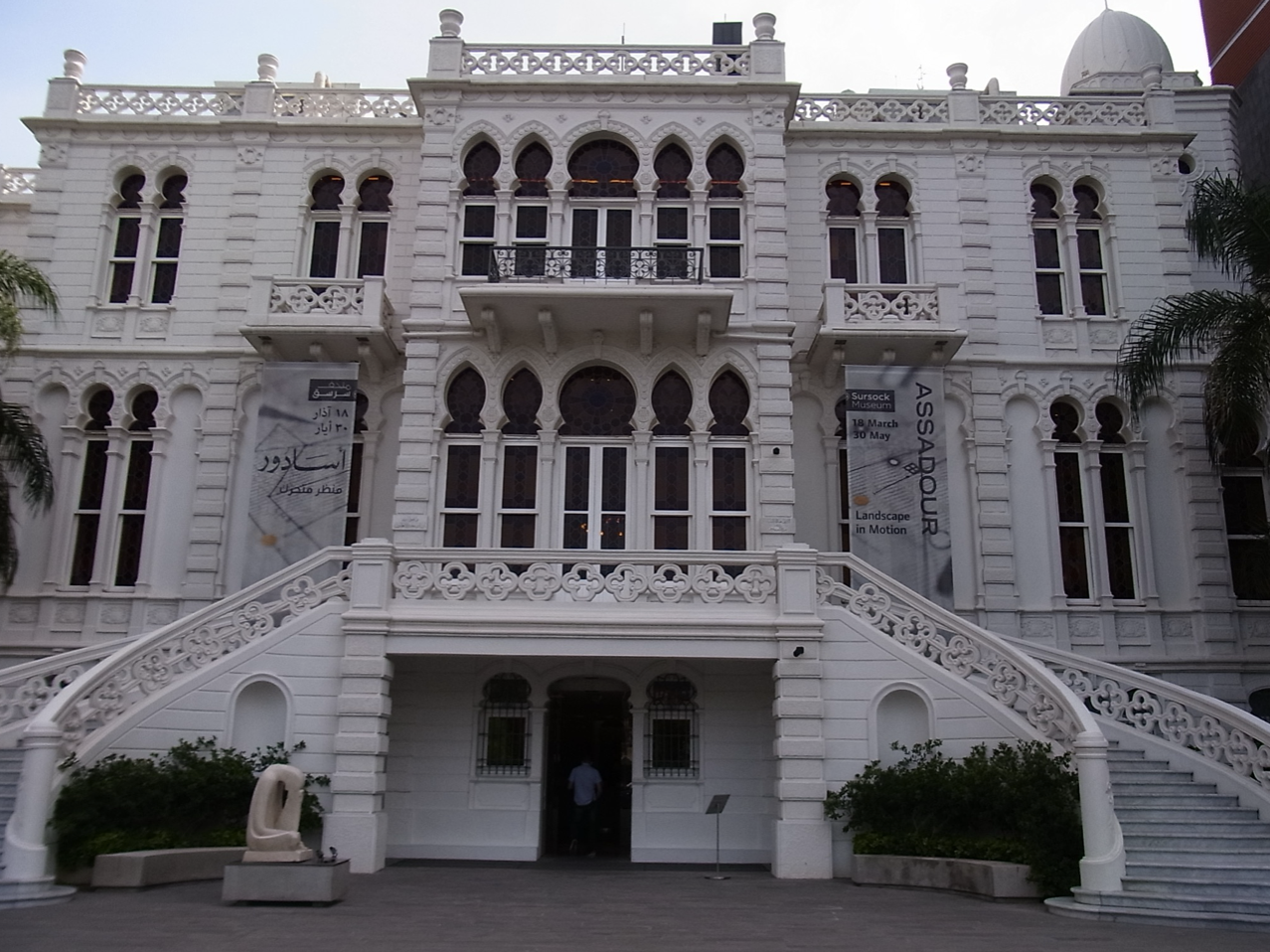
Sursock Museum, Beirut. Photo: antomoro, Wikimedia Commons, Free Art License. Suggested alt text: “Front façade of the Sursock Museum in Beirut with white stone architecture, arched windows, and exterior staircases.”
Alternative Spaces Are Not Marginal, They Are the Engine
Beirut’s most important cultural lessons do not only come from formal institutions. They also come from alternative spaces that operate between house, stage, studio, classroom, shelter, and argument. Zico House, located in Spears, describes itself as a platform for emerging artists and for avant-garde and experimental art events in Beirut, and as a space that has welcomed artist residencies and provided space and technical equipment. [6] Its official presence also states that it has hosted experimental artistic projects since 1995. [6]
Spaces like this complicate the meaning of cultural infrastructure. They are not polished museums. They are not white-cube products. They are messy, social, domestic, improvised, and institutionally unstable in the best and most difficult ways. Their value comes from use, not from spectacle. They host practices that may not yet have market clarity. They allow young artists, musicians, performers, writers, and organizers to test forms before those forms become acceptable.
This matters because cultural strategy must recognize the ecology behind visible culture. A finished artwork appears in a gallery, hotel, museum, or public site, but its conditions are formed elsewhere: in rehearsal rooms, basements, staircases, printing shops, cafés, friends’ houses, shared studios, and tiny organizations with terrible funding and enormous influence. If a city loses those places, it loses its cultural engine while keeping only its display windows.
The strongest cultural strategies do not only commission objects. They protect conditions. They ask where artists can afford to work, where audiences can gather without spending heavily, where archives are kept, how skills are transmitted, what happens after an exhibition closes, and whether cultural space remains culturally alive or becomes another lifestyle asset.
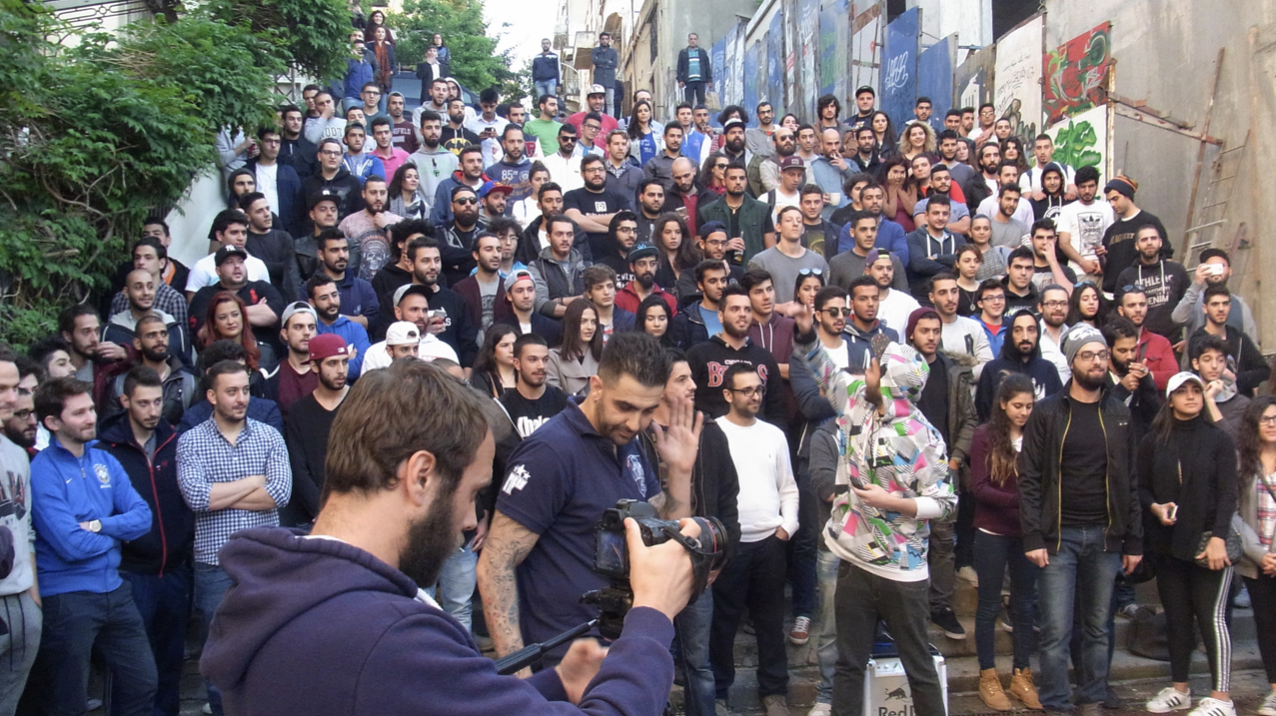
Steps of Mar Mikhael, Beirut. Photo: Sluggh Mcgee, Wikimedia Commons, CC0. Suggested alt text: “Crowd gathered on the Steps of Mar Mikhael in Beirut, showing the staircase as an informal public and cultural space.”
What Cultural Strategy Would Actually Mean in Beirut
Cultural strategy in Beirut would begin with a refusal: refusal to use the city as distressed wallpaper, refusal to treat heritage as a premium finish, refusal to mistake nightlife for cultural depth, refusal to commission art as a last-minute layer, and refusal to speak about “identity” without speaking about ownership, access, maintenance, and governance.
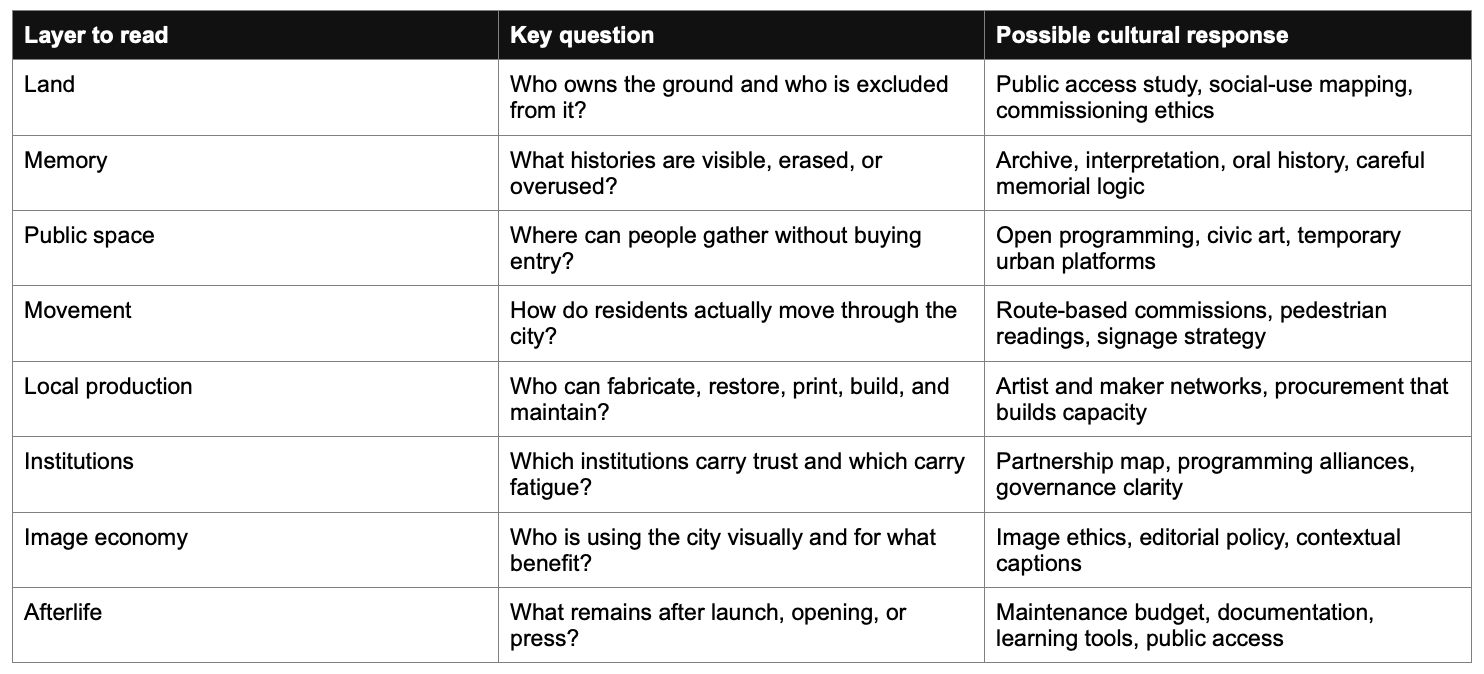
A serious framework would include several stages. First, city reading: mapping neighborhoods, historical layers, political signs, movement patterns, informal cultural spaces, and the emotional charge of sites. Second, stakeholder listening: artists, residents, architects, municipal actors, independent spaces, historians, fabricators, youth communities, and property owners. Third, cultural positioning: defining what a project should contribute to the city rather than what mood it should borrow from it. Fourth, commissioning logic: deciding whether the right response is an artwork, archive, residency, public program, acquisition strategy, exhibition, spatial intervention, or no intervention at all. Fifth, implementation: production, fabrication, budgeting, permissions, installation, interpretation, documentation, and maintenance. Sixth, afterlife: what remains in the city after opening night.
This is where art consultancy becomes strategic rather than decorative. It is not about choosing beautiful objects. It is about aligning art with architecture, brand, public meaning, local intelligence, and long-term cultural value. In Beirut, that alignment has to be especially careful because the city is already saturated with meaning. A weak intervention disappears. A cynical one is exposed. A smart one can create a new layer without pretending to solve the city.
Public Works Studio’s mission is useful here because it names the political and social dimensions of architecture, urban planning, design, public circulation, knowledge production, and spatial justice. [7] Cultural strategy does not have to become activism, but it cannot remain innocent. Every spatial decision participates in a politics of visibility.
Core Art Strategies City-Reading Matrix
What Beirut Teaches the Gulf About Cultural Intelligence
The Gulf’s current cultural expansion makes Beirut more relevant, not less. Saudi Arabia, Qatar, and the UAE are building museums, biennials, heritage districts, luxury hotels, public art programs, cultural districts, and destination-led developments at extraordinary speed. Beirut cannot compete with that scale, but it can teach what scale alone cannot buy.
It teaches that culture without lived contradiction becomes thin. It teaches that imported spectacle ages quickly when it is not rooted in local intelligence. It teaches that heritage cannot be treated only as visual reference. It teaches that artists need ecosystems, not only invitations. It teaches that public art without public life becomes furniture. It teaches that a city’s identity is not a theme. It is an argument.
For hospitality, real estate, and cultural developments, this lesson is direct. A hotel in Riyadh, Doha, Abu Dhabi, or Beirut cannot become culturally meaningful by filling walls with regional art at the end of construction. A headquarters cannot communicate national identity by installing generic monumental pieces near reception. A cultural district cannot generate relevance by importing institutional language without cultivating local participation. Art must be embedded early, at the level of story, spatial logic, commissioning, production, and experience.
This is precisely the territory where Core Art Strategies can speak with authority. The firm’s proposition should not be “we source art.” It should be “we read the place, construct the art strategy, manage the cultural narrative, and deliver the program from concept to execution.” Beirut gives this claim depth because it is a city where poor reading is immediately punished. If you do not understand the context, the context eats the project.
Conclusion: Stop Reducing Beirut With Language
There is a moral laziness in calling Beirut beautiful too quickly. The city is beautiful, yes, but beauty is not the point. Beauty can become an alibi. It allows people to enjoy the visual result of damage without confronting the systems that produced it. It lets the observer feel sensitive while remaining passive. It turns collapse into atmosphere.
A stronger reading begins elsewhere. Beirut is not a backdrop. It is not a mood. It is not a ruin with nightlife. It is not a brand asset for people who need quick authenticity. It is a city where culture operates under pressure, where public space is contested, where memory is overexposed and underprotected, where institutions struggle, where informal spaces carry disproportionate weight, where every wall knows more than it should.
To write about Beirut through cultural strategy is not to save it with language. It is to stop reducing it with language. It is to insist that cities must be read before they are curated, and that art must enter the city as responsibility, not as decoration.
At its best, art consultancy is not the business of placing objects. It is the discipline of translating context into form. Beirut, in all its difficulty, is one of the clearest arguments for why that discipline matters.
At its best, art consultancy is not the business of placing objects. It is the discipline of translating context into form.
Research Sources and References[1] UNESCO, Culture: Urban Future. Global Report on Culture for Sustainable Urban Development, 2016. ICOMOS catalogue entry notes that culture must lie at the heart of sustainable policies and strategies, and that the report frames culture as a resource for urban sustainability, heritage, creative industries, and resilient cities. https://publ.icomos.org/publicomos/jlbSai?html=Pag&page=Pml/Not&base=technica&ref=D59F27A372697D9C81ADE0C2ABC35DF3 [2] UN-Habitat, Beirut City Profile, 2021. The profile provides a multisectoral and spatial analysis of Beirut to support recovery and reconstruction. https://unhabitat.org/beirut-city-profile [3] Beirut Urban Lab, Beirut Land Dialogues: Pathways Towards Recovering the Social Value of Urban Land, 2021 to 2022. The project states that land is a central node of Lebanon’s economic collapse and must be conceptualized in recovery strategy. https://beiruturbanlab.com/en/Details/873 [4] UNESCO, Beirut: UNESCO has completed the rehabilitation of the iconic Sursock Museum damaged by port explosions, 2023, updated 2024. https://www.unesco.org/en/articles/beirut-unesco-has-completed-rehabilitation-iconic-sursock-museum-damaged-port-explosions[5] Sursock Museum, Your Museum is back!, 2023. The museum states that it reopened on 26 May 2023 after almost three years of closure, repair, and rehabilitation following the port explosion. https://sursock.museum/content/your-museum-back[6] Zico House official website. Zico House describes itself as a platform for emerging artists and avant-garde and experimental art events in Beirut, and notes its support for artist residencies and experimental artistic projects since 1995. https://zicohouse-beirut.com/[7] Public Works Studio, About Us. The studio’s mission statement emphasizes socially inclusive spaces, the political and social dimensions of architecture and urban planning, and knowledge production around spatial and urban issues. https://publicworksstudio.com/en/about-us/[8] World Bank, Lebanon’s Crisis: Great Denial in the Deliberate Depression, 2022. The World Bank describes the disintegration of key pillars of Lebanon’s post-civil war political economy, collapse of basic services, political discord, and brain drain. https://www.worldbank.org/en/news/press-release/2022/01/24/lebanon-s-crisis-great-denial-in-the-deliberate-depression