
Why Beirut Needs Cultural Infrastructure, Not More Events
A critique of temporary exhibitions, festivals, pop-ups, and cultural moments that disappear without building anything lasting
By Mohamad Makouk | Core Art Strategies
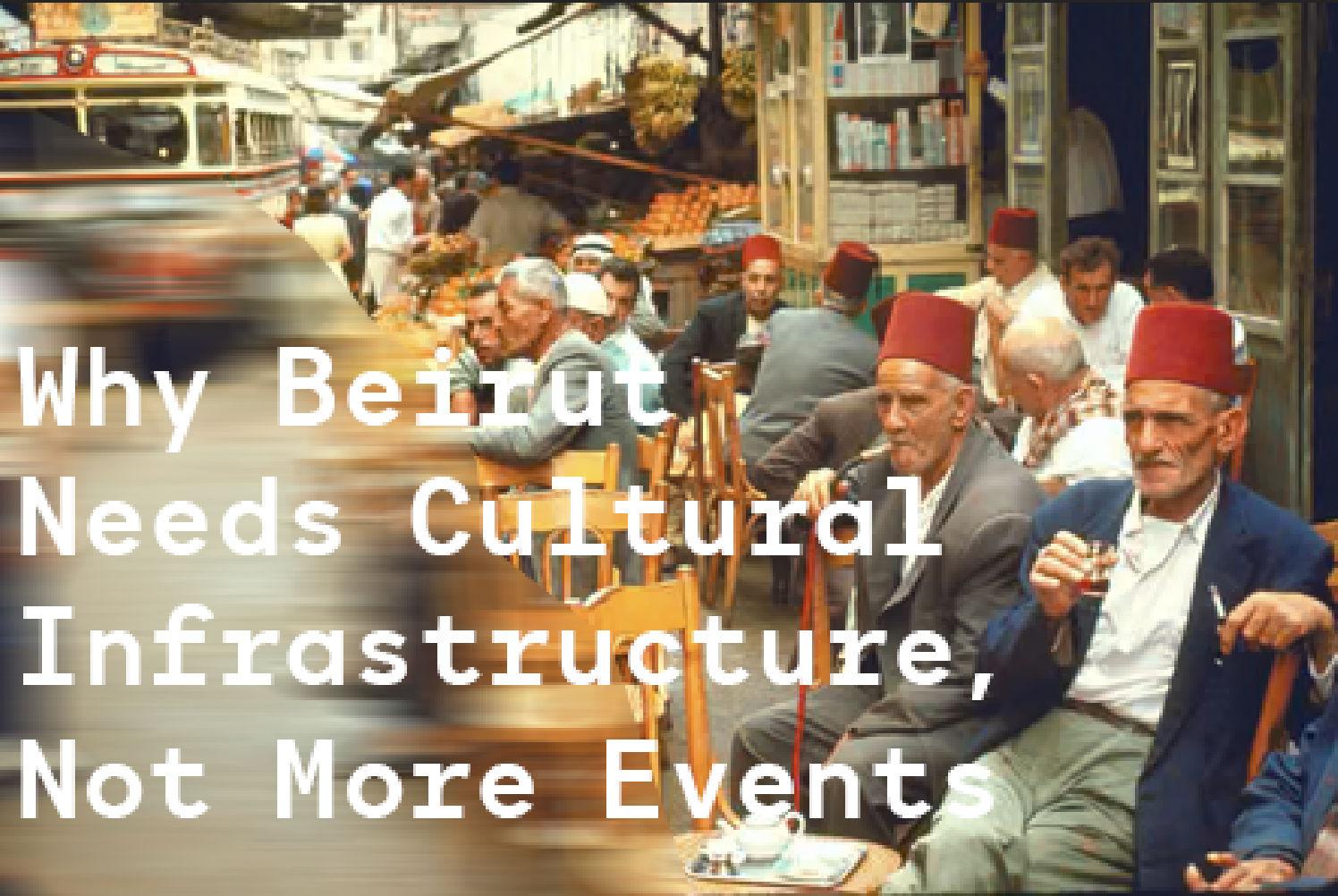
Beirut does not suffer from a lack of cultural activity. That is the lazy diagnosis. Beirut suffers from a surplus of cultural moments and a shortage of cultural continuity.
The city knows how to gather people. It knows how to turn a damaged building into a venue, a staircase into a stage, a gallery opening into a social weather report, a neighborhood into a temporary festival map. Beirut can produce atmosphere with almost no resources. It can turn crisis into gathering, memory into image, ruin into backdrop, survival into performance. This ability is seductive. It is also dangerous.
Because when culture is reduced to events, it becomes a candle. Beautiful, emotional, photogenic, temporary. It lights a room for a few hours and then disappears. What Beirut needs now is not another candle. It needs wiring.
Cultural infrastructure is the wiring. It is not only museums, theaters, archives, libraries, collections, residencies, foundations, schools, research centers and public programs. It is the strategy connecting them. It is the long-term system that allows cultural production to survive after the opening night, after the Instagram story, after the sponsor logo fades, after the guest list goes home.
This matters because Beirut has repeatedly proven that culture is not decoration in the life of the city. It is one of the few languages through which the city processes collapse, memory, class, violence, beauty, exile, identity and return. After the 2020 Beirut Port explosion, the World Bank Rapid Damage and Needs Assessment estimated total damages at US$3.8 to US$4.6 billion, with housing and culture among the severely affected sectors. Culture was not a side casualty. It was infrastructure hit by disaster. [1]
And yet Beirut's cultural recovery is still too often treated as a calendar problem. Another exhibition. Another festival. Another pop-up. Another three-day activation. Another symbolic reopening. Another speech about resilience.
Resilience is not a strategy. It is what people say when they do not want to pay for structure.
The event economy is not enough
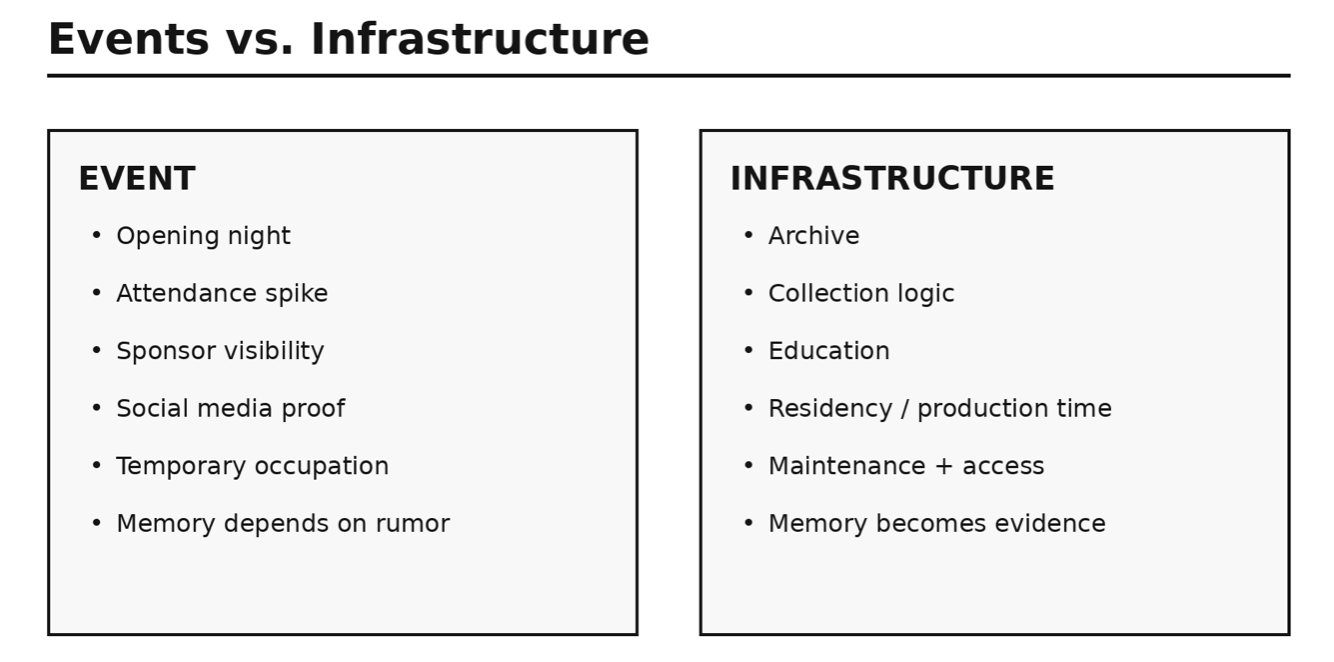
Diagram: Events create visibility; infrastructure creates continuity. Original diagram prepared for Core Art Strategies.
Events matter. A city without events is a city without public pulse. Exhibitions, screenings, performances, biennials, festivals, talks, workshops and pop-ups create visibility. They introduce artists to audiences. They remind citizens that public life is still possible. In a city as bruised as Beirut, that is not nothing.
Beirut Art Days 2025, for example, brought together more than 250 artists across 50 venues and 130 events over four days. That scale matters. It proves that Beirut's artistic ecosystem is still alive, networked, generous and capable of mobilizing across museums, galleries, studios, institutions and independent spaces. [2]
But a city cannot live on cultural adrenaline forever.
An event is not an archive. A festival is not an education system. A pop-up is not a collection. A panel discussion is not a research department. A beautiful opening in a decaying building is not heritage policy. A weekend of public programming is not a cultural strategy.
The problem is not that Beirut has too many events. The problem is that many events are not designed to leave anything behind.
What remains after the crowd leaves? Were the works documented? Were the artists paid properly? Were the talks recorded, transcribed, translated, indexed and made accessible? Was a publication produced? Were young practitioners trained? Did the event strengthen a venue, an archive, a residency, a school, a collection, a neighborhood, a cultural map? Did it create policy pressure? Did it generate data? Did it help a cultural worker stay in Lebanon? Did it move an artist's practice forward? Did it build institutional memory?
If the answer is no, then the event may have been beautiful, but it was not infrastructure. It was weather.
Beirut’s real crisis is continuity
Beirut has mastered interruption. War interrupts. Financial collapse interrupts. Explosion interrupts. Emigration interrupts. Electricity interrupts. Funding cycles interrupt. Donor priorities interrupt. Real estate speculation interrupts. Exhaustion interrupts.
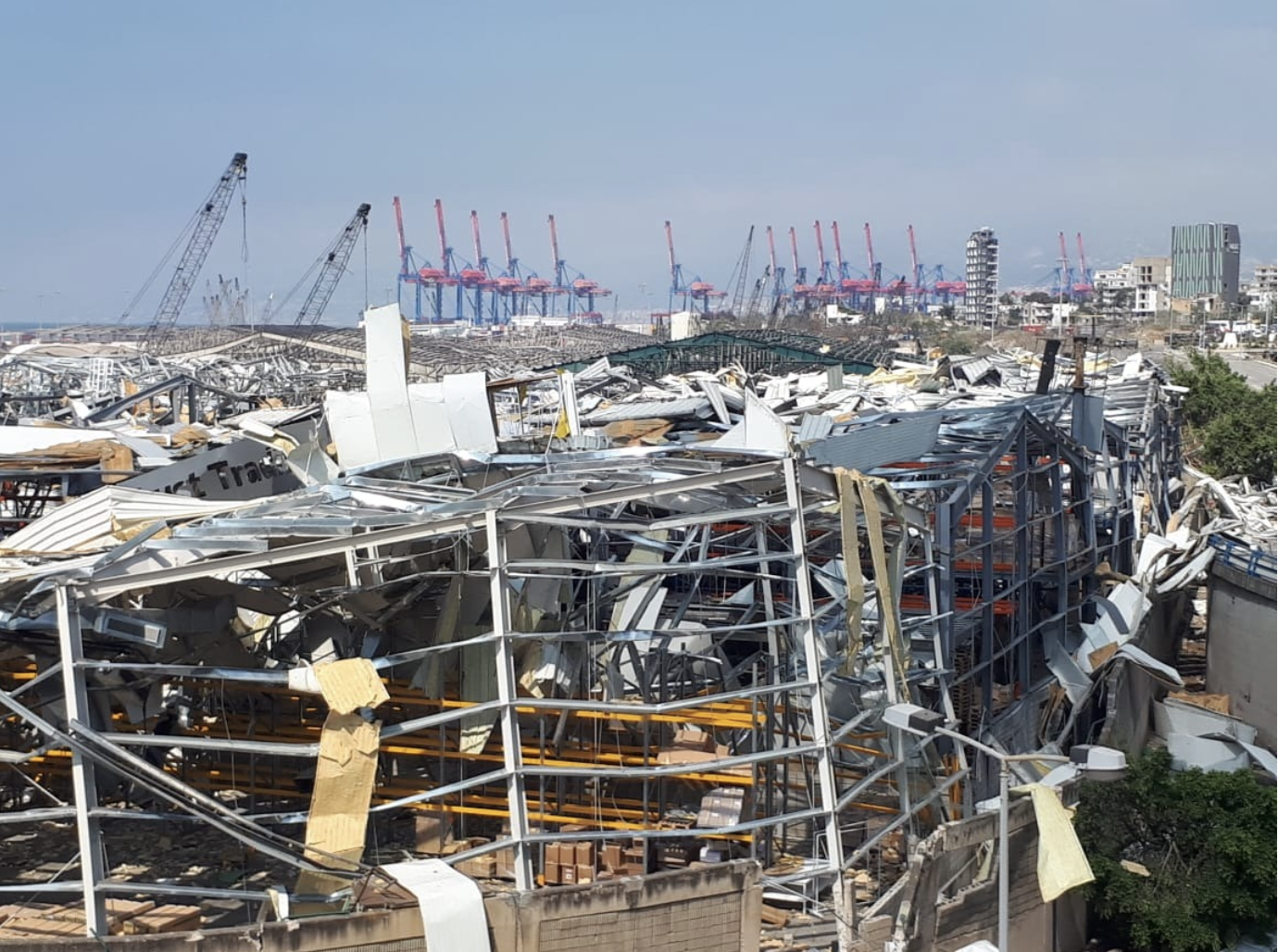
mage: Aftermath of the 2020 Beirut explosions. Photo: Freimut Bahlo, Wikimedia Commons, CC BY-SA 4.0.
The city's cultural life has therefore learned to operate in fragments. It appears, disappears, relocates, improvises, restarts. This has created a mythology of brilliance under pressure: the Beirut artist as survivor, the Beirut curator as emergency worker, the Beirut institution as miracle, the Beirut audience as witness.
There is truth in this mythology, but there is also a trap. When a city becomes too proud of its ability to improvise, it stops demanding the conditions that would make improvisation less necessary.
Lebanon's cultural and creative industries have remained vital through the financial crisis, COVID-19 and the 2020 port explosion, but UNESCO notes that the 2024 hostilities produced further economic and structural losses, including physical damage, lost archives, disrupted funding and reduced operations for cultural actors. [3]
That phrase, lost archives, should terrify anyone who cares about culture.
Because when an archive disappears, a city does not simply lose objects. It loses evidence. It loses context. It loses the ability to remember itself accurately. Without archives, every generation is forced to begin again, badly, emotionally, with myths instead of records.
This is why Beirut needs cultural infrastructure. Not because infrastructure sounds serious. Not because institutions look good in grant applications. But because without infrastructure, culture becomes a series of beautiful disappearances.
What cultural infrastructure actually means
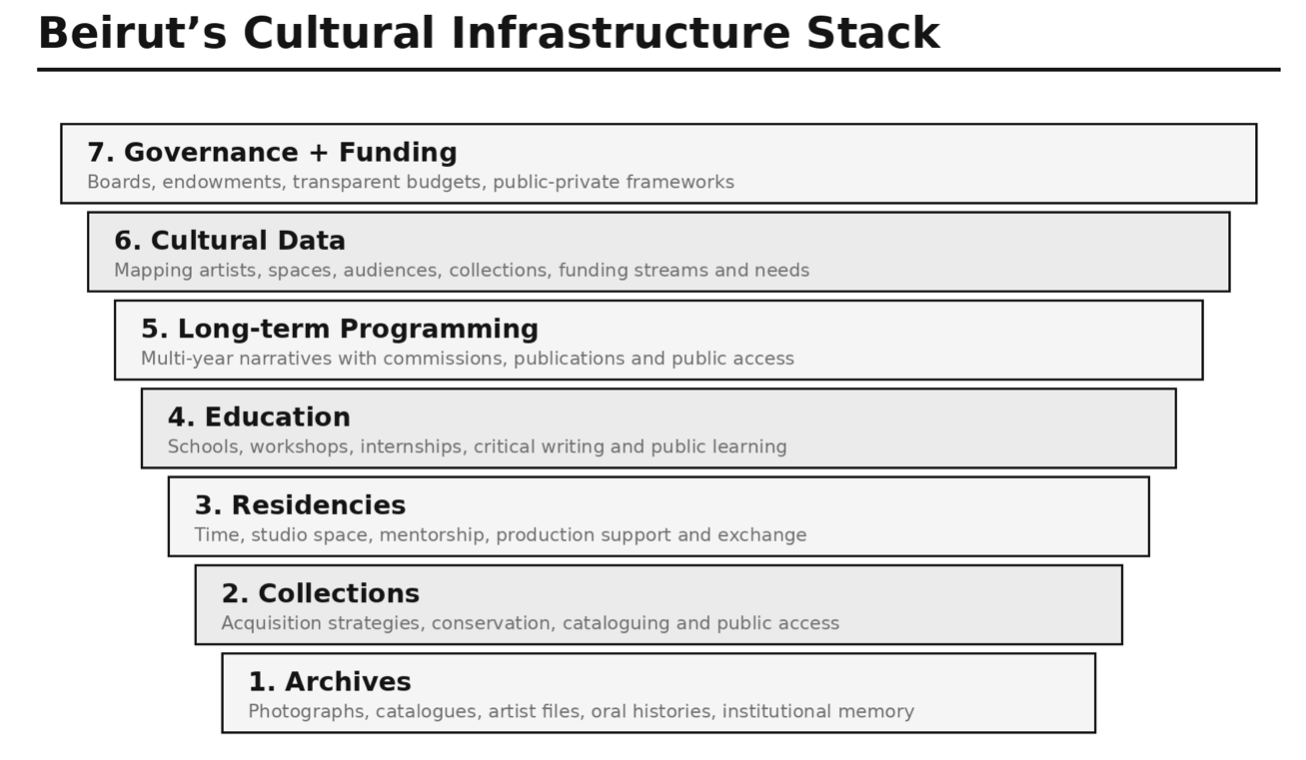
Diagram: Cultural infrastructure is a stack, not a single venue. Original diagram prepared for Core Art Strategies.
Cultural infrastructure is often misunderstood as architecture. A museum building. A performance hall. A cinema. A library. A foundation headquarters. These matter, but they are only the visible skin of the system.
Real cultural infrastructure includes at least seven layers: archives, collections, residencies, education, long-term programming, cultural data, and governance/funding models. Without these layers, culture remains dependent on personality, crisis, charisma and luck.
Beirut has enough charisma. It needs systems.
Archives preserve images, documents, oral histories, exhibition records, artist files, catalogues, architectural drawings, correspondence, press coverage and institutional memory. Collections preserve artistic production through acquisition strategies, conservation, research and public access. Residencies give artists time, space, context, mentorship and production support without forcing every output to become immediately marketable.
Education creates future audiences and future professionals through schools, informal learning programs, apprenticeships, internships, public talks, reading groups and critical writing platforms. Long-term programming connects events into multi-year cultural narratives with research, commissions, publications and public access. Cultural data maps artists, spaces, audiences, collections, heritage buildings, funding streams, visitor behavior, cultural employment and neighborhood-level needs. Governance and funding models provide boards, endowments, transparent budgets, patron circles, public-private frameworks and accountability.
The institutions that already show the way
The argument for infrastructure is not theoretical. Beirut already has examples of what long-term cultural systems can do.
The Arab Image Foundation is one of the clearest models. Founded in Beirut in 1997 by Fouad Elkoury, Samer Mohdad and Akram Zaatari, it collects, preserves, digitizes and researches photographs from South West Asia, North Africa and their diasporas. Its holdings include approximately 500,000 photographic objects dating back to 1860. [4]
This is infrastructure. Not because it is glamorous, but because it gives memory a body. It prevents images from becoming orphaned. It turns photographs into research, history, exhibition material and public knowledge. It gives the region a visual archive that is not dependent on foreign museums, colonial collections or family drawers decaying in humidity.
Ashkal Alwan's Home Workspace Program is another model. Launched in Beirut in 2011, it is an annual arts study program that supports participants in developing formal, technical and theoretical skills in a critical setting, with professors, workshops, seminars, feedback and resources. [5]
This is infrastructure because it invests in artistic formation rather than cultural consumption. It understands that a serious art scene cannot be built only by exhibiting finished works. It must also support the unstable, invisible and difficult phase where artists are still thinking, failing, reading, testing and becoming.
Metropolis Cinema offers another lesson. Founded in 2006 in response to the lack of circulation of independent films in Lebanon, it lost its permanent venue in 2020, restructured, decentralized activities across multiple locations and prepared a new home in Mar Mikhael after years of crisis. [6]
This is the difference between an event and an institution. An event disappears when the venue disappears. An institution fights to regenerate itself.
The Sursock Museum is another case. Damaged by the Beirut Port explosion, it underwent major rehabilitation supported by UNESCO, Italy, France, ALIPH and other partners, reopening in May 2023 after almost three years of closure. UNESCO's work included lighting systems, internal partitions, fire doors, glass walls, waterproofing, landscaping, electromechanical systems and solar energy panels. [7]
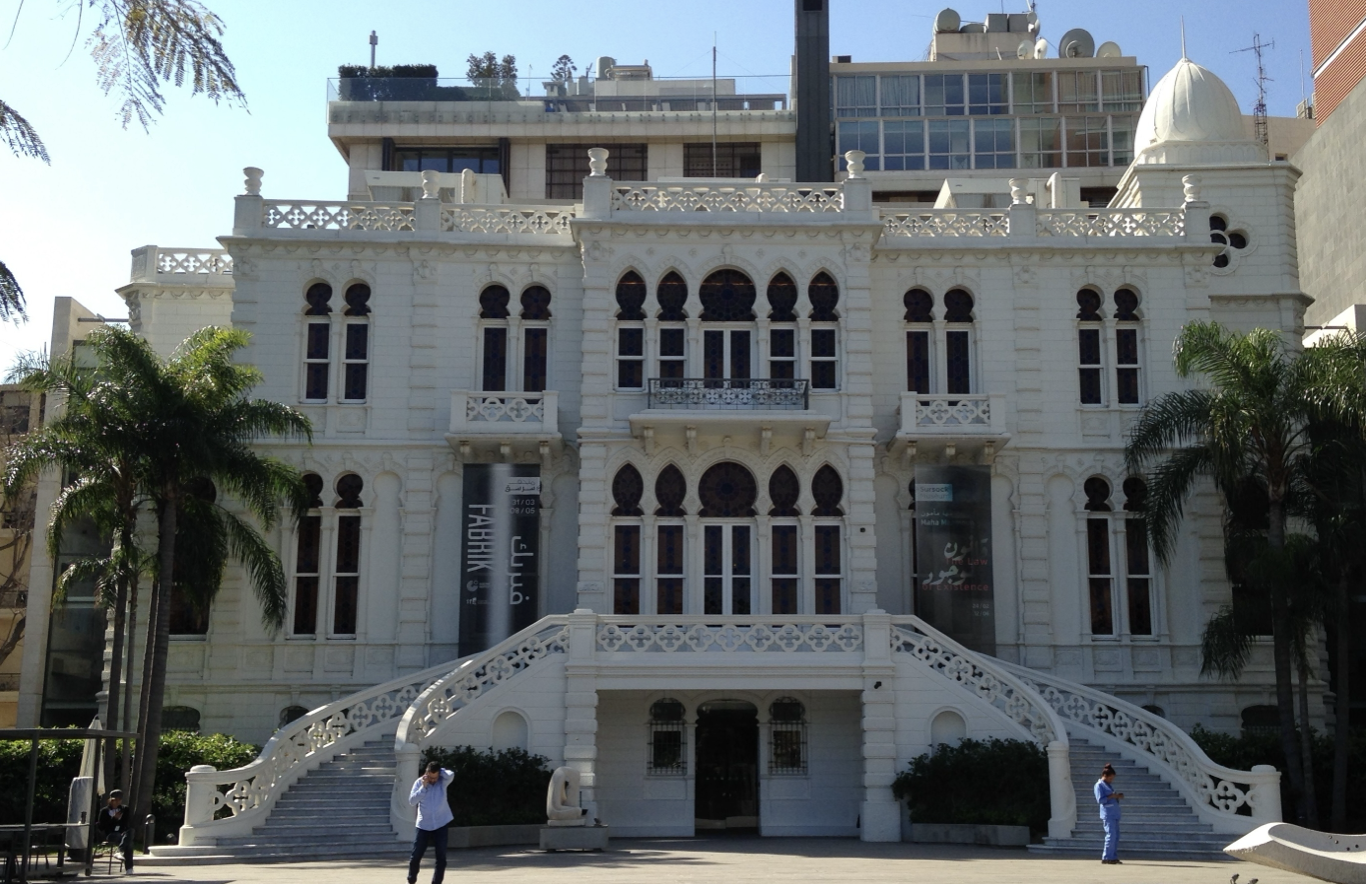
Image: Sursock Museum, Beirut. Photo: Bdx, Wikimedia Commons, CC BY-SA 4.0.
That is the point. A museum is not important because it hosts exhibitions. It is important because it holds memory, teaches publics, preserves collections, produces knowledge and gives culture an address.
The danger of cultural moments
The contemporary city has become addicted to the moment. The cultural moment is easy to sell. It photographs well. It attracts sponsors. It gives politicians and patrons something to attend. It allows developers to claim sensitivity. It gives brands cultural flavor. It gives audiences the emotional satisfaction of participation without the responsibility of continuity.
The moment is efficient because it does not ask difficult questions.
It does not ask who owns the archive. It does not ask whether artists can pay rent. It does not ask whether collections are being conserved. It does not ask why public schools have so little access to contemporary culture. It does not ask why cultural workers are underpaid. It does not ask why Beirut's heritage is often activated after it is already endangered. It does not ask why cultural spaces depend on foreign funding cycles, private generosity or heroic exhaustion.
It simply happens.
This is why cultural strategy matters. Strategy forces the cultural sector to move from occurrence to consequence. It asks what each project builds, who it serves, what it leaves behind and how it connects to a larger ecosystem.
A city does not become culturally strong because it has many openings. It becomes culturally strong when its openings become part of a chain: documentation, acquisition, education, preservation, publication, public access, artist development and institutional growth.
Culture as recovery, not decoration
There is growing policy recognition that Lebanon's cultural sector needs structure, not only celebration. Lebanon's National Strategy for Cultural and Creative Industries 2026-2031 is framed around conditions for a more structured, equitable and sustainable environment for cultural and creative actors, with coordination, investment and collaboration among stakeholders. [8]
This is exactly the language Beirut needs. Structure. Equity. Sustainability. Coordination. Investment. Collaboration.
But strategy cannot remain a PDF. A cultural strategy that does not enter buildings, budgets, schools, collections, archives, contracts, urban planning and professional practice becomes another event in document form.
Lebanon's cultural and creative industries face serious structural challenges. A 2025 Lebanese Center for Policy Studies paper highlighted financial instability, brain drain and lack of coordinated policy support as major obstacles, calling for targeted interventions, a national authority for cultural and creative industries, digital transformation and stronger regional collaboration. [9]
This is the part Beirut must confront without sentimentality. Talent is not enough. Resilience is not enough. Genius is not enough. A city can produce brilliant artists and still fail them structurally.
In fact, Beirut has done exactly that for decades.
The archive as resistance
In Beirut, archiving is not administrative. It is political.
To archive is to refuse disappearance. It is to say that the city's cultural production deserves more than nostalgia and rumor. It is to protect the evidence of what happened, who made it, where it was shown, how it was received and why it mattered.
Every exhibition should have a file. Every artist should have documentation. Every public commission should have technical records. Every cultural project should have photographs, contracts, texts, budgets, press, maintenance plans, conservation notes and public access points. Every major cultural initiative should produce material that can be studied ten years later.
This is not boring. This is power.
A city without archives becomes dependent on whoever tells the story loudest. A city with archives can argue with itself intelligently.
For Beirut, this is essential because the city is constantly being mythologized. It is packaged as ruin, nightlife, resistance, decadence, trauma, beauty, chaos, freedom, collapse. These cliches circulate faster than research. Without archives, Beirut becomes a mood board for outsiders and a wound for insiders.
Cultural infrastructure gives the city back its complexity.
Residencies over pop-ups
Pop-ups are useful when they test ideas. They are dangerous when they replace institutions.
A pop-up can activate a vacant space, bring attention to a neighborhood, support emerging artists or create a temporary public encounter. But if pop-up culture becomes the dominant cultural model, it trains artists and audiences to expect instability. It normalizes the absence of permanence.
Residencies offer another model. A residency does not only display culture. It produces conditions for culture. It gives artists time, research access, studio space, mentorship and critical exchange. It can connect local artists with international practitioners. It can generate publications, exhibitions, talks, workshops and archives. It can develop a neighborhood culturally without reducing it to scenery.
For Beirut, residencies are especially important because so many artists are trapped between staying and leaving. A strong residency ecosystem can make the city intellectually livable. It can create reasons for return. It can connect Beirut to regional and international networks without turning it into a cultural export machine.
The goal should not be to make Beirut the next anything. Not the next Dubai. Not the next Berlin. Not the next Athens. Beirut does not need to imitate another city's cultural economy. It needs to build from its own conditions: dense memory, fractured politics, architectural scars, intellectual intensity, diaspora networks, multilingual publics, informal knowledge and a brutal relationship with history.
Collections as cultural sovereignty
Collections are one of the most underestimated forms of cultural infrastructure in Lebanon.
A collection is not simply ownership. At its best, it is a cultural argument. It says: these works matter, these artists matter, this period matters, this story must be preserved.
Without serious collection strategies, a city's artistic production becomes vulnerable to disappearance, export, speculation and fragmentation. Works leave. Estates scatter. Archives rot. Documentation is lost. Artists die without proper cataloguing. Galleries close. Private collectors hide work from public access. Institutions lack acquisition budgets. The national story becomes incomplete.
Beirut needs stronger public, private and hybrid collection models. It needs acquisition funds. It needs collection management training. It needs conservation labs. It needs digital catalogues. It needs artist estate planning. It needs agreements between private collectors and public institutions. It needs corporate collections that do more than decorate offices. It needs hospitality collections that commission artists seriously rather than filling walls with anonymous objects.
This is where art consultancy becomes more than procurement.
A serious art consultancy should not ask only: what artwork fits this wall? It should ask: What cultural value is being created? What story is being preserved? What artist ecosystem is being supported? What collection logic is being built? What will this project mean in ten years?
That is the difference between buying art and building cultural infrastructure.
Why this matters for Core Art Strategies
This is where Core Art Strategies enters the argument naturally.
Core Art Strategies should not position itself as a company that organizes cultural moments. Beirut has enough moments. CAS should position itself as a cultural strategy and art consultancy platform that understands how art becomes infrastructure: through concept, collection, commissioning, documentation, education, programming and long-term value.
For hospitality projects, this means art is not wall filling. It is identity infrastructure.
For real estate projects, art is not lobby decoration. It is place-making, memory-making and value-building.
For corporate headquarters, art is not a prestige accessory. It is a narrative system that communicates institutional identity, geography, ambition and cultural intelligence.
For cultural institutions, art is not only exhibition-making. It is archive, access, public programming, audience development, research and continuity.
For cities like Beirut, art is not a weekend activity. It is part of civic survival.
The Core Art Strategies position can be very clear: temporary cultural programming has value only when it feeds a larger system. A pop-up should lead to documentation. An exhibition should lead to publication. A commission should enter a collection. A residency should produce research. A public artwork should include maintenance and interpretation. A festival should generate data and future partnerships. A cultural activation should leave behind capacity.
Otherwise, it is just noise with better lighting.
The city as cultural system
Beirut is often described as fragmented. Politically fragmented. Socially fragmented. Architecturally fragmented. Economically fragmented. The cultural sector mirrors this condition. It has brilliant galleries, independent spaces, foundations, festivals, archives, schools, designers, filmmakers, musicians, writers, collectors and cultural workers, but they often operate under pressure, separately, without enough shared infrastructure.
The goal is not to centralize everything. Beirut would suffocate under one cultural authority. Its strength lies partly in its multiplicity. But multiplicity without coordination becomes exhaustion.
The city needs connective tissue.
It needs a shared cultural calendar that does more than list events. It needs cultural mapping by neighborhood and discipline. It needs databases of artists and spaces. It needs shared storage and conservation resources. It needs coordinated education programs. It needs translation funds. It needs critical writing platforms. It needs public-private frameworks. It needs long-term support for cultural workers, not only project grants. It needs heritage protection connected to contemporary use. It needs cultural tourism that does not turn the city into a trauma safari.
And yes, it still needs events. But events should become doors into infrastructure, not substitutes for it.
Against the romance of disappearance
There is a very Beirut temptation to romanticize disappearance. The vanished cinema. The closed gallery. The demolished house. The lost archive. The artist who left. The exhibition no one documented. The club that became legend because it no longer exists. The building that mattered only after it was destroyed.
This romance is understandable, but it is also a failure.
Disappearance should not be the main engine of cultural meaning. A city cannot keep proving its depth through loss. Beirut deserves cultural structures that do not require catastrophe to become visible.
The most radical cultural gesture in Beirut today may not be another dramatic exhibition in a wounded building. It may be a database. A conservation plan. A paid internship. A digitized archive. A collection policy. A long-term residency. A public education program. A maintenance budget. A translation fund. A serious catalogue. A cultural endowment. A legally protected space.
These things do not always photograph well. That is why they matter.
They are not cultural moments. They are cultural commitments.
Conclusion: less spectacle, more structure
Beirut does not need fewer cultural events. It needs better consequences from them.
Every exhibition should ask what it leaves behind. Every festival should ask what it strengthens. Every pop-up should ask what it builds. Every cultural sponsor should ask whether they are funding visibility or continuity. Every institution should ask whether it is preserving memory or simply producing programming. Every art consultant should ask whether they are placing objects or shaping cultural infrastructure.
The city has already proven its creativity. That case is closed.
The question now is whether Beirut can convert creativity into structure, structure into continuity and continuity into power.
Because a cultural event says: something happened here.
Cultural infrastructure says: something can keep happening here.
That is what Beirut needs now. Not another moment. A system.
Sources
[1] World Bank. Q&A: Beirut Rapid Damage and Needs Assessment, August 2020. https://www.worldbank.org/en/news/factsheet/2020/08/30/qa-beirut-rapid-damage-and-needs-assessment-august-2020[2] This Is Beirut. Beirut Art Days 2025: A Citywide Celebration of Art and Resilience. https://thisisbeirut.com.lb/articles/1319554/beirut-art-days-2025-a-citywide-celebration-of-art-and-resilience[3] UNESCO. Emergency funding support for cultural and creative industries in Lebanon. https://www.unesco.org/en/culture-emergencies/heritage-emergency-fund/emergency-funding-support-cultural-and-creative-industries-lebanon [4] Arab Image Foundation. About. https://arabimagefoundation.org/about [5] Ashkal Alwan. About the Home Workspace Program. https://www.ashkalalwan.org/program.php?category=3 [6] Metropolis Cinema. About. https://metropoliscinema.net/page/about/ [7] United Nations Lebanon / UNESCO. UNESCO completed the rehabilitation of the iconic Sursock Museum. https://lebanon.un.org/en/231183-unesco-completed-rehabilitation-iconic-sursock-museum-damaged-beirut-port-explosions [8] IFACCA. National Strategy for Cultural and Creative Industries 2026-2031. https://ifacca.org/news/2026/02/24/national-strategy-cultural-creative-industries-cci/ [9] Lebanese Center for Policy Studies. Lebanon's Cultural and Creative Industries: How to Thrive in an Ailing Economy?. https://www.lcps-lebanon.org/en/articles/details/4946/lebanon%E2%80%99s-cultural-and-creative-industries-how-to-thrive-in-an-ailing-economy