
Saudi Arabia in the Plural
Regional Cultures, Landscapes, Heritage, and the Making of a National Cultural Geography
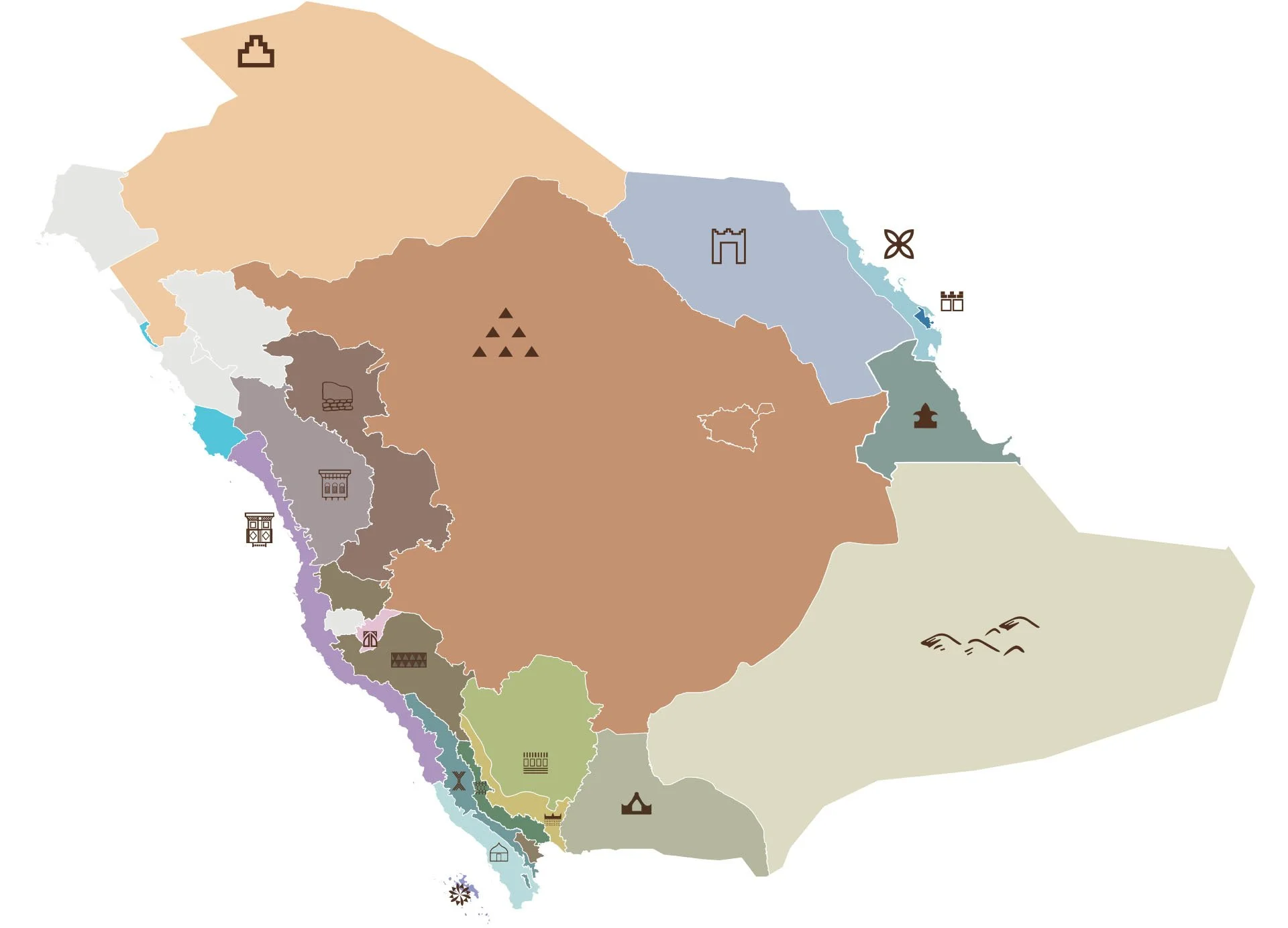
Saudi Arabia is often described through a narrow repertoire of national symbols: the desert, the majlis, Arabic coffee, the white thobe, the black abaya, camels, palm trees, and Najdi architecture. None is fictitious, but together they can produce a misleading impression of cultural uniformity. The territory of the modern Kingdom contains radically different ecological zones and historical societies: Red Sea merchant cities connected to Africa and the Indian Ocean; pilgrimage centers receiving populations from across the Muslim world; central Arabian oasis towns linked by caravan commerce; pastoral territories; rain-fed southwestern mountains; Tihami coastal plains; Gulf fishing and pearling settlements; major date-palm oases; northern caravan corridors; and archaeological landscapes whose histories predate the Saudi state by millennia.
This paper argues that Saudi regional cultures emerged through the interaction of ecology, mobility, settlement, economy, religious history, political organization, and transregional exchange. A house in Diriyah and a merchant residence in Jeddah are therefore not merely two aesthetic variations of “Saudi architecture.” They encode different materials, climates, economies, social relations, and external connections. The same principle applies to food, dress, performance, craft, agriculture, and forms of hospitality.
The analysis moves through Najd, Hijaz, Asir, Jazan and Tihama, Al-Baha, Najran, Al-Ahsa and Qatif, Ha’il, Al-Jouf, Tabuk, and AlUla before comparing architecture, clothing, performance, cuisine, crafts, hospitality, modernization, and contemporary heritage policy. Arabic-language Saudi academic and institutional research is considered alongside international scholarship and UNESCO documentation. Particularly important is the refusal to equate tribal affiliation with the totality of Saudi social history. Urban merchants, agriculturalists, craftspeople, religious scholars, fishermen, pastoralists, migrants, pilgrims, and women working within domestic and productive economies all participated in forming the cultures now understood as Saudi.
Understanding Saudi Arabia regionally does not weaken the idea of a Saudi national culture. It explains how that national culture was assembled from multiple older cultural worlds—and why effective heritage interpretation must preserve those distinctions rather than flatten them.
1. Introduction: One State, Many Cultural Landscapes
The administrative map of Saudi Arabia contains thirteen regions. The cultural map does not. Najd spills across several modern administrative boundaries. Hijaz is simultaneously a western geographic zone, a historical province, a pilgrimage landscape, and a network of cities whose cultural histories differ substantially from one another. Tihama extends along a coastal ecological corridor rather than conforming neatly to provincial lines. Al-Ahsa belongs administratively to the Eastern Province but possesses an oasis history distinct from the twentieth-century oil cities of Dammam and Khobar. AlUla sits within Medina Region administratively but belongs historically to a northwestern oasis corridor linking Arabia with the Levant and ancient caravan networks.
This distinction is not merely anthropological. Saudi Arabia’s own Saudi Architecture Map, launched in March 2025, identifies nineteen architectural styles and explicitly states that these cultural-geographic styles are not bound to administrative divisions. They include Najdi, northern Najdi, coastal Hijazi, Medina urban and rural, Taif, Asir escarpment, Sarawat, Tihama coast, Tihama foothills, Abha highlands, Bisha desert, Farasan, Najran, Qatif, Al-Ahsa oasis, eastern Najdi, eastern coast, and Tabuk coast traditions. The framework is significant because it institutionalizes something architectural historians have long recognized: environmental and cultural geography often explains Saudi built heritage more accurately than provincial administration (Saudipedia 2025).
Geoffrey King’s survey of Saudi vernacular architecture similarly emphasized climatic variation, differences in building materials, regional trade, pilgrimage, and historical connections. Coral, stone, earth, timber, and palm were not interchangeable stylistic choices. Their availability—and the skills required to work them—produced regional traditions. King consequently organized Saudi architecture geographically, moving from the Red Sea through the southwestern highlands and Najran to Najd and the Eastern Province rather than proposing a single national vernacular (King 1998).
The same analytical approach must be extended beyond architecture. Cuisine is an archive of agricultural ecology and migration. Dress records trade in textiles, local techniques, climate, gender, profession, and status. Music reveals occupational histories and patterns of contact: maritime songs are difficult to understand without seafaring; camel-calling traditions without pastoral movement; Taif’s performance traditions without its western Arabian social history. Craft is not simply decoration. A woven tent divider, palm basket, carved door, fishing implement, decorated interior wall, and silver ornament are technologies embedded in particular ways of life.
Saudi Arabia is thus best understood as a layered cultural geography in which an overarching national identity coexists with Najdi, Hijazi, Asiri, Tihami, Jazani, Najrani, Ahsa’i, Qatifi, Ha’ili, northern, oasis, maritime, mountain, urban, mercantile, agricultural, and pastoral histories.
2. Geography as a Generator of Cultural Diversity
Physical geography created some of the Kingdom’s strongest historical differences. Central Arabia is dominated by plateaus, deserts, wadis, and dispersed oases. The western edge of the peninsula rises dramatically through the Sarawat mountain chain before descending toward the Red Sea through Tihama. The southwest receives substantially more rainfall than most of the interior, enabling terraced agriculture and different construction methods. The Gulf coast is humid and historically oriented toward maritime exchange. Al-Ahsa is defined by an enormous cultivated oasis. Najran occupies a broad agricultural valley. AlUla, Al-Jouf, Tayma, and other northern oases formed nodes along corridors through otherwise arid territory.
This environmental variety did not mechanically determine culture, but it established possibilities and constraints. In Najd, earth construction provided thermal mass suited to extreme heat and cold and could be fabricated from locally available material. Southwestern mountain settlements employed extensive stone because it was abundant and because steep topography encouraged compact, defensible settlements. Historic Jeddah used coral masonry and imported timber in a port economy where the sea was a supply route. Al-Ahsa combined earth, palm trunks, palm fronds, reeds, gypsum, and oasis by-products. Saudi architectural scholarship therefore identifies climate, topography, local materials, and cultural requirements as mutually constitutive elements of vernacular design rather than separate influences (Bahammam 2000).
Agricultural systems were equally differentiated. Wheat and date agriculture supported central oasis towns. Mountain terraces in Asir and Al-Baha retained soil and seasonal rainfall. Sorghum and millet were important in parts of the southwest. Khawlani coffee became associated with highland communities in Jazan. The Al-Ahsa oasis depended upon sophisticated management of springs, channels, wells, and palms. Northern oases connected agriculture with caravan economies. Fish naturally assumed greater importance along the Red Sea and Gulf than in interior diets.
Landscape therefore shaped more than subsistence. It influenced the rhythms of labor, the arrangement of houses, transport, seasonal movement, social cooperation, food preservation, craft materials, and even aesthetic vocabularies. The cultural distance between a Jazan fishing settlement and a Qassimi oasis town was historically far greater than a modern national costume or festival pavilion might suggest.
3. Historical Networks, Migration, Trade, and Pilgrimage
Arabia was never simply an isolated interior surrounded by more connected civilizations. Different parts of the peninsula participated in different networks. Northwestern oases connected South Arabia, the Levant, Egypt, and Mediterranean-oriented caravan systems. Southwestern Arabia communicated continuously with Yemen and the Red Sea. The eastern coast participated in the Gulf and Indian Ocean worlds. Hijaz combined Red Sea commerce with the exceptional mobility produced by pilgrimage. Central merchants traveled far beyond Najd.
The history of Unaizah is instructive. Altorki and Cole’s ethnographic and historical study demonstrates that pre-oil central Arabia cannot be reduced to nomadism. Unaizah combined agriculture, craft production, pastoral exchange, a local market, and long-distance trade. Its merchants and transport specialists traveled to Yemen, Hijaz, Gulf ports, Iraq, Greater Syria, Egypt, Bahrain, and India. Their evidence demonstrates a central Arabian society simultaneously rooted in oasis agriculture and embedded within distant commercial circuits (Altorki and Cole 1989, 32–82).
Hijaz was connected still more intensively. Jeddah functioned both as a commercial port and as the principal maritime gateway to Mecca. Pilgrims, merchants, scholars, officials, workers, and settlers arrived from Africa, Egypt, Yemen, India, Southeast Asia, Central Asia, and elsewhere in the Muslim world. Ulrike Freitag consequently interprets Jeddah’s cosmopolitanism not as a recent consequence of globalization but as a historically produced urban condition in which migrant groups, commerce, pilgrimage, and local government interacted over generations (Freitag 2020).
The Gulf generated another orientation. Al-Ahsa and Qatif were historically linked to Bahrain, southern Iraq, Persia/Iran, Kuwait, and Indian Ocean commerce. The material implications included marine occupations, imported commodities, maritime terminology, boat culture, pearling, fishing, and foodways different from those of interior Arabia. By contrast, northern centers such as Dumat al-Jandal looked toward Wadi Sirhan and Levantine routes, while Ha’il developed as an oasis and political center mediating movements between Najd, northern Arabia, Iraq, and Syria.
“Foreign influence,” therefore, is too crude a category. South Asian culinary traces in Hijaz, Gulf links in Qatif, Yemeni affinities in the southwest, and Levantine connections in northern Arabia came through different routes, at different times, and entered different social settings.
4. Najd and Central Arabia
Najd is often allowed to stand for Saudi Arabia as a whole because Riyadh became the capital of the unified state and because several nationally prominent symbols have central Arabian associations. Historically, however, Najd itself contained considerable internal variation. Riyadh, Diriyah, Sudair, Shaqra, Ushaiger, Qassim, Unaizah, Buraydah, and other settlements formed distinctive agricultural, political, religious, and mercantile environments.
Traditional Najdi towns were generally compact. Narrow streets produced shade. Exterior walls tended toward visual restraint while significant ornament appeared inside houses, particularly in reception spaces. Earth construction—mud brick or layered earth combined with timber and palm materials—created thick walls with substantial thermal mass. Courtyards organized domestic life and ventilation, while reception spaces such as the majlis or diwaniya mediated the relationship between household and guest. These characteristics were environmental, but they also encoded privacy, hospitality, gendered domestic organization, and the social importance of receiving visitors.
Najdi architecture cannot be separated from settlement economies. Oasis towns were agricultural centers as well as marketplaces. Altorki and Cole’s Unaizah demonstrates that farming, craft production, merchant activity, and pastoral exchange coexisted. Their evidence is particularly useful because it dismantles the idea that central Arabian society was simply “tribal.” Urban residents might possess tribal genealogies, but the social economy also included farmers, craftspeople, merchants, wage workers, religious figures, and long-distance traders (Altorki and Cole 1989, 54–82, 232–248).
Poetry formed part of this cultural landscape. Nabati poetry preserved genealogies, reputations, journeys, social commentary, memory, and descriptions of environments. An Arabic-language architectural study by Musaed al-Sadhan goes further by treating vernacular poetry as evidence for the changing built environment of Najd. It identifies poetry, proverbs, stories, and popular narratives as sources capable of recording places later altered or removed by modernization (al-Sadhan 2006). This is methodologically important: intangible heritage can preserve information about vanished material heritage.
العرضة النجدية — al-’Ardah al-Najdiyah combines lines of male performers, swords, drumming, and sung or recited poetry. UNESCO inscribed it in 2015. Its later national prominence does not erase its Najdi historical identity; rather, it illustrates the process by which a regional form can acquire national ceremonial meaning.
Food similarly reveals ecology. Central dishes based on wheat, cracked grain, bread, dates, meat, and dairy reflect inland agricultural and pastoral systems. Jareesh, qursan, marqooq, and matazeez are associated strongly with central Saudi culinary repertoires, while Qassim developed particularly prominent traditions around dates and kleeja. These should not be interpreted as timeless “desert foods.” Their ingredients point to cultivated grains, oasis production, household storage, livestock economies, and trade.
Modern Riyadh transformed this environment radically. Walls disappeared, road systems expanded, concrete construction replaced much traditional earth building, and metropolitan expansion absorbed former agricultural and desert zones. This change should not be narrated simply as a transition from “tradition” to “modernity.” It involved a reorganization of spatial relationships: domestic compounds became detached villas, transport became automobile-based, occupational structures changed, and national institutions increasingly overshadowed local urban economies.
5. Hijaz: Mecca, Medina, Jeddah, Taif, and the Red Sea World
Hijaz presents perhaps the clearest challenge to any culturally homogeneous account of Saudi Arabia. The region contained the two Holy Cities, a major Red Sea port, mountain agricultural centers, pilgrimage routes, scholarship, merchant families, migrant communities, and coastal settlements. Mecca, Medina, Jeddah, and Taif belonged to one broad historical region yet were never culturally interchangeable.
Jeddah: Architecture of Commerce and Mobility
Historic Jeddah emerged as the maritime gateway to Mecca and as a major Red Sea commercial center. UNESCO emphasizes its role from the seventh century onward as a port channelling Indian Ocean goods toward Mecca and receiving pilgrims arriving by sea. Its population was formed through sustained interactions among people from Asia, Africa, and the Middle East. The opening of the Suez Canal and expansion of steam navigation in the nineteenth century intensified these networks rather than creating them from nothing.
Its architecture makes those connections physical. Historic merchant houses combined coral-stone masonry with extensive woodwork and projecting rawashin/roshan. These wooden screens moderated glare, airflow, privacy, and street visibility. Tall façades and vertically organized houses responded to dense urban plots and commercial wealth. Significantly, UNESCO’s description of Jeddah stresses that its characteristic houses did not simply replicate the inward courtyard model commonly associated with many Islamic cities. Their outward-facing roshan systems and vertical organization constituted a distinctive Red Sea solution. Some ground floors accommodated commercial functions, while accommodation associated with pilgrimage also entered the urban economy.
The result was architecture generated by shipping, craft networks, imported timber, coral masonry, urban density, family life, commercial activity, and climate. A Jeddah merchant house therefore belongs as much to the Red Sea cultural world as to an abstract category of “Saudi traditional architecture.”
Mecca and Medina: Pilgrimage as Urban Culture
Mecca and Medina were shaped by an institution unparalleled elsewhere in the Kingdom: repeated mass arrival from the global Muslim community. Hajj and Umrah generated lodging, transport, charity, scholarship, markets, food circulation, translation, and migration. Pilgrims sometimes remained; scholars established intellectual connections; merchant households serviced the religious economy; foods and fabrics moved with people. The Holy Cities consequently accumulated cultural repertoires that could not have developed in a geographically isolated urban society.
Medina possessed its own vernacular architecture. Traditional houses could rise several stories and were organized seasonally, with differences between cooler lower spaces and upper spaces used according to climate. The city’s oasis setting further distinguished it from both Mecca and Jeddah.
Food as Migration History
Hijazi cuisine is particularly revealing because foreign origins did not remain simply foreign. Foods circulating through pilgrimage and trade could become embedded in local family traditions. Makkah-region culinary documentation identifies saleeg, mutabbaq, ful, tamees, ma’soub, coastal sayadiyah, sweets, and other dishes within a cuisine explicitly shaped by the region’s religious centrality and contact with multiple populations. Taif’s saleeg tradition itself differs in preparation from versions elsewhere.
The anthropological point is more important than establishing a single birthplace for every dish. Hijazi cuisine developed through domestication of movement: repeated encounters became household practice. Foods that may have antecedents beyond Arabia could, after generations of local adaptation, become genuinely Hijazi.
Performance
Hijaz also possesses performance forms that should not be collapsed into Najdi ’ardah. UNESCO describes المزمار — al-Mezmar as a Hijazi group performance involving drumming, dancing, and sticks, practiced at festive and social occasions. Taif is particularly associated with المجرور — al-Majrour, performed in facing rows with rhythmic movement and percussion. Coastal settlements, including Yanbu, maintain traditions associated with the سمسمية — semsemiah, linking music with Red Sea maritime environments.
Hijaz, then, is not simply “more cosmopolitan” than Najd in some vague stylistic sense. Its cosmopolitanism was produced by identifiable institutions—pilgrimage, maritime trade, Ottoman-era administration, Islamic scholarship, migration, and merchant capitalism—and these institutions left measurable traces in architecture, cuisine, music, vocabulary, family histories, and urban life.
6. Asir and the Southwestern Highlands
Asir’s cultural distinctiveness begins with altitude and rainfall. Much of the region occupies mountainous terrain unlike the central plateau. Agricultural terraces transform steep slopes into productive surfaces, while settlement forms respond to stone availability, rainfall, topography, and historically defensive conditions.
Traditional structures around Abha and other highland areas combine stone and earth in complex ways. Local stone—including basalt and other geological materials—could form lower sections, while earth construction and projecting stone courses appeared above. Roofs required drainage strategies inappropriate to the much drier interior. Terraces captured soil and water and supported wheat, barley, millet, sorghum, fruits, and other crops. Beekeeping and honey also developed substantial regional importance.
Al-Qatt Al-Asiri
The best-known Asiri visual tradition is القط العسيري — al-Qatt al-Asiri, but calling it “colorful geometric decoration” strips it of cultural meaning. UNESCO identifies it specifically as a traditional form of female interior wall decoration. Women developed, executed, and transmitted the practice within domestic settings. It is therefore both a graphic system and a history of women’s authorship within architecture.
The geometry organizes bands, triangles, lines, fields, repeated motifs, and color relationships across interior surfaces. Its architectural location matters. Al-Qatt intervened in lived domestic interiors rather than functioning originally as portable gallery art. Knowledge passed among women and could express skill, household identity, aesthetic judgment, and social transmission. UNESCO’s 2017 inscription has helped elevate its visibility, while contemporary artists and designers increasingly extract its motifs into canvases, products, graphics, and public interiors.
That transition requires critical interpretation. A motif copied onto a hotel wall may reference al-Qatt, but it is not equivalent to the historical practice. The maker has changed, the surface has changed, the patronage has changed, the social environment has changed, and often the design process has changed. Preservation therefore cannot mean pattern replication alone.
Food, Agriculture, and Performance
Asiri food makes mountain agriculture visible. Areekah, mashghoutha, asid and various grain breads depend upon combinations of wheat or other grains, ghee, honey, dairy, and locally available foods. Haneeth demonstrates the importance of meat cookery, while the mifa oven belongs to a specific domestic technology rather than to restaurant branding.
Performance traditions are similarly plural. Saudi intangible-heritage inventories document forms in Asir including al-khatwah, al-zahfah, al-zamil, regional ’ardah forms, and others rather than a single “southern dance.”
The widely circulated image of southwestern men wearing flower wreaths must likewise be handled carefully. Floral head adornment is genuinely associated with particular southwestern highland communities, but contemporary tourism imagery frequently expands a locally situated practice into a general “Asiri costume.” Good interpretation should identify the specific locality and community rather than treating a spectacular visual marker as ethnographic shorthand for an entire region.
7. Jazan and Tihama: Coast, Plain, Wadi, and Highland
Jazan should not be presented as a warm-weather extension of Asir. Its cultural geography moves from Red Sea islands and fishing communities through hot Tihami plains and wadis to high mountains along the Yemeni frontier. These zones produced different settlement forms and food systems.
Saudi architectural documentation identifies at least three broad vernacular patterns in Jazan: construction associated with coastal plains; forms found around Tihami wadis; and highland buildings. The well-known ’ushshah or hut form belongs particularly to hot lowland contexts. Stone buildings occur in wadi environments, while highland settlements include more substantial circular or tower-like stone forms often built on elevated terrain. Climate and altitude matter here more than administrative designation.
Food follows the same ecological gradient. Coastal communities rely heavily on fish. Mountain environments incorporate meat, honey, and ghee. Plains support grain and vegetable traditions. Foods documented in Jazan include marsa, khamir, maghash, asid and others, often prepared with regionally characteristic stone or fired-clay cooking vessels.
The highlands are also the center of Khawlani coffee cultivation. UNESCO’s 2022 inscription recognizes the knowledge and practices associated with cultivating Khawlani coffee beans in Saudi Arabia. This heritage concerns much more than drinking coffee: it includes seed selection, cultivation, agricultural knowledge, harvest, processing, and intergenerational transmission among highland communities.
Jazan’s performance inventory includes al-dana, al-zamil, al-zifah, al-sayf, al-’azawi, and other forms. The existence of this vocabulary alone should caution programmers against importing Najdi ’ardah or generic “southern dancing” as interchangeable entertainment.
The Red Sea, Yemen, African maritime connections, highland agriculture, and Tihami ecology intersect here. Jazan’s cultural identity is consequently not one tradition but a set of closely neighboring environments whose differences remain legible in architecture, diet, music, dress, and occupation.
8. Al-Baha: Stone Villages of the Sarawat
Al-Baha occupies another southwestern mountain landscape but deserves independent treatment. Its built heritage is especially associated with compact stone villages, defensive forms, terraced agriculture, and forests of juniper and other local trees.
Traditional houses frequently combine stone, earth, and locally available timber. Settlements could be tightly clustered, with narrow lanes and multi-level houses. Lower levels were often used for animals or storage while upper spaces served domestic life, illustrating the direct integration of agricultural production and household architecture.
Dhee Ayn, positioned on a conspicuous pale rocky outcrop overlooking agricultural land, dramatizes that relationship. Its stone buildings rise vertically over terraced and irrigated cultivation, historically supported by a perennial spring. The surrounding agricultural landscape has included bananas, citrus, aromatic plants, and other crops. The village therefore makes little sense when photographed only as architecture. Its cultural significance lies equally in water, terraces, labor, movement between levels, and the relationship between built settlement and cultivated wadi.
Agriculture across Al-Baha has included grains, fruit cultivation, pomegranates, honey production, and livestock, with practices varying between mountain and lower-lying environments.
There are obvious affinities with Asir: Sarawat mountain ecology, stone building, terraces, oral traditions, and some overlapping performance cultures. Yet similarity should not erase local histories associated with communities including Ghamid and Zahran, nor differences in village form, regional repertoires, agriculture, and speech. “Southern heritage” is therefore too blunt a programming category to be analytically useful.
9. Najran: Valley Civilization and Southern Arabian Crossroads
Najran’s identity is anchored in its valley. Agriculture, caravan movement, southern Arabian connections, and monumental earth architecture distinguish it sharply from both Asir and central Najd.
Traditional Najrani construction uses earth in highly developed layered systems combined with stone foundations, timber, palm material, mud plaster, and lime. Tower houses rise vertically from the valley landscape. Their forms are responses to material knowledge, climate, defense, family organization, and the economics of agricultural settlement rather than simply decorative variations on “mud architecture.”
Najran also occupies a much older religious and commercial landscape. In Late Antiquity, Najran was an important Christian center within southern Arabia; scholarship on pre-Islamic Arabia records Christian communities in Najran and the violent religious conflicts that affected the region in the sixth century. This history should be approached as evidence of the peninsula’s pre-Islamic religious complexity, not retrofitted into modern sectarian categories (Conrad 2008).
Nearby Ḥimā Cultural Area, now a UNESCO World Heritage property, preserves rock art and inscriptions within a landscape associated with routes and human movement across very long periods. Its importance widens the historical frame of Najran beyond the modern city and even beyond the Islamic period.
Najrani material culture includes distinctive women’s dress, silver ornament, leather and metal traditions, and the ceremonial use of daggers among men in particular contexts. Saudi documentation identifies the mukammam among women’s traditional garments in Najran, demonstrating how regional clothing formerly contained much greater variation than the contemporary national visual shorthand of abaya and thobe suggests.
Performance traditions include al-razfah, al-zamil and percussion-based forms documented in Saudi intangible-heritage inventories. Foods such as ruqsh and other local preparations belong to a culinary system shaped by grain, meat, dairy, and valley agriculture.
Najran should therefore be read as a valley society connected historically northward into Arabia and southward toward Yemen, with an architectural and cultural identity that cannot be assimilated into a generic “southern Saudi” category.
10. Al-Ahsa, Qatif, and the Eastern Arabian Gulf
The Eastern Province contains cultural histories profoundly different from those of Riyadh despite geographic proximity at a national scale. Before oil transformed Dammam, Dhahran, and Khobar, older centers such as Al-Ahsa and Qatif belonged to oasis and maritime economies embedded in the Gulf.
Al-Ahsa: An Agricultural Civilization
UNESCO describes Al-Ahsa as an evolving cultural landscape composed of gardens, canals, springs, wells, drainage systems, archaeological sites, historic buildings, and urban fabric. Continuous settlement extends deep into the past. Millions of palms and associated agriculture form not an ornamental “oasis experience” but a working cultural landscape produced through water management and collective agricultural knowledge.
Federico Vidal’s classic study of date culture in Al-Hasa documented the centrality of palm cultivation and agricultural technology well before contemporary heritage branding (Vidal 1954, 417–428).
Traditional construction utilized palm trunks and fronds, reeds, earth, straw, local gypsum and other materials generated by or available within the oasis environment. Palm culture thus entered architecture, food, craft, agricultural labor, and household economy simultaneously.
Al-Ahsa’s food traditions likewise reflect oasis specificity. Dates are obvious, but the region is also associated with distinctive rice traditions, including Al-Ahsa red rice. Culinary identity here is tied to irrigation and agricultural production as much as to Gulf exchange.
Qatif and the Gulf Coast
Qatif’s historical cultural geography combines palm agriculture with fishing, pearling, boat culture, coastal commerce, and Gulf movement. The sea connected communities toward Bahrain, Kuwait, southern Iraq, Iran, and the Indian Ocean. Maritime economic histories produced tools, songs, occupational vocabularies, market systems, and foods based on seafood that cannot be explained through an inland Najdi framework.
Religious history adds another layer. Al-Ahsa and Qatif contain long-established Shia communities as well as Sunni populations. Scholarship emphasizes the historic depth of Shia communities in these eastern oases and their local Arabian roots. Their presence affects religious institutions, ritual calendars, family histories, and cultural memory. These differences should be documented descriptively rather than sensationalized or reduced to geopolitical narratives (al-Rasheed 1998; Matthiesen 2015).
The Eastern Province is consequently not simply “Saudi Arabia with a Gulf influence.” Al-Ahsa and Qatif belong to an eastern Arabian cultural zone in which oasis agriculture and the sea generated social worlds markedly different from central plateau societies.
11. Ha’il and Jabal Shammar
Ha’il occupies a strategic position between central and northern Arabia. It historically combined oasis agriculture, pastoralism, caravan movement, political power, hospitality, poetry, and exchange across Jabal Shammar.
During the nineteenth century the Rashidi polity transformed Ha’il into a major center of Arabian politics. Madawi al-Rasheed’s work on the Rashidis shows that Ha’il cannot be treated as a provincial appendage of Najd; it possessed its own political trajectory and regional networks (al-Rasheed 1991). Scholarship on Jabal Shammar likewise emphasizes the coexistence of pastoralism and agriculture rather than a simple nomadic economy.
The region’s rock-art landscapes add extraordinary chronological depth. UNESCO’s Rock Art in the Hail Region includes Jubbah and Shuwaymis, preserving petroglyphs and inscriptions across thousands of years. At Jubbah, environmental change from a lake environment toward increasing aridity is recorded alongside changing human occupation.
Ha’ili oral culture is particularly important. Saudi heritage inventories document not only samri, ’ardah, rababa traditions, and hijini but also songs historically associated with milling, harvest, palms, construction, and other forms of work. This is a useful corrective to festival presentation: folklore was not necessarily “performed heritage.” Much of it accompanied labor.
Ha’il therefore sits at the intersection of cultivated oasis, pastoral hinterland, mountain landscape, caravan route, political center, and oral archive.
12. Al-Jouf and Northern Oasis Culture
Al-Jouf developed around northern oases and corridors leading toward Syria and the Levant. Dumat al-Jandal possesses an ancient history extending to Assyrian references to Adummatu and later connections with Qedarite and Nabataean worlds. Its location within Wadi Sirhan made the oasis a strategic stopping point and political center.
Traditional domestic architecture combines thick earth and stone walls, timber and palm roofs, courtyards, storage spaces, and reception rooms. Architectural documentation also identifies details particular to Dumat al-Jandal and Qurayyat, demonstrating again that the northern built environment is not simply a weaker version of Najdi architecture.
Modern Al-Jouf has become particularly famous for olive production, but agricultural interpretation should not project contemporary production statistics backward unchanged. Historically, oasis survival depended upon water management, palms, grains, livestock, and strategic location; current olive cultivation represents another layer in a long agricultural history.
Northern performance traditions include الدحة — al-Dahha, samri, ’ardah, camel-related song and الهجيني — al-Hijini. Their distribution extends across northern Arabia and neighboring territories, reminding us that cultural regions often cross modern borders.
13. Tabuk and Northwestern Arabia
Tabuk Region is culturally heterogeneous because it includes Red Sea coast, inland wadis, oases, mountain zones, and desert territories. Saudi architectural research distinguishes coastal traditions from inland and desert forms. Interior settlements such as Tabuk and Tayma historically used earth, timber, palm, and other materials familiar across arid northern Arabia, whereas coastal architecture belonged to a different ecological system.
Its strategic importance derives partly from mobility. Northwestern Arabia has carried caravan and pilgrimage routes connecting the Holy Cities with Egypt, Syria, and the Levant. UNESCO’s Saudi tentative list still includes the Hejaz Railway, Syrian Hajj Road, Egyptian Hajj Road, and ancient walled oases of northern Arabia, evidence that movement itself constitutes a major heritage layer in the northwest.
Performance again separates coast from interior. Tabuk documentation records dahiya, rafihee, rayhan, samri, rababa and hijini alongside semsemiah traditions in coastal communities. Semsemiah performance is particularly associated with maritime settings, fishing, and sea songs.
Contemporary megaprojects have made northwestern Arabia globally visible, but heritage interpretation must resist narrating the region as empty terrain newly activated by development. It contained fishing communities, agricultural settlements, pastoral groups, pilgrimage infrastructure, trade corridors, and archaeological landscapes long before contemporary destination planning.
14. AlUla: Archaeological Heritage and Living Oasis Culture
AlUla presents one of the most important conceptual tests for Saudi heritage practice because archaeology, local memory, agriculture, monumental landscape, tourism, and contemporary cultural programming now occupy the same place.
Hegra is the best internationally known layer. UNESCO describes it as the largest substantially conserved Nabataean site south of Petra, containing more than one hundred monumental tombs, extensive inscriptions, wells, and evidence of sophisticated hydraulic practice. Yet Nabataean Hegra is only one chapter. The wider oasis contains Dadanite and Lihyanite heritage, Jabal Ikmah, historic settlement, agricultural systems, pilgrimage histories, Old Town, and twentieth-century memories.
The oasis is essential. Royal Commission for AlUla planning itself recognizes a continuous landscape connecting major heritage districts and identifies oasis regeneration as central to the region’s future. This is important because monumental archaeology can visually dominate interpretation while the agricultural system that sustained generations of residents appears secondary.
Old Town demonstrates the value of oral history. RCU documentation records consultation with former residents and elders to reconstruct knowledge about gates, bakeries, houses, trade, defense, neighborhoods, and everyday life. This is a fundamentally different evidence base from excavation. Archaeology may reconstruct an ancient tomb; oral testimony can explain how a twentieth-century resident moved through a market or remembered a bakery. Both are heritage, but they require different methods.
Four layers should therefore remain conceptually separate:
Archaeological heritage concerns Dadan, Lihyan, Hegra, inscriptions, ancient infrastructure, and material remains.
Living heritage concerns agriculture, crafts, family memory, oral history, local food, landscape knowledge, and community practice.
Conservation and reconstruction concern decisions about stabilizing or presenting historic fabric.
Contemporary cultural programming concerns exhibitions, festivals, hospitality, art commissions, performances, and tourism.
Confusing these layers creates false continuity. A contemporary event staged beside an ancient monument does not automatically become ancient heritage. Conversely, contemporary practice can be culturally meaningful without claiming antiquity. That distinction is one of the most important professional principles for destination development in AlUla.
15. Comparative Vernacular Architecture
Architecture provides perhaps the clearest visual demonstration of Saudi cultural plurality.
Najd
Arid plateau; large temperature range
Earth/mud brick, palm, timber, gypsum
Courtyard houses, compact towns, thick walls, restrained exteriors, decorated reception interiors
Thermal control, privacy, household organization, hospitality
Coastal Hijaz / Jeddah
Hot humid Red Sea coast; dense port city
Coral masonry, imported timber, plaster
Tall merchant houses, projecting rawashin, narrow streets
Ventilation, commerce, urban density, pilgrimage and merchant wealth
Medina oasis
Hot oasis environment
Earth, stone, timber, palm
Multi-level houses with seasonal spatial use
Oasis urbanism, privacy, seasonal comfort
Asir highlands
Mountain rainfall; steep terrain
Stone, earth, juniper and local timber
Multi-storey fortified forms, terraces, projecting stone courses
Rain management, defense, agriculture, topography
Al-Baha
Sarawat mountains
Stone, earth, local timber
Compact stone villages; multi-level agricultural houses
Defense, livestock/storage integration, terraced agriculture
Jazan/Tihama
Hot coast and plains to wet highlands
Thatch/reeds, earth, stone according to zone
’Ushshah lowland forms; wadi stone houses; highland towers
Extreme ecological variation
Najran
Agricultural valley, arid climate
Earth, stone foundations, palm, timber, lime
Tall earth tower houses
Valley agriculture, defense, family compounds, earthen-building expertise
Al-Ahsa
Irrigated oasis; Gulf heat
Earth, gypsum, palm trunks/fronds, reeds
Oasis courtyard and reception structures
Agriculture, water, palm economy, thermal adaptation
Qatif/Gulf coast
Humid maritime environment
Earth, stone, palm, imported materials
Coastal/oasis settlement forms
Fishing, trade, palm agriculture
Ha’il / northern Najd
Oasis and mountain-desert environment
Earth, stone, timber, palm
Fortified oasis settlement traditions
Agriculture, caravan trade, defense
Al-Jouf
Northern oasis
Earth, stone, timber, palm
Courtyard compounds, thick walls, local opening systems
Oasis agriculture and northern routes
Tabuk / northwest
Coast, oasis, wadis and desert
Variable: earth, stone, palm, coastal materials
Distinct coastal and inland types
Pilgrimage, trade, pastoral and maritime ecologies
Najd
Arid plateau; large temperature range
Earth/mud brick, palm, timber, gypsum
Courtyard houses, compact towns, thick walls, restrained exteriors, decorated reception interiors
Thermal control, privacy, household organization, hospitality
Coastal Hijaz / Jeddah
Hot humid Red Sea coast; dense port city
Coral masonry, imported timber, plaster
Tall merchant houses, projecting rawashin, narrow streets
Ventilation, commerce, urban density, pilgrimage and merchant wealth
Medina oasis
Hot oasis environment
Earth, stone, timber, palm
Multi-level houses with seasonal spatial use
Oasis urbanism, privacy, seasonal comfort
Asir highlands
Mountain rainfall; steep terrain
Stone, earth, juniper and local timber
Multi-storey fortified forms, terraces, projecting stone courses
Rain management, defense, agriculture, topography
Al-Baha
Sarawat mountains
Stone, earth, local timber
Compact stone villages; multi-level agricultural houses
Defense, livestock/storage integration, terraced agriculture
Jazan/Tihama
Hot coast and plains to wet highlands
Thatch/reeds, earth, stone according to zone
’Ushshah lowland forms; wadi stone houses; highland towers
Extreme ecological variation
Najran
Agricultural valley, arid climate
Earth, stone foundations, palm, timber, lime
Tall earth tower houses
Valley agriculture, defense, family compounds, earthen-building expertise
Al-Ahsa
Irrigated oasis; Gulf heat
Earth, gypsum, palm trunks/fronds, reeds
Oasis courtyard and reception structures
Agriculture, water, palm economy, thermal adaptation
Qatif/Gulf coast
Humid maritime environment
Earth, stone, palm, imported materials
Coastal/oasis settlement forms
Fishing, trade, palm agriculture
Ha’il / northern Najd
Oasis and mountain-desert environment
Earth, stone, timber, palm
Fortified oasis settlement traditions
Agriculture, caravan trade, defense
Al-Jouf
Northern oasis
Earth, stone, timber, palm
Courtyard compounds, thick walls, local opening systems
Oasis agriculture and northern routes
Tabuk / northwest
Coast, oasis, wadis and desert
Variable: earth, stone, palm, coastal materials
Distinct coastal and inland types
Pilgrimage, trade, pastoral and maritime ecologies
The differences are too systematic to be dismissed as style. They map rain, humidity, stone geology, agricultural practice, family structure, commerce, defensive conditions, imported materials, and patterns of movement. Saudi architectural scholarship in Arabic reaches the same conclusion: geographic scale, topography, climate, available materials, and cultural requirements generated different settlement and housing types across the Kingdom (Bahammam 2000).
16. Clothing, Jewelry, and Regional Identity
The modern white thobe and black abaya possess enormous national visibility, but they should not be projected backward as the complete historical dress culture of the peninsula.
Traditional clothing differed according to climate, textile availability, occupation, wealth, age, marital status, gender, and trade access. Port cities could obtain imported fabrics more easily than remote agricultural settlements. Mountain clothing responded to a different climate from Tihama coastal dress. Working garments differed from wedding or ceremonial clothing. Silver ornament in southwestern and southern regions performed social and aesthetic roles distinct from urban merchant fashions of Hijaz.
Women’s clothing is particularly important because national visual standardization can obscure local embroidery, cut, color, trousers, head coverings, jewelry, and regional garments. Saudi documentation identifies, for example, the decorated mukammam in Najran and embroidered karta traditions in Jazan. These garments belonged to specific regional systems rather than a universal pre-modern Saudi wardrobe.
Collections assembled by organizations such as the Mansoojat Foundation, together with museum holdings in Saudi Arabia and international collections, are therefore important research archives. Textile evidence can preserve techniques and regional distinctions that photographs alone do not reveal.
The same caution applies to men’s dress. The bisht, now nationally and regionally familiar, has recently received UNESCO recognition through a Saudi nomination concerning its skills and practices. Yet even such widely recognized garments should be studied through material, tailoring, occasion, status, and historical distribution rather than treated as timeless national costume. UNESCO inscribed Bisht (men’s Abaa): skills and practices in 2025.
17. Music, Dance, Poetry, and Oral Traditions
There is no single “Saudi dance.” Performance traditions map cultural geography with remarkable precision.
Najd is strongly associated with al-’Ardah al-Najdiyah, samri, Nabati poetry, and other forms. Hijaz includes al-Mezmar, khubaiti, majrour, regional wedding traditions, and Red Sea musical forms. Medina and Yanbu contain both inland and maritime repertoires. Asir, Al-Baha, Jazan, and Najran contain separate southern repertoires rather than one homogeneous “southern folklore.” Northern regions preserve al-Dahha, hijini, rababa and camel-related oral traditions. The Eastern Province maintains its own Gulf-associated forms.
The social function of a form is as important as its choreography. Some performances celebrated weddings. Others marked communal festivals, martial occasions, or hospitality. Maritime songs accompanied work and expressed relationships to sea travel. Camel songs coordinated movement and communication. Agricultural songs accompanied harvest, grinding, construction, or palm work. Poetry preserved personal and collective memory.
This distinction matters because stage performance changes heritage. A work song transferred to a ten-minute festival slot is no longer functioning as work song, even if melody and words survive. It becomes heritage representation. The change is not necessarily harmful, but it should be acknowledged.
Saudi Arabia’s intangible-heritage inventory demonstrates the scale of this diversity. Its documented repertoires distinguish Asiri forms from Jazani forms, Najrani forms from Al-Baha forms, Taif traditions from Jeddah traditions, and northern forms from central ones.
18. Cuisine, Agriculture, and Food Heritage
Food offers perhaps the most accessible evidence that Saudi culture is regional, but only if dishes are interpreted rather than listed.
Central Arabian cuisine historically drew heavily upon grain, dates, livestock products, and foods capable of functioning within oasis and pastoral economies. Qassim’s date culture and baked products emerged from an agricultural and mercantile environment. Asir’s grain breads, honey, ghee, and mountain cooking reflect another ecology. Jazan combines fish from the coast with grains and tropical or subtropical agricultural products inland. Al-Ahsa’s dates and red rice belong to an irrigated oasis civilization. Hijazi urban cuisine registers sustained migration and pilgrimage. Eastern coastal cuisine incorporates fish and Gulf trade.
Rice itself is instructive. It eventually became central to many ceremonial meals across the Kingdom, but Altorki and Cole’s research indicates that rice, like coffee, tea, sugar, and cardamom, functioned historically as an imported luxury in central Arabia rather than a basic subsistence crop. National cuisines can therefore be built from ingredients that were once expensive imports (Altorki and Cole 1989, 162–184).
Hijaz provides the clearest example of food as migration. Pilgrimage and port commerce allowed culinary forms to circulate repeatedly until foreign and local distinctions blurred. Asking whether a dish is “originally Saudi” can therefore be less useful than asking when, how, and among which communities it became locally embedded.
UNESCO’s recent inscriptions reinforce this broader definition of culinary heritage. Harees was inscribed in 2023; Arabic coffee and Taif rose practices in 2024; Khawlani coffee cultivation and date-palm knowledge in 2022. These nominations recognize not simply finished dishes but the knowledge, cultivation, ritual, tools, and social relations surrounding them.
19. Craft, Material Culture, and Women’s Cultural Production
Craft should be understood as technology before it is understood as souvenir.
السدو — al-Sadu converts wool and other fibers into textiles historically used within mobile and semi-mobile life. UNESCO documentation emphasizes women’s expertise and the transmission of weaving knowledge. Patterns, loom techniques, material preparation, and object function together constitute the heritage—not the geometric motif alone.
Al-Qatt similarly depended upon women’s mastery of domestic architectural decoration. Palm weaving in oasis regions transformed agricultural by-products into containers, mats, screens, and household objects. Wood carving and decorated doors translated carpentry into markers of domestic identity. Metalworking produced jewelry, coffee implements, tools, incense burners, weapons, and ceremonial objects. Boatbuilding and fishing equipment belong to maritime rather than desert material culture.
Women’s participation is particularly important because heritage narratives organized around warfare, male hospitality, rulers, and monumental architecture can make domestic production invisible. Women transmitted recipes, weaving, embroidery, interior decoration, wedding practices, songs, clothing knowledge, agricultural techniques, oral histories, and family ritual.
Altorki and Cole’s Unaizah study is again instructive because it documents women’s economic participation and shows that pre-oil society cannot be accurately reconstructed through male public institutions alone (Altorki and Cole 1989).
The contemporary challenge is commercialization. When a motif from al-Qatt or al-Sadu moves onto a luxury product, cultural transmission may gain new economic life. Yet extraction can also detach the motif from its makers. Serious craft revival should therefore address attribution, apprenticeship, compensation, technical knowledge, and community authorship rather than merely reproducing a visual style.
20. Coffee, Majlis, Hospitality, and Social Space
Hospitality is genuinely significant across Saudi Arabia, but the statement becomes analytically useful only when practices are examined in detail.
Arabic coffee involves roasting, grinding, brewing, the dallah, small finjan cups, serving order, gesture, repetition, and the interaction between host and guest. Coffee may be accompanied by dates, incense, or food. Serving can encode age, prestige, kinship, respect, and the host’s obligations. UNESCO’s multinational inscription describes Arabic coffee specifically as a symbol of generosity embedded within social practice rather than merely a beverage.
The majlis is similarly social architecture. UNESCO inscribed the majlis as intangible heritage in 2015, recognizing it as a cultural and social space. Its significance lies in what occurs there: reception, discussion, storytelling, decision-making, teaching, dispute mediation, visiting, and intergenerational interaction.
Architecturally, however, majlis spaces are not identical across Saudi Arabia. A Najdi reception room in an earth-built courtyard house, an Ahsa’i oasis reception space, and a Hijazi merchant-house reception environment emerge from different building traditions. Women’s hosting spaces and family reception practices likewise deserve study rather than treating the male formal majlis as the only social interior.
The nationalization of coffee and majlis imagery illustrates a recurring process: a practice can be broadly shared across Arabia while its exact etiquette, architecture, vocabulary, foods, implements, and social relationships remain locally variable.
21. Pilgrimage, Religion, and Cultural Exchange
Religion shaped Saudi cultural geography unevenly.
Mecca and Medina were not merely settlements in which religion happened to be important. Pilgrimage was an urban system. Hajj and Umrah generated transport industries, lodging, markets, charitable institutions, scholarship, manuscript movement, food exchange, migration, and long-term relationships with Muslim communities abroad. Jeddah’s economy was inseparable from the movement of pilgrims toward the Holy Cities. Freitag’s history consequently treats trade and pilgrimage as economic lifelines rather than decorative context (Freitag 2020, 218–270).
Religious geography elsewhere took different forms. Najd’s scholarly and political history profoundly influenced the formation of the Saudi state. Eastern Saudi Arabia contains historically rooted Sunni and Shia communities. Najran’s pre-Islamic history includes Christianity. Northern Arabia contains archaeological evidence connected to multiple ancient religious worlds.
A sophisticated history must therefore avoid two errors. The first is treating Saudi religious history as if it began with the twentieth-century state. The second is assuming that religious culture operated identically everywhere. The pilgrimage cosmopolitanism of Jeddah, Mecca, and Medina cannot be projected onto Qassim; the sectarian history of Qatif cannot be projected onto Riyadh; the late-antique religious landscape of Najran cannot be translated directly into modern identities.
22. Modernization, Oil, and the Transformation of Regional Culture
Oil altered Saudi culture not simply because people became wealthier but because the spatial and economic structures that reproduced regional difference were transformed.
Roads and automobiles shortened distances that had once structured trade and marriage networks. State education circulated standardized curricula. Salaried government and corporate employment reduced dependence on local agricultural and craft economies. Concrete, steel, glass, mechanical air-conditioning, and new construction systems displaced vernacular techniques. Metropolitan expansion absorbed fields, palms, walls, and historic settlements. National radio and television circulated common speech, music, fashion, and ceremonies.
The transformation of Unaizah documented by Altorki and Cole is particularly revealing. Agricultural, craft, and merchant systems that had connected the city to regional and long-distance markets were restructured through salaried employment, infrastructure, state development, imported labor, and national economic integration. Family structures changed as new housing and occupational systems emerged (Altorki and Cole 1989, 85–248).
Architecture changed at extraordinary speed. King’s late-twentieth-century survey was motivated partly by the disappearance of traditional building stock as concrete, highways, new technology, and mechanical climate control reconfigured the built environment (King 1998).
Yet modernization did not erase regional identity. Accents, foods, marriage networks, music, local memories, festivals, crafts, agricultural products, poetry, and place attachment survived unevenly. Some practices continued within households. Others disappeared from everyday use and later returned as heritage. Still others were reconstructed from documentation.
This produces an essential distinction:
Survival means a practice continued.
Revival means it declined and was intentionally restored.
Reconstruction means fragments of evidence were assembled into a new representation.
Reinterpretation means historical material was deliberately transformed for contemporary use.
Treating all four as “preservation” obscures major cultural differences.
23. Heritage Preservation, UNESCO, and Contemporary Revival
Saudi heritage policy has expanded dramatically. Heritage, architecture, cuisine, fashion, museums, music, performing arts, and other sectors now possess dedicated national institutions or commissions. Craft training, documentation, inventories, conservation, and destination development increasingly operate at national scale.
The 2025 Saudi Architecture Map is particularly significant because it embeds regional differentiation into contemporary design policy. Rather than prescribing one national architectural language, it identifies nineteen regional styles and explicitly disconnects them from rigid administrative geography.
UNESCO World Heritage Status — verified 17 August 2026
UNESCO currently lists eight Saudi World Heritage properties: seven cultural and one natural.
Property
Inscription
Regional significance
Hegra Archaeological Site
2008
Northwestern Arabian/Nabataean trade and hydraulic landscape
At-Turaif District in ad-Dir’iyah
2010
Najdi urbanism and the history of the first Saudi state
Historic Jeddah, the Gate to Makkah
2014
Red Sea commerce, pilgrimage, merchant architecture
Rock Art in the Hail Region
2015
Long-term human occupation and environmental history
Al-Ahsa Oasis
2018
Oasis agriculture, water management, settlement and palms
Ḥimā Cultural Area
2021
Rock art, inscriptions and route landscapes in the south
’Uruq Bani Ma’arid
2023
Natural desert landscape and biodiversity
Cultural Landscape of Al-Faw Archaeological Area
2024
Ancient settlement and trade landscape in central/southern Arabia
UNESCO’s current Saudi page additionally contains tentative nominations associated with pilgrimage roads, the Hejaz Railway, Dhee Ayn, Rijal Alma, Sarawat rural landscapes, northern oases, water management, oil industrial heritage, and Red Sea natural heritage. These tentative entries reveal how much of Saudi heritage lies outside the eight inscribed properties.
Intangible Cultural Heritage
As of the same date, UNESCO records 18 Saudi intangible-cultural-heritage elements. They include both nationally specific elements and multinational files shared with neighboring countries.
Year
UNESCO-listed element
2015
Majlis, a cultural and social space
2015
Alardah Alnajdiyah
2016
Almezmar
2017
Al-Qatt Al-Asiri
2021
Arabic calligraphy
2021
Falconry
2022
Alheda’a, oral traditions of calling camel flocks
2022
Knowledge and practices related to cultivating Khawlani coffee beans
2022
Date palm knowledge, skills, traditions and practices
2023
Harees dish: know-how, skills and practices
2023
Engraving on gold, silver and copper
2024
Semsemiah: instrument crafting and playing
2024
Henna: rituals, aesthetic and social practices
2024
Arabic coffee, a symbol of generosity
2024
Cultural practices related to Taif roses
2025
Traditional weaving of Al Sadu
2025
Bisht (men’s Abaa): skills and practices
2025
Arabic Kohl
The list itself demonstrates regional plurality: Najdi ceremonial performance, Asiri women’s interior decoration, Jazan coffee cultivation, Taif floriculture, Red Sea semsemiah, pastoral camel knowledge, weaving, dress, food, hospitality, and body culture coexist within the same national heritage framework.
Yet inscription is not preservation by itself. Heritage can be documented accurately and still become culturally detached when moved from a household, field, fishing boat, wedding, or village into a festival stage or luxury resort.
A productive contemporary heritage policy must therefore distinguish documentation, conservation, transmission, revival, reinterpretation, commodification, and nation-branding. These processes may overlap, but they are not synonyms.
24. Comparative Regional Cultural Matrix
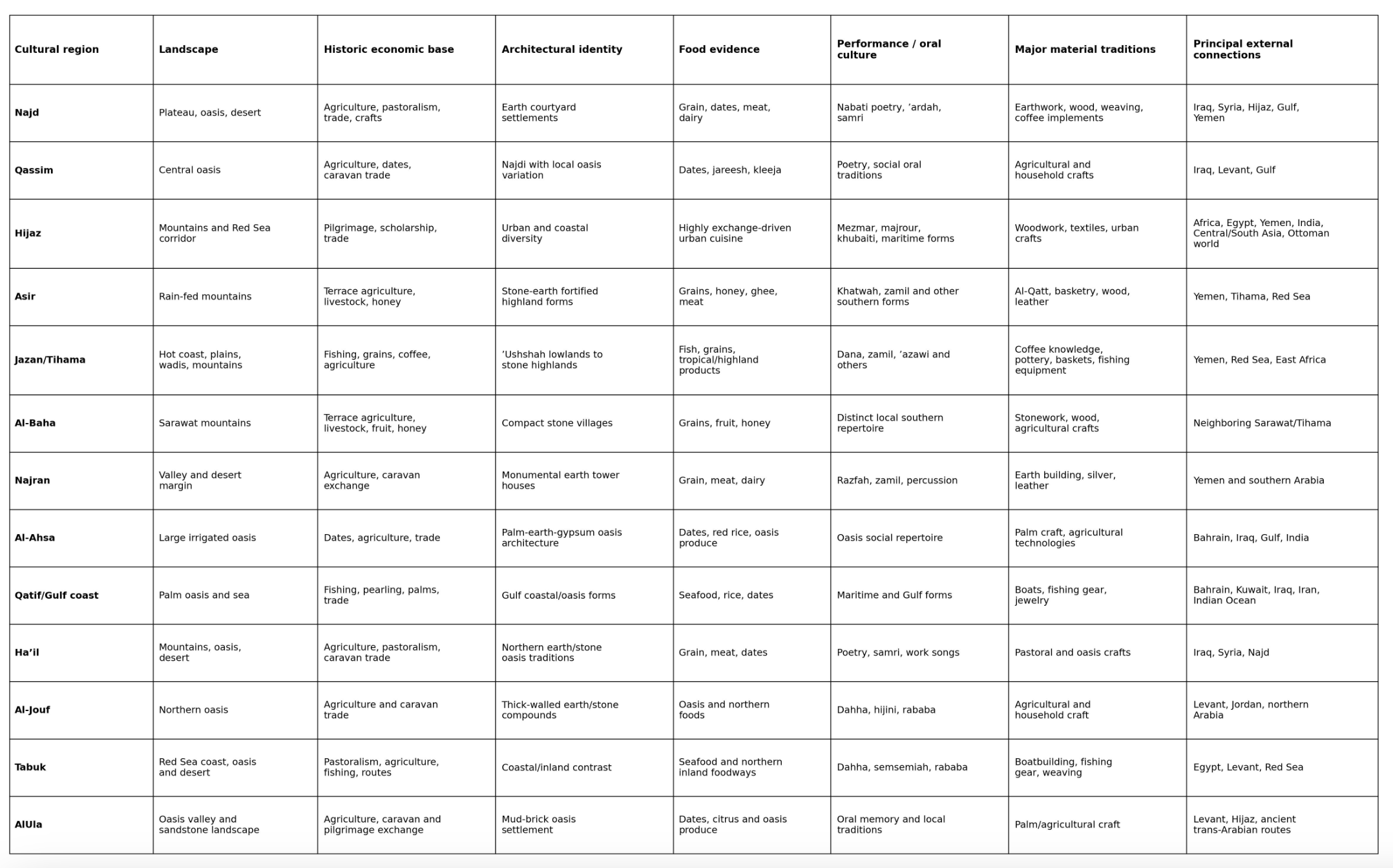
The matrix demonstrates why “Saudi heritage” cannot responsibly be represented by selecting one dance, one costume, one house type, one coffee setting, and one craft. The cultural systems are structurally different.
25. Implications for Cultural Programming and Destination Experience
Regional knowledge changes professional practice.
Riyadh and Najd
Programming should engage earth architecture, oasis history, Nabati poetry, central agricultural traditions, Najdi hospitality, woodworking, historical trade, and the transformation of Riyadh itself. Diriyah should not become merely a beige visual style. Its earth architecture should be interpreted through construction knowledge, political history, domestic space, water, agriculture, and settlement.
Jeddah and Hijaz
Programming should foreground the Red Sea, pilgrimage, migration, merchant families, roshan craftsmanship, culinary exchange, port labor, music, and cosmopolitan urban memory. A “Bedouin desert camp” is an especially poor shorthand for historic Jeddah.
AlUla
The central curatorial task is separating archaeological time from living memory and contemporary programming. Dadan, Hegra, Old Town, twentieth-century settlement, oasis agriculture, current residents, and contemporary arts should be allowed to coexist without being falsely presented as one continuous aesthetic.
Asir
Local women practitioners and al-Qatt lineages should remain central to al-Qatt interpretation. Terrace agriculture, rainfall, architecture, local foods, honey, poetry, and multiple performance forms should prevent regional identity from collapsing into flower crowns and colorful wall graphics.
Jazan
Programs should recognize the coastal-highland gradient. Fishing heritage belongs to different environments from Khawlani coffee cultivation. A highland coffee program and a Farasan maritime program should not look like two versions of the same “Jazan heritage festival.”
Al-Baha
Stone architecture, springs, village organization, terraces, fruit cultivation, honey, mountain forests, and local oral traditions should structure interpretation. Dhee Ayn should be read as a settlement-and-agriculture system, not an isolated photogenic village.
Najran
Earth-building expertise should be treated as sophisticated technical knowledge. Valley agriculture, southern Arabian trade, Ḥimā, pre-Islamic history, poetry, local ornament, and contemporary community memory can create a far richer narrative than displaying daggers and mud façades alone.
Al-Ahsa
Palm cultivation and hydraulic knowledge should anchor programming. Markets, agricultural labor, irrigation, local food, palm crafts, architecture, and oral histories belong to one oasis system. The palm should not become a decorative prop detached from labor.
Qatif and the Eastern Coast
Maritime history, fishing, pearling, palms, food, boat culture, Gulf mobility, and community religious history deserve careful documentation. Programs should avoid importing Najdi material simply because it is nationally recognizable.
Ha’il
Programming can connect oasis agriculture, Rashidi political history, poetry, work songs, caravan movement, Jabal Shammar, and UNESCO rock art. The region has sufficient historical depth to resist generic northern “Bedouin” staging.
Al-Jouf
Dumat al-Jandal offers a route-based interpretation combining ancient history, oasis settlement, northern architecture, agriculture, Levantine connections, and contemporary cultivation.
Tabuk
Programs should differentiate coastal communities from inland desert and oasis culture. Pilgrimage infrastructure, fishing, semsemiah, northern oral forms, archaeology, and route histories offer stronger regional anchors than contemporary megaproject imagery.
Principles for Good Practice
The most important principle is cultural provenance. A programmer should be able to explain why a performance, dish, textile, building technique, story, or object is being shown in a particular place.
The second principle is community authorship. Practitioners should not simply be hired to decorate a concept created elsewhere. Their knowledge should influence interpretation, terminology, chronology, and program design.
The third is context before spectacle. A beautiful craft becomes more meaningful when the visitor understands who made it, from what material, for whom, through which technique, and under what conditions.
The fourth is ecological literacy. Landscape should be treated as cultural evidence. Coffee in Jazan, roses in Taif, palms in Al-Ahsa, terraces in Asir and Al-Baha, fish on the Red Sea, and oasis cultivation in AlUla are not interchangeable “local produce activations.” Each comes from a particular environmental history.
The fifth is temporal honesty. A contemporary reinterpretation should be identified as contemporary. A reconstructed building should not masquerade as untouched historic fabric. A festival version of a work song should be identified as a staged performance. Heritage does not become less valuable when change is acknowledged.
Finally, cultural programming should resist the instinct to make every Saudi destination instantly recognizable through the same national symbols. Recognition achieved through repetition can destroy the very diversity that destination development is supposed to reveal.
26. Conclusion: What Changes When Saudi Arabia Is Understood Regionally?
A regional reading changes the fundamental question.
Instead of asking, “What is Saudi culture?”, one begins asking: Which Saudi culture, produced where, by whom, under what ecological conditions, through which historical networks, and during which period?
That question does not fragment Saudi identity. It gives the national identity historical substance.
Najd demonstrates that central Arabia contained agricultural towns, merchants, craftspeople, pastoral populations, religious institutions, poets, and political centers rather than an undifferentiated Bedouin world. Hijaz demonstrates that pilgrimage and Red Sea commerce could produce cosmopolitan urban cultures inside Arabia centuries before contemporary globalization. Asir shows how rainfall, terraces, women’s visual production, and mountain architecture generated an aesthetic vocabulary impossible to explain through desert stereotypes. Jazan demonstrates how dramatic ecological difference can occur within a comparatively small territory. Al-Baha reveals the intimate relationship between stone village and agricultural mountain. Najran preserves a southern Arabian valley culture with monumental earthen architecture and pre-Islamic religious depth. Al-Ahsa demonstrates the extraordinary complexity of oasis civilization. Qatif turns Saudi history toward the Gulf. Ha’il and Al-Jouf turn it northward. Tabuk connects desert, pilgrimage, and Red Sea. AlUla forces archaeology and living heritage into the same conversation.
Seen this way, Saudi culture is neither culturally homogeneous nor an arbitrary collection of disconnected regional curiosities. It is an historically integrated plurality.
People moved between these landscapes. Merchants connected them. Pilgrims crossed them. Political unification joined them. Roads and education intensified interaction. National media created shared symbols. Migration brought regional families into the same cities. Contemporary Saudi identity exists precisely because these older landscapes entered a common political and cultural space.
The mistake is therefore not to speak of Saudi national heritage. The mistake is to assume that national heritage requires regional difference to disappear.
A sophisticated cultural professional should be able to enter a traditional house in Diriyah and understand why its earth walls, courtyard, majlis, and interior ornament belong to central Arabia; then walk through Al-Balad in Jeddah and understand why coral masonry, roshan screens, vertical merchant houses, pilgrimage accommodation, and Red Sea commerce produced another architectural universe. The same professional should recognize al-Qatt not as a graphic pattern but as women’s domestic authorship; Khawlani coffee not as a beverage but as agricultural knowledge; a semsemiah performance as maritime history; an Ahsa’i palm basket as part of an oasis production system; and a staged ’ardah as a regional form that later acquired national ceremonial significance.
That is the intellectual shift regional analysis produces.
Saudi Arabia ceases to look like a single tradition distributed across a large territory.
It becomes what its history actually suggests: a peninsula-scale meeting of oasis, mountain, maritime, pilgrimage, mercantile, pastoral, agricultural, and urban cultures that today coexist inside one national frame.
Bibliography
Al-Rasheed, Madawi. 1991. Politics in an Arabian Oasis: The Rashidis of Saudi Arabia. London: I.B. Tauris.Al-Rasheed, Madawi. 1998. “The Shia of Saudi Arabia: A Minority in Search of Cultural Authenticity.” Academic article indexed by JSTOR.Al-Sadhan, Musaed bin Abdullah. 2006. “دراسة البيئة العمرانية التقليدية من خلال الشعر العامي بمنطقة نجد” [Studying the Traditional Built Environment through Vernacular Poetry in the Najd Region]. Journal of Architecture and Planning 19 (1). King Saud University Press.Altorki, Soraya, and Donald P. Cole. 1989. Arabian Oasis City: The Transformation of ’Unayzah. Austin: University of Texas Press.Bahammam, Ali bin Salem. 2000. “الخصائص المعمارية والعمرانية للمساكن التقليدية في المملكة العربية السعودية” [The Architectural and Urban Characteristics of Traditional Dwellings in Saudi Arabia]. Paper presented at the First Scientific Conference on Earthen Architecture at the Threshold of the Twenty-First Century, Hadhramout University, Sayun.Freitag, Ulrike. 2020. A History of Jeddah: The Gate to Mecca in the Nineteenth and Twentieth Centuries. Cambridge: Cambridge University Press.King, Geoffrey. 1998. The Traditional Architecture of Saudi Arabia. London and New York: I.B. Tauris.Matthiesen, Toby. 2015. The Other Saudis: Shiism, Dissent and Sectarianism. Cambridge: Cambridge University Press.Royal Commission for AlUla. n.d. Documentation concerning AlUla’s Journey Through Time masterplan, oasis regeneration, Old Town, and community oral histories. Accessed August 17, 2026.Saudipedia. 2025. “خريطة العمارة السعودية” [Saudi Architecture Map]. March 17, 2025.Saudi Heritage Commission. n.d. Institutional documentation on tangible and intangible heritage, safeguarding, and craft revival. Accessed August 17, 2026.UNESCO. 2017. “Al-Qatt Al-Asiri, Female Traditional Interior Wall Decoration in Asir, Saudi Arabia.” Representative List of the Intangible Cultural Heritage of Humanity.UNESCO. 2022. “Knowledge and Practices Related to Cultivating Khawlani Coffee Beans.” Representative List of the Intangible Cultural Heritage of Humanity.UNESCO. 2022. “Date Palm, Knowledge, Skills, Traditions and Practices.” Representative List of the Intangible Cultural Heritage of Humanity.UNESCO. 2026a. “Saudi Arabia.” World Heritage Convention. Current listing accessed August 17, 2026.UNESCO. 2026b. “Saudi Arabia: Elements on the Lists of Intangible Cultural Heritage.” Current listing accessed August 17, 2026.Vidal, Federico S. 1954. “Date Culture in the Oasis of Al-Hasa.” Middle East Journal 8 (4): 417–428.Selected Institutional Web Sources ConsultedSaudi Architecture Map, Saudipedia: https://saudipedia.com/خريطة-العمارة-السعوديةUNESCO World Heritage — Saudi Arabia: https://whc.unesco.org/en/statesparties/saUNESCO Intangible Cultural Heritage — Saudi Arabia: https://ich.unesco.org/en/state/saudi-arabia-SAUNESCO Historic Jeddah: https://whc.unesco.org/en/list/1361/UNESCO Al-Ahsa Oasis: https://whc.unesco.org/en/list/1563/UNESCO Hegra Archaeological Site: https://whc.unesco.org/en/list/1293/UNESCO Rock Art in the Hail Region: https://whc.unesco.org/en/list/1472/Royal Commission for AlUla — Journey Through Time: https://www.rcu.gov.sa/en/strategic-initiatives/journey-through-time-masterplanSaudi Heritage Commission: https://heritage.moc.gov.sa/enArchitecture and Design Commission: https://archdesign.moc.gov.sa/en