
THE CANON OF WHAT ESCAPED
War, sanctions and the transfer of authority over Iranian contemporary art
A LONG-FORM RESEARCH ESSAY
July 2026
Prepared for publication by Core Art Strategies
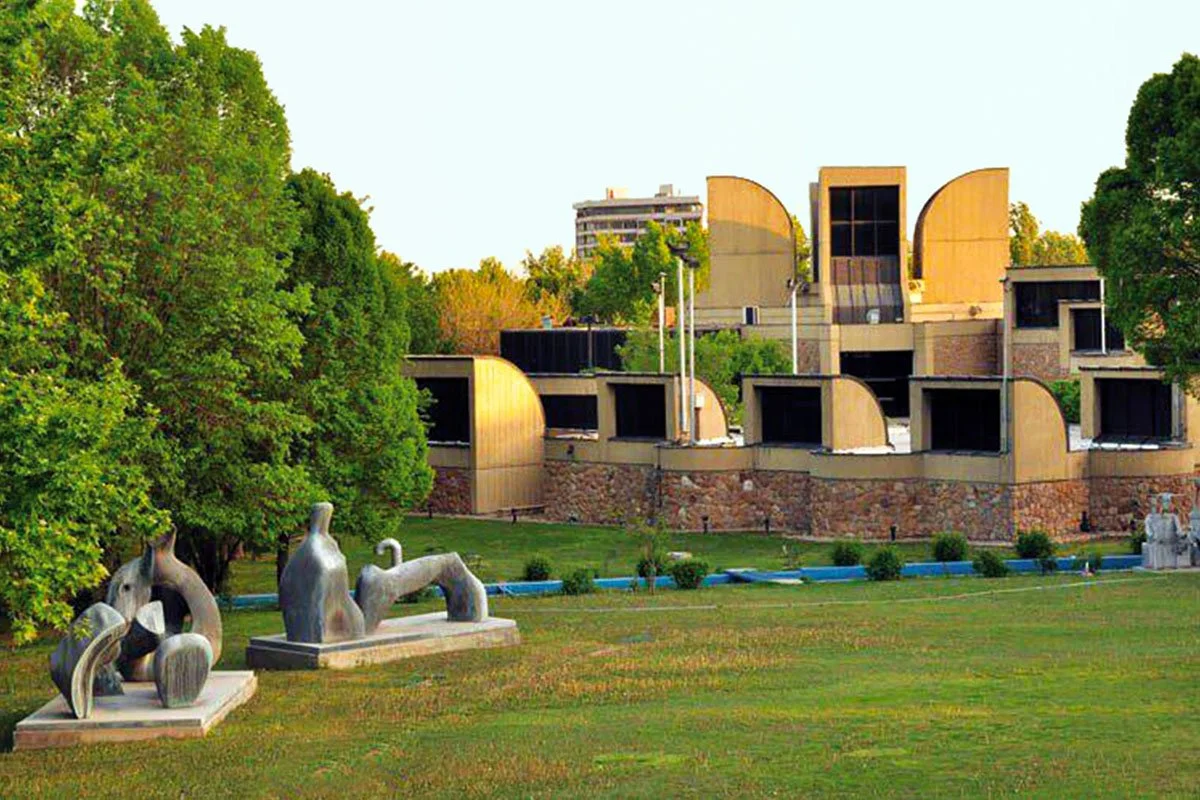
Tehran Museum of Contemporary Art under emergency protocols: During recent regional escalations, the Tehran Museum of Contemporary Art (TMoCA) activated crisis protocols, closing its doors, shifting highly valuable Western masterpieces to deep secure storage, and draining volatile materials to prevent blast fires. [1, 2]
Following a reduction in immediate hostilities, the museum reopened under a fragile, ongoing "war mode." Operating under strict emergency protocols, the museum has been rotating small, highly selective batches of its $3 billion collection
Abstract
War does not affect an art world only by damaging museums, interrupting exhibitions or compelling artists to produce images of violence. It alters the institutional conditions through which art is authenticated, circulated, historicised and assigned value. In Iran, the present conflict is accelerating pressures that long predate the war: sanctions, banking restrictions, constrained mobility, digital isolation, migration and the growing dependence of Iranian artists on institutions outside the country. This essay argues that the most consequential transformation may be the externalisation of Iranian cultural authority. Iranian art could become more visible, valuable and institutionally urgent abroad while artists, scholars, galleries and museums inside Iran lose influence over how that art is interpreted. Museums, auction houses, diaspora collections, international galleries, banks, insurers and compliance departments may increasingly determine which artists circulate, which archives survive and which account of Iranian art becomes canonical. The danger is therefore not simply that Iranian artists will be reduced to witnesses of crisis. It is that the systems capable of recognising an artist as historically important may become detached from Iran itself. What survives internationally may not be a representative history of Iranian art, but a canon of what could escape: the works that could be exported, documented, insured, translated and made institutionally legible abroad.
1. War does not only destroy culture. It redistributes the power to define it.
The immediate cultural consequences of war are visible: buildings are damaged, collections are moved into storage, exhibitions close, and artists lose studios, materials, income and mobility. The less visible consequences unfold more slowly. Documentation is interrupted. Correspondence disappears. Small galleries close. Scholars migrate. The institutional authority to explain a culture shifts toward organisations situated elsewhere.
A work of art may survive physically while losing the infrastructure that allows it to be understood. Its gallery may close; its exhibition history may become inaccessible; its certificate may exist only in an account that cannot be reached; the critic who understood its local context may be unable to publish; and the artist may remain in Iran while the international narrative surrounding the work is produced in London, Paris, Dubai, Istanbul, Los Angeles or New York.
This process is more than the export of objects. It is the externalisation of cultural authority: the relocation of the functions that establish authenticity, significance, visibility and historical value. It includes archival control, provenance verification, museum acquisition, scholarly publication, conservation capacity, market validation and the authority to decide which artists are made to represent Iran.
The current crisis makes the distinction tangible. The Art Newspaper reported that the bombardment beginning on 28 February 2026 left museums and galleries closed, collections evacuated, studios idle and artists cut off by internet blackouts (Geranpayeh 2026a). UNESCO reported damage to Golestan Palace from debris and shock waves following an airstrike in the site’s buffer zone and reminded all parties that cultural property is protected under international law (UNESCO 2026a).
Heritage destruction and the contemporary art market are not identical fields, but they belong to the same institutional ecology. Museums, archives, universities, artist estates, restoration workshops, commercial galleries and cultural ministries collectively sustain a society’s capacity to record and interpret itself. When that ecology is fractured, culture does not necessarily disappear. It becomes dependent on different custodians.
2. The domestic art world existed before the crisis narrative
International discussion frequently approaches Iranian art as if it emerged directly from political repression. This erases the complexity of the country’s own artistic infrastructure. Iran possesses a substantial history of modern and contemporary exhibition-making, private collecting, artistic education, criticism and commercial gallery activity. These systems have never been free of state power, economic instability or censorship, but they cannot be reduced to those conditions.
Hamid Keshmirshekan’s study of contemporary Iranian art shows that post-revolutionary production developed through negotiations among modernism, tradition, state institutions, independent practice and global contemporaneity rather than through political opposition alone (Keshmirshekan 2013). Katrin Nahidi similarly demonstrates that exhibitions and art-historical categories do not neutrally describe Iranian modernism; they actively produce it, selecting which artistic debates become durable history (Nahidi 2023).
The commercial sector also developed meaningful domestic depth. Ahmad Rafiei Vardanjani’s analysis of twelve galleries in Tehran and Dubai found that sanctions affected not only transactions but exhibition formats, marketing strategies and artistic production itself. Galleries increasingly used digital circulation and less materially cumbersome practices to compensate for financial and logistical isolation (Rafiei Vardanjani 2020).
The resilience of domestic collecting remained visible immediately before the present escalation. In October 2025, Tehran Auction presented 120 works and recorded approximately US$1.5 million in sales before fees. The significance of the result was not the number alone. It demonstrated that Iranian art continued to circulate through a local system of knowledge, prestige and collecting despite exclusion from international banking (Naji 2025).
This domestic art world has its own hierarchies, neglected figures, influential teachers, private collections and aesthetic disputes. Artists who matter profoundly within Iran may remain almost unknown abroad. Conversely, some internationally prominent Iranian artists may occupy a different place within the everyday history of artistic production inside the country. War threatens to turn that difference into a structural divide. What is accessible abroad can gradually be mistaken for what was historically important.
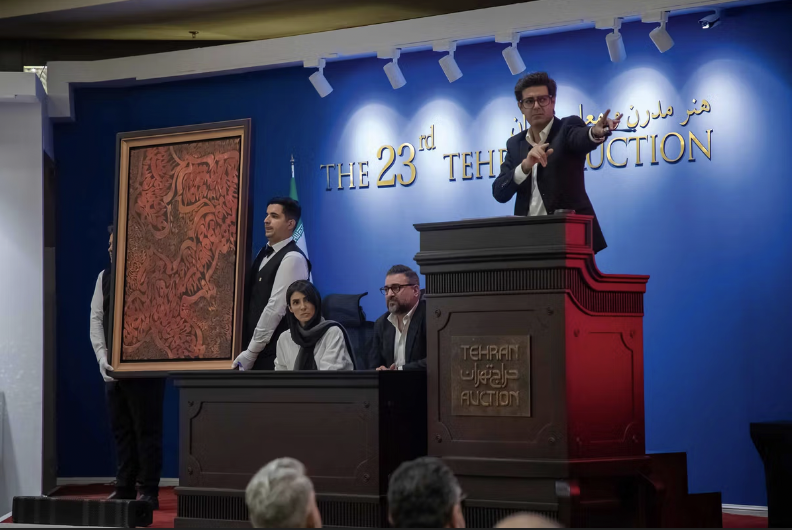
Tehran Auction, October 2025: the Azadi Hotel sale photographed by Adel Mashoori, courtesy Tehran Auction.
3. The sanctions curator
Curatorial narratives are normally attributed to museum directors, scholars and exhibition organisers. Iranian art, however, is also curated by institutions that rarely appear in exhibition credits: banks, insurers, shipping firms, customs authorities, visa regimes, sanctions lawyers, technology platforms and compliance departments. This essay calls their cumulative influence the sanctions curator.
The term does not imply that a compliance officer makes an aesthetic selection. It describes the way administrative decisions determine which artworks and cultural organisations can pass through the international system. A curator may select an artist in Tehran, but a bank may refuse to process payment. A museum may approve a loan, but an insurer may judge the jurisdiction too risky. A gallery may be admitted to an art fair, but institutional communications may conceal its Tehran address. A lawful transaction can be abandoned because the cost of proving that it is lawful exceeds the value of the work.
The legal position is more complex than the common claim that “art is exempt from sanctions.” The United States Treasury recognises certain protections for information and informational materials, including artworks, while also warning that exemptions do not apply uniformly to property connected to blocked persons and that art-market actors retain compliance obligations (OFAC 2019a; OFAC 2019b). The distinction between what is formally prohibited and what institutions are prepared to risk creates a wide field of overcompliance.
O Gallery’s participation in the 2025 Armory Show demonstrated how this works in practice. The gallery’s name was temporarily removed from the exhibitor list, its Tehran location was removed from the fair website, and the founder described high shipping costs, currency pressure and bureaucratic obstacles. The work was not censored through a curatorial rejection. Its institutional origin was made less visible through compliance (Shaw 2025).
Economic policy thus becomes cultural policy without declaring itself as such. Sanctions influence the size and material of artworks, the ability to import supplies, the feasibility of international shipping, the use of online exhibitions and the migration of artists toward jurisdictions from which galleries can represent them more easily. The eventual canon may reflect compliance compatibility as much as artistic significance.
4. A market divided by mobility
Conflict will not produce a single economic outcome for Iranian art. It may generate opposite outcomes simultaneously. Inside Iran, war can reduce liquidity, weaken private galleries, interrupt auctions, increase the cost of materials and encourage collectors to protect cash or foreign currency. Outside Iran, the same crisis may produce institutional urgency, perceived scarcity and greater demand for artists who already possess international representation.
This is not a simple “war premium.” It is a division between works and artists capable of circulation and those effectively immobilised. Pierre Bourdieu’s concept of the cultural field is useful here: artistic value is produced through relationships among artists, critics, galleries, institutions, collectors and educational systems, not by the object alone (Bourdieu 1993). War does not merely alter prices within this field. It rearranges the field itself.
An established Iranian artist living in Paris, London or New York may have access to stable banking, international shipping, cataloguing and professional estate management. An equally important artist in Tehran may confront interrupted communications, inaccessible archives, currency instability and a gallery unable to receive payment. The international market can interpret the first artist as an increasingly important representative of Iranian culture while the second becomes less visible precisely because of being more embedded in Iran.
The stronger economic concept is therefore an infrastructure premium. Works with recognised provenance, secure storage, foreign representation and accessible documentation become more desirable because they can pass through institutional systems with less friction. The market does not reward exposure to danger equally. It rewards the ability to convert danger into internationally manageable cultural property.
This asymmetry also creates ethical problems around distressed acquisition. A transaction can be legally consensual while remaining structurally unequal. A buyer with hard currency, international legal advice and access to global resale markets possesses advantages over a seller facing inflation, isolation or urgent financial need. What the market later calls foresight may, in some cases, resemble extraction.
5. From artist to witness: the politics of crisis legibility
The international art world frequently asks artists from conflict zones to function as witnesses. Their work is expected to explain repression, gender, religion, violence, exile, revolution or national trauma to audiences situated elsewhere. Many Iranian artists deliberately engage these subjects with complexity, and political expression can be an exercise of agency rather than a curatorial imposition.
The problem emerges when political readability becomes a condition of visibility. An artist working through abstraction, ecology, architecture, sound or material research may be considered insufficiently representative of Iran. Another artist whose work addresses the veil, state violence or exile may appear immediately legible because the work corresponds to an established institutional vocabulary.
This produces a crisis-legibility regime: a system that rewards art according to how effectively it translates geopolitics for an external audience. Artists from stable Western states are often permitted to be obscure, formal, self-referential or indifferent to national representation. Iranian artists are more often asked to explain where they come from.
War intensifies this identity tax. Existing works can be retroactively framed as prophetic documents; new work may be assessed by how visibly it addresses the conflict; and museum programmes may prioritise resistance, women, censorship and exile because these subjects are morally urgent and institutionally communicable. The danger is not that these subjects receive attention. It is that they monopolise attention.
Fereshteh Daftari’s 2006 exhibition Without Boundary offered an important counter-model. The exhibition questioned the use of a broad “Islamic” rubric for artists of distinct nationalities, religions and practices, insisting on the inadequacy of treating geography as artistic essence (Daftari 2006; Museum of Modern Art 2006). During war, institutions need this distinction more, not less. Political engagement should be visible without becoming the only acceptable form of Iranian artistic identity.
6. The diaspora canon and the archive of what escaped
Diaspora should not be treated as culturally secondary or insufficiently Iranian. Iranian culture has long been produced through migration, translation and transnational exchange. Stuart Hall’s account of cultural identity is useful because it rejects the idea of identity as an unchanging essence; identity is continuously produced through history, difference and position (Hall 1990).
The problem is not that Iranian art history may be written in the diaspora. The problem is that it may increasingly be written almost exclusively there. External collections can correct historical neglect, preserve vulnerable works and introduce Iranian modernism to broader scholarship. Yet every exhibition assembled abroad is shaped by what left Iran, what collectors purchased, which archives are accessible, which lenders can participate and which artists can be researched in the languages and systems of the receiving institution.
The Asia Society’s 2013 Iran Modern exhibition was a landmark in international recognition of Iranian modern art. It also demonstrated the power of an institution outside Iran to consolidate a historical narrative from loans dispersed across the United States, Europe and the Middle East (Asia Society 2013). Such exhibitions are indispensable, but they should not be mistaken for total histories.
Conflict can transform the limitations of access into the architecture of the canon. Artists who migrated, estates administered abroad, works already exported, and documentation available in English or French will accumulate scholarship, conservation records, catalogues and institutional references. Artists whose work remains inside Iran may become harder to verify, lend or publish. Accessibility then becomes historical importance.
This is the canon of what escaped. What escaped may be exceptional, but it is not necessarily representative. The archive becomes recursive: institutions exhibit the artists they can access; those exhibitions generate scholarship; scholarship justifies acquisitions; acquisitions produce further exhibitions. Artists outside the circuit appear peripheral because the circuit itself never recorded them.
7. The coming provenance problem
Provenance is often discussed in relation to antiquities, looting and restitution. Modern and contemporary art also depends upon documentary continuity: studio inventories, certificates, invoices, gallery records, emails, photographs, exhibition catalogues, customs documents, conservation reports and correspondence with collectors. War and digital isolation can fracture this chain.
The risk is not only forgery. It is the creation of unequal documentary status. Works already held abroad are likely to retain stronger records because international galleries, auction houses and collectors maintain recognised systems. Works inside Iran may later be treated as difficult to authenticate, insure or lend even when their histories are known locally. The market interprets that gap as risk; art history experiences it as disappearance.
ICOM’s revised Code of Ethics, adopted in 2026, reinforces the importance of due diligence, provenance, public accountability and communities’ rights in relation to cultural heritage (ICOM 2026). These principles should be adapted carefully to wartime contemporary art. A missing document should not automatically invalidate a work whose archive was interrupted by conflict. At the same time, crisis cannot become an excuse for relaxed scrutiny or opportunistic transfer.
Institutions should distinguish between documentation damaged by war and documentation concealed to facilitate an unethical transaction. A responsible provenance statement must record not only what is known, but what cannot presently be established, why the gap exists, who has been consulted and what research remains open. Uncertainty should be preserved as information rather than erased by a false claim of completeness.
This requires distributed archives. Artist records should be duplicated across secure locations; digital files should retain metadata and version history; oral testimony should be recorded where paper trails are incomplete; and institutions acquiring work during the crisis should fund archival work rather than simply benefit from it. Provenance research must become a form of cultural repair, not merely a defence against legal liability.
8. When protection becomes possession
Cultural preservation during conflict often requires emergency action. Collections may be removed from display, stored in protected facilities, digitised or transferred temporarily. UNESCO activated emergency measures across the region in 2026, including guidance for the transfer and safe storage of artefacts and training against illicit trafficking (UNESCO 2026b). Tehran Museum of Contemporary Art similarly operated under emergency protocols before reopening with its Art and War programme; staff removed oil from Noriyuki Haraguchi’s installation to reduce the risk of fire and spillage during a blast (Geranpayeh 2026b).
Emergency preservation is essential, but it raises questions of authority and duration. Who approves the movement of a collection? Who controls the inventory? Under what agreement is the work stored? Does temporary custody include a mandatory return procedure? Can the receiving institution publish, exhibit or digitise the material? What happens if sanctions later prevent transport, insurance or payment for conservation?
The language of rescue can conceal a transfer of power. A museum or foundation may legitimately provide storage and conservation, but if the originating institution loses practical access, the intervention risks becoming custodial extraction. Preservation then protects the object while weakening the originating community’s relationship to it.
The appropriate principle is preservation without appropriation. Emergency agreements should include a complete shared inventory, explicitly temporary custody, limits on sale and reproduction, transparent conservation records, access for Iranian researchers and a legally defined return process. The institution that provides safety must not acquire unilateral authority over meaning.
9. Digital disappearance and the struggle over the image of Iran
Internet blackouts affect more than communication. They determine who can produce and distribute the visual record of conflict. When Iran-based artists, photographers and cultural workers lose access to international platforms, the image of the country is increasingly constructed by actors who remain online: foreign news agencies, state broadcasters, diaspora accounts, activists abroad and international institutions.
The people physically closest to events can become least capable of captioning them. A photograph may circulate without attribution; a video may be downloaded, reposted and later exhibited without its original context; screenshots may outlive the accounts from which they were taken; metadata can be stripped; and a work intended for a limited audience may become public evidence.
The archive of war is therefore not a transparent record. It is shaped by connectivity. International museums and archives should not treat publicly circulating images as ownerless. Material collected under blackout conditions requires attribution research, contextual verification, consent where possible and restrictions against premature commercial or exhibition use.
Digitisation alone is not cultural sovereignty. Sovereignty also concerns who describes the file, controls access, writes the caption, determines the search terms and decides how the record will later be interpreted. A secure archive can still reproduce external authority if Iranian creators and researchers have no meaningful role in its governance.
10. The museum as geopolitical actor
A museum that acquires Iranian art during war is not making a politically neutral decision. It may frame the acquisition as preservation, solidarity, opposition to censorship or recognition of an underrepresented history. These goals can be legitimate. Yet the acquisition also benefits the museum by expanding the collection, producing institutional relevance and positioning the institution as morally responsive to a global crisis.
The question is not whether museums should collect Iranian art. Refusing to collect it could reinforce the very isolation criticised here. The question is what obligations accompany acquisition. A museum should not acquire work during a moment of vulnerability, produce a politically resonant exhibition, and then withdraw when public attention moves elsewhere.
Ethical collecting requires investment in the ecosystem from which the work emerged. That may include translation, conservation, artist residencies, oral histories, research into less visible practices, support for archives, and sustained collaboration with scholars and cultural workers inside Iran whenever communication and safety permit. Participation should not be limited to testimony; Iranian partners should share conceptual and interpretive authority.
The revised ICOM Code emphasises due diligence, public accountability, reparative practice and communities’ right to reclaim cultural heritage (ICOM 2026). Applied to Iranian contemporary art, these principles imply acquisition without crisis discounting, independent valuation, transparent documentation of seller circumstances, heightened provenance research, distributed archives and a commitment to relationships that continue after the news cycle.
Museums are geopolitical actors because their collections shape what later becomes teachable, exhibit-able and historically real. Neutrality is not available. The responsible question is whether their power is exercised extractively or reciprocally.
11. What could be lost without being destroyed
The most serious cultural loss may never appear in a damage assessment. It may consist of artists who stop working because materials become unaffordable; gallery assistants who leave the field; students whose education is interrupted; exhibitions cancelled before documentation; critics who can no longer publish; archives that are never digitised; and works never produced because artistic time is consumed by survival.
These losses do not leave ruins. They produce absences in the future. Established artists may retain visibility through galleries and collectors. Younger artists depend on fragile networks: affordable studios, local exhibitions, peer communities, fabrication workshops, criticism and opportunities to be seen before their reputations are secure.
When those networks collapse, the international art world often encounters the consequences years later and misreads them as a lack of artistic production. The missing generation appears never to have existed because its institutional record was never created. This is why emergency support cannot focus only on masterpieces and famous names. An art world is not a collection of objects. It is a system that makes artistic life possible.
12. A framework for ethical international engagement
The analysis above does not argue for isolation. Iranian artists and institutions need international exchange precisely because sanctions and war restrict it. The objective is not to keep Iranian art inside national borders, nor to deny the cultural legitimacy of the diaspora. It is to prevent mobility from becoming a monopoly over meaning.
1. Separate political urgency from curatorial reduction. Exhibit work responding to conflict, but maintain research into formal, historical, technological and non-crisis practices. Do not make nationality a compulsory subject.
2. Publish the hidden infrastructure of circulation. Institutions should disclose when sanctions, insurers, banks, shipping restrictions or visa decisions shape an exhibition. Administrative exclusion should not remain invisible.
3. Treat provenance gaps as research obligations. Record what is unknown, why it is unknown and who has been consulted. Fund artist archives and preserve uncertainty rather than manufacturing false completeness.
4. Prevent crisis discounting. Use independent valuation and document the circumstances of acquisition. A lawful purchase can still be ethically compromised by asymmetrical information or urgent need.
5. Distribute archives and authority. Maintain secure copies across multiple locations and create governance structures that include artists, estates and Iranian researchers.
6. Build reciprocal, long-duration partnerships. Acquisition should be accompanied by translation, scholarship, conservation, training and institutional support that outlasts the exhibition cycle.
7. Protect return and access. Emergency custody agreements must define access, reproduction rights and return procedures. Preservation should never become indefinite possession.
Conclusion: visibility without sovereignty
The international consequences of war cannot be reduced to a single forecast. Iranian contemporary art may receive greater museum attention. Established artists may experience stronger demand. Diaspora institutions may expand. Historical works may be reassessed. Archives may be digitised. International collections may preserve objects that would otherwise be endangered. All of these outcomes can be beneficial.
They can also conceal a deeper transfer of power. The bank determines which transaction proceeds. The insurer determines which work travels. The foreign gallery determines which artist is represented. The diaspora collection determines which work is available for loan. The museum determines which narrative receives institutional legitimacy. The archive determines which account later becomes history.
Under these conditions, the global visibility of Iranian art can rise while Iranian participation in the production of its meaning declines. That is the contradiction at the centre of the present moment. The challenge for museums, collectors and cultural organisations is not merely to support Iranian artists, but to preserve the conditions under which Iranian artists, scholars and institutions retain authority over their own histories.
The most responsible international response would not attempt to become the new centre of Iranian art. It would help sustain a distributed cultural field in which no single museum, market or diaspora capital can claim exclusive authority. The future of Iranian contemporary art should not be determined only by what survives the war, but by who retains the right to explain what survived—and why it mattered.