
Why So Much Arab Art Looks Like It Was Made for Foreign Audiences
Identity as performance, exoticism and the market for legible difference
“Arab art” is an unstable category. It covers more than twenty countries, several languages, contradictory political systems, multiple religious traditions and an enormous diaspora. It includes artists working in monarchies, military states, occupied territories, collapsing republics and wealthy international capitals. No coherent aesthetic could possibly represent this field.
Yet the category survives because it is useful. It gives museums an exhibition theme, auction houses a department, collectors a market segment and journalists a manageable story. It transforms a vast and contradictory history into a recognisable cultural product.
The artist is then recruited as a cultural informant. The work is expected to explain the veil, the war, the revolution, the refugee camp, the religious prohibition, the status of women, the persistence of tradition or the meaning of Arabic script. It must educate without becoming didactic, accuse without becoming propagandistic and remain visually seductive while performing political seriousness.
This expectation is not always stated. It operates through invitations, acquisitions, residencies, grant applications and curatorial conversations. Artists quickly learn which aspects of their work require no explanation because they match an existing institutional vocabulary. Displacement is understood. Hybridity is understood. Postcolonial memory is understood. The archive is understood. A work about an untranslated neighbourhood joke, an obscure local argument, a failed romance, middle-class pretension or the boredom of family life may be more culturally specific, but it is harder to package as “Arab contemporary art.”
The result is not necessarily false art. It is art produced under a regime of selective visibility. Certain experiences become internationally visible because institutions possess a language for them. Others remain local, informal or invisible because they cannot be converted as easily into wall text.
The mechanism resembles Orientalism, but it is more sophisticated than the nineteenth-century version. The old Orientalist painter travelled east and returned with images of harems, markets, deserts and supposedly timeless people. The contemporary institution no longer needs to invent the East from outside. It can invite artists from the region to represent difference themselves.
The authority has changed hands, but the demand for recognisable difference has not disappeared. Orientalism has, in some cases, been outsourced.
Why So Much Arab Art Looks Like It Was Made for Foreign Audiences
Identity as performance, exoticism and the market for legible difference
There is a room that appears repeatedly in exhibitions of contemporary Arab art. The location changes—London, Paris, Berlin, New York—but the contents remain strangely familiar. Somewhere there is a map with a border cut through it. Somewhere there is a passport, a checkpoint, a military document or an abandoned building. Arabic writing appears across a photograph, usually partially obscured. A woman is veiled, unveiled or caught between the two. There may be archival images, family photographs, fragments of news footage, rubble, embroidery, oil, sand or an object associated with prayer.
None of these subjects is illegitimate. Borders govern real lives. War is not an invention of curators. Exile is not a metaphor for people who have actually been expelled, occupied or prevented from returning home. Religion, language, gender and memory remain central to the region’s experience of modernity. The problem is not that Arab artists address these subjects. The problem begins when these subjects become the admission requirements for Arab artists entering the international art world.
The work arrives already translated. It explains where it comes from, what historical wound it represents and which political category should contain it. Before the viewer has encountered its form, scale, rhythm, material or ambiguity, the biography has supplied the meaning. The artist is Palestinian, Lebanese, Syrian, Iraqi, Egyptian, Saudi or “of Arab origin.” The label enters the room before the art does.
A European or American artist may produce an abstract painting and be discussed in terms of colour, perception, gesture or art history. An Arab artist producing the same painting is often asked where the Arabic influence is. The Western artist is permitted an individual psychology. The Arab artist is expected to provide regional information. One makes art; the other is treated as evidence.
This is why so much Arab art shown internationally can feel as though it has been produced for foreign audiences, even when the artist’s intentions are serious. The international system does not simply select art from the Arab world. It selects the forms of Arabness it already knows how to recognise.
The Artist as Cultural Informant
“Arab art” is an unstable category. It covers more than twenty countries, several languages, contradictory political systems, multiple religious traditions and an enormous diaspora. It includes artists working in monarchies, military states, occupied territories, collapsing republics and wealthy international capitals. No coherent aesthetic could possibly represent this field.
Yet the category survives because it is useful. It gives museums an exhibition theme, auction houses a department, collectors a market segment and journalists a manageable story. It transforms a vast and contradictory history into a recognisable cultural product.
The artist is then recruited as a cultural informant. The work is expected to explain the veil, the war, the revolution, the refugee camp, the religious prohibition, the status of women, the persistence of tradition or the meaning of Arabic script. It must educate without becoming didactic, accuse without becoming propagandistic and remain visually seductive while performing political seriousness.
This expectation is not always stated. It operates through invitations, acquisitions, residencies, grant applications and curatorial conversations. Artists quickly learn which aspects of their work require no explanation because they match an existing institutional vocabulary. Displacement is understood. Hybridity is understood. Postcolonial memory is understood. The archive is understood. A work about an untranslated neighbourhood joke, an obscure local argument, a failed romance, middle-class pretension or the boredom of family life may be more culturally specific, but it is harder to package as “Arab contemporary art.”
The result is not necessarily false art. It is art produced under a regime of selective visibility. Certain experiences become internationally visible because institutions possess a language for them. Others remain local, informal or invisible because they cannot be converted as easily into wall text.
The mechanism resembles Orientalism, but it is more sophisticated than the nineteenth-century version. The old Orientalist painter travelled east and returned with images of harems, markets, deserts and supposedly timeless people. The contemporary institution no longer needs to invent the East from outside. It can invite artists from the region to represent difference themselves.
The authority has changed hands, but the demand for recognisable difference has not disappeared. Orientalism has, in some cases, been outsourced.
The Market Discovers the Region
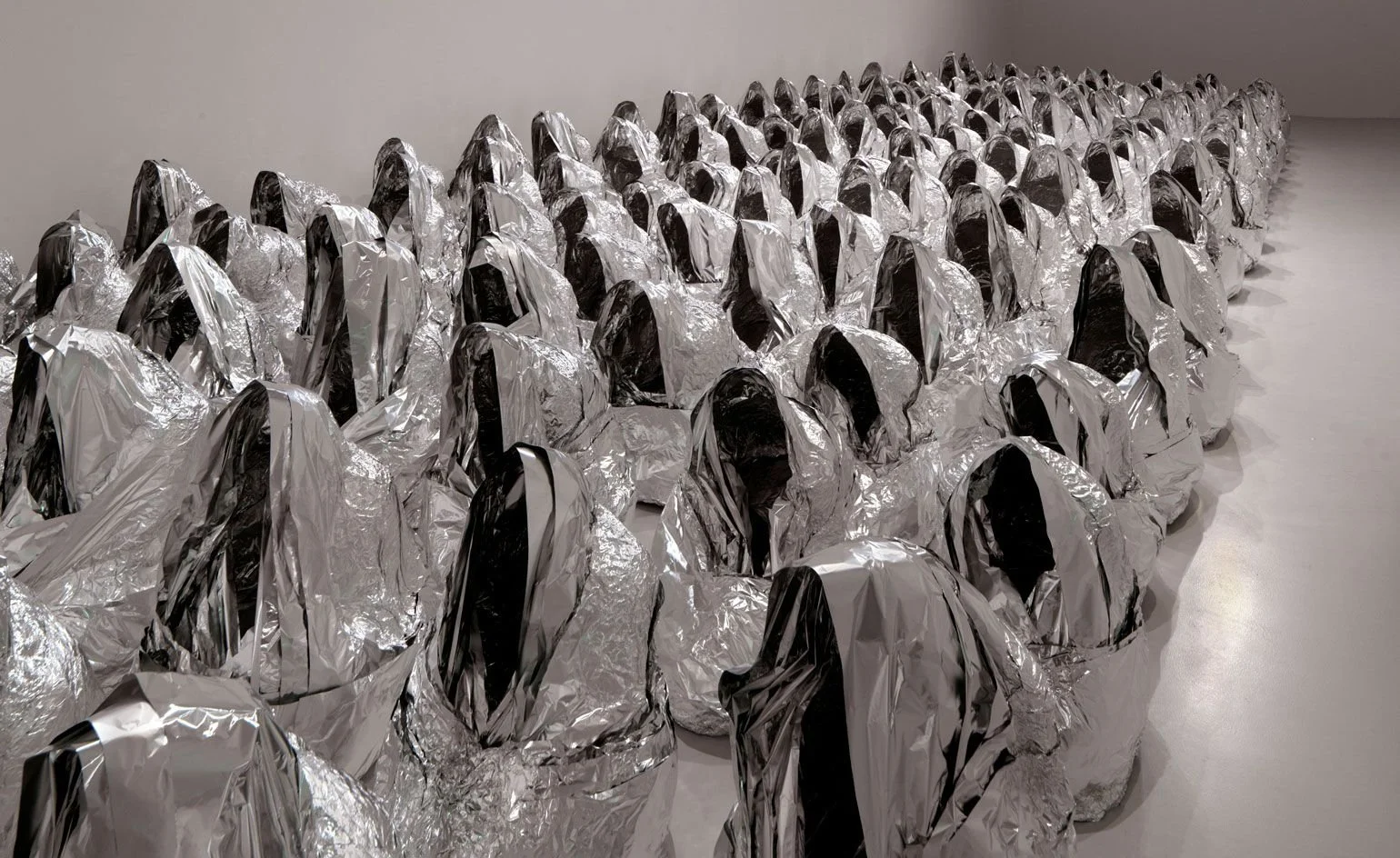
Ghost, 2007 was Kader Attia’s breakthrough work, a large mass of kneeling bodies made of layers of aluminium foil, questioning narratives of multiculturalism and how they are dissolved by contemporary politics. All artwork images: installation views from ‘Kader Attia: On Silence’, Mathaf: Arab Museum of Modern Art, Doha. Images courtesy of the artist and Mathaf. Image credit: Markus Elblaus)
The rapid international expansion of the Middle Eastern art market during the 2000s changed the conditions under which Arab art circulated. Christie’s established its Dubai headquarters in 2005 and held its first regional modern and contemporary art auction in 2006. Art Dubai followed in 2007. Museums, foundations, commercial galleries, art fairs and cultural districts multiplied across the Gulf. Arab modernism and contemporary art, long neglected by major Western institutions, acquired new financial and scholarly visibility.
This expansion corrected genuine exclusions. Artists who had been treated as peripheral entered collections, exhibitions and academic histories. Major modernists from Baghdad, Beirut, Cairo, Damascus, Casablanca and Khartoum could no longer be dismissed as derivative footnotes to European modernism. Regional collectors began building serious collections. Archives were recovered. Neglected histories became research fields.
But markets do not merely reveal value. They organise it.
Once “Middle Eastern art” became a category, the market required objects capable of representing it. Arabic calligraphy, regional maps, political symbols and recognisable cultural references became commercially efficient because they announced their difference immediately. They could be placed in a London living room, a Paris exhibition or a Dubai auction and remain identifiable from across the room.
This does not mean every artist using Arabic script is opportunistic, or that culturally specific imagery is inherently shallow. Arabic writing carries profound formal, spiritual, political and linguistic histories. Modern artists across the region used the letter not as decoration but as part of a serious effort to produce modernisms grounded in their own intellectual environments. The hurufiyya movements, for example, cannot simply be reduced to market-friendly calligraphy.
The problem is repetition without necessity. When the letter becomes a logo for cultural identity, when the map becomes a compulsory political emblem and when the veil becomes a visual shortcut for gender, the work begins to resemble branding. Identity stops functioning as a condition of experience and starts functioning as packaging.
Foreign collectors do not need to read the Arabic phrase. Its unreadability may even increase its attractiveness. The script confirms that the object has travelled from elsewhere. It supplies cultural authenticity without requiring cultural comprehension.
In that sense, the work is not always being read. It is being recognised.
Politics as an Entrance Visa
For Arab artists, politics often functions as an entrance visa into international institutions.
A German painter may be apolitical without being accused of evasion. A British sculptor may investigate balance, material or humour without being expected to address the British Empire in every exhibition. An American artist can make deliberately useless objects and still be treated as intellectually serious. Arab artists are rarely granted the same freedom from representation.
They are expected to answer for their countries. Silence can be interpreted as privilege, fear or political failure. Formalism may be regarded as decorative. Beauty is viewed with suspicion unless it is attached to trauma. Pleasure must justify itself.
This creates a distorted economy in which suffering produces cultural value. War generates archives. Displacement generates maps. Censorship generates coded language. Occupation generates documentation. The more politically catastrophic the place, the more legible its art can become to international curators.
This is not an argument against political art. Some of the most important works produced by artists from the Arab world have emerged from direct confrontations with violence, state power, colonialism and forced movement. Emily Jacir’s Where We Come From, developed between 2001 and 2003, records requests from Palestinians who could not move freely or return to places from which they had been separated. Jacir used her own mobility to perform simple acts on their behalf. The project is political because movement itself has been politicised, not because the artist added a Palestinian symbol to make the work marketable.
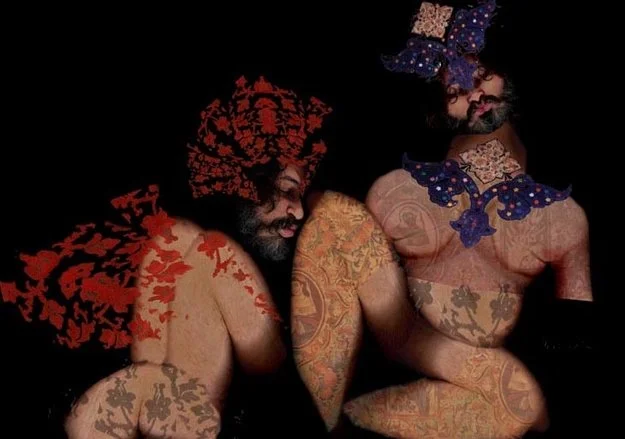
Ramin Haerizadeh, Men of Allah
The distinction lies between politics as structure and politics as iconography. In serious political art, power determines the work’s method, material and conditions. In weaker work, politics appears as an image placed on top of an otherwise conventional object.
A checkpoint photographed as a checkpoint is not automatically a critique of occupation. A passport enlarged on a gallery wall does not automatically become a profound meditation on nationality. Rubble can become as decorative as flowers when its emotional meaning is assumed rather than examined.
The international art world often rewards the appearance of resistance more easily than resistance itself. It prefers rebellion that can be installed, insured, shipped and explained in three hundred words.
When the Exhibition Manufactures the Region
Group exhibitions play a central role in producing the idea of Arab art for foreign audiences. Their titles frequently promise revelation: the Middle East “unveiled,” seen “from within,” discovered “beyond the veil” or presented as a region finally speaking for itself. The language implies that the region has been hidden, silent and inaccessible until the Western institution opens the door.
The Saatchi Gallery’s 2009 exhibition Unveiled: New Art from the Middle East offered a particularly obvious example. Even before entering the exhibition, the visitor had been given the governing metaphor. “Unveiled” connected artistic discovery to the exposure of a concealed female body and to the broader Western fixation on Muslim women. The individual works could complicate the theme, but the title had already organised their reception.
The New Museum’s 2014 exhibition Here and Elsewhere attempted something more intelligent. It brought together more than forty-five artists and explicitly resisted the idea of a coherent, homogeneous Arab world. Yet even a critically self-aware exhibition could not entirely escape the problem built into its scale. Artists from radically different contexts were assembled because their work could be read through a shared regional and political frame.
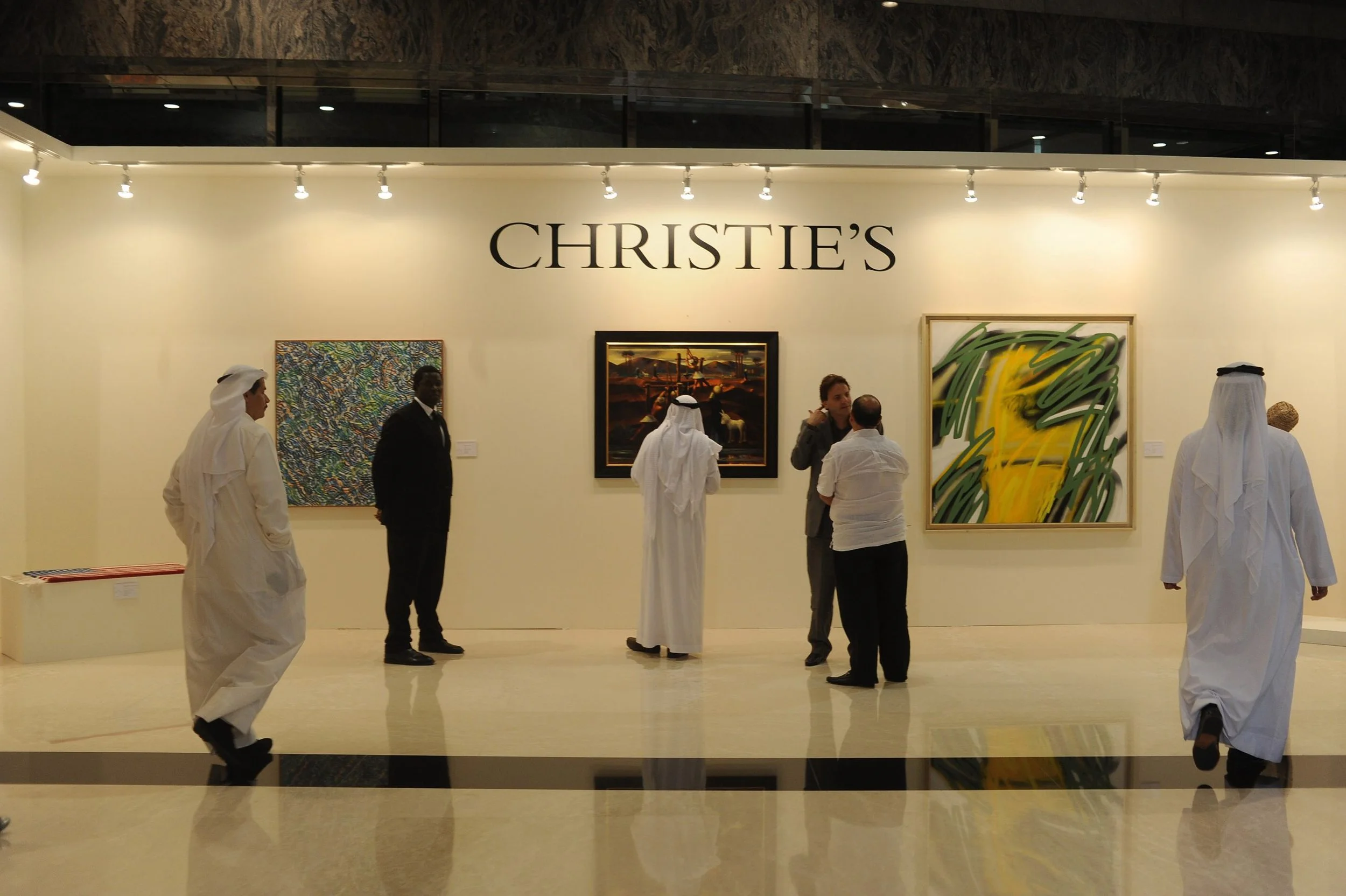
Christie’s inaugural Dubai auction or an early Art Dubai fair, 2006–2007
The contradiction is difficult to solve. Without regional exhibitions, many artists remain excluded. With them, artists are included through the same category that restricts them.
Curatorial framing can also simplify works that are actively resisting simplification. Mona Hatoum’s Measures of Distance is frequently discussed through exile and displacement, which are certainly present. But the work is also an intimate exchange between a mother and daughter. Arabic letters pass across images of the mother’s body while Hatoum translates and reads correspondence sent from Beirut. The work deals with sexuality, maternal intimacy, language and the difficulty of translation. To present it merely as the story of a displaced Arab woman is to remove precisely the complexity that gives it force.[5]
Walid Raad’s Atlas Group projects similarly resist functioning as straightforward historical testimony. Raad constructs fictional archives, invents historians and mixes research with unreliable narrative. His work does not simply tell the West what happened during the Lebanese Civil War. It questions the expectation that history can be made coherent through documents. His later project, Scratching on Things I Could Disavow, turns toward the machinery of Arab art itself: museums, fairs, collections, cultural investment and the strange relationship between artistic infrastructure and geopolitical violence.
These works travel internationally because they engage with war, memory and the Arab world, but they matter because they frustrate the role of the artist as reliable native witness. They do not deliver the region intact. They make the demand for an intact region appear absurd.
The Veil Is Too Useful
No image has been more useful to the international packaging of art from the region than the veil.

Emily Jacir, Where We Come From (Hana), 2001-2003 · SFMOMA
It permits several narratives to operate at once: oppression, faith, sexuality, concealment, resistance, tradition, feminism and modernity. It is immediately recognisable and endlessly interpretable. For a curator, journalist or collector, it provides an efficient bridge between an artwork and an existing political discussion.
Kader Attia’s Ghost demonstrates both the force and the danger of this imagery. The installation consists of rows of hollow aluminium-foil figures positioned in prayer. From behind, they appear as a congregation. From the front, their bodies are empty. The work can easily be consumed as another image of anonymous Muslim women, yet its emptiness complicates that reading. The figures are devotional and industrial, collective and absent, reflective and voided. The material refuses the stability of the cultural image.
But not every use of veiling survives its own symbolism. In a weaker work, the covered female body arrives with its interpretation already attached. The viewer is invited either to condemn religion or celebrate resistance. The woman becomes a surface upon which competing political positions are projected. Her complexity is lost because her symbolic value is too useful.
This is one reason works involving veiled women have circulated so successfully in Western exhibitions. They confirm the idea that the Arab world is organised around a dramatic conflict between tradition and liberation. The possibility that a woman might be religious, fashionable, conservative, ambitious, contradictory, ordinary or completely uninterested in representing Islam is less visually convenient.
The symbol succeeds where the person would be difficult.
The Local Audience Disappears
Art made for international circulation often speaks in the language of international circulation. The artist statement is written in English. The theoretical references come from the same group of translated European and American thinkers. The work is photographed for a portfolio before it is discussed locally. Its first serious review may appear outside the country in which it was produced.
This is partly practical. English remains the dominant language of grants, residencies, fairs and international publishing. Many regional institutions lack sustained criticism, acquisition budgets, archives and specialist audiences. Artists cannot be blamed for seeking the spaces that exist.
Yet something is lost when international recognition becomes the main measure of local relevance. The foreign institution begins to certify the artist for the region. A museum acquisition in Europe or America generates more authority than years of local engagement. The artist returns home validated by elsewhere.
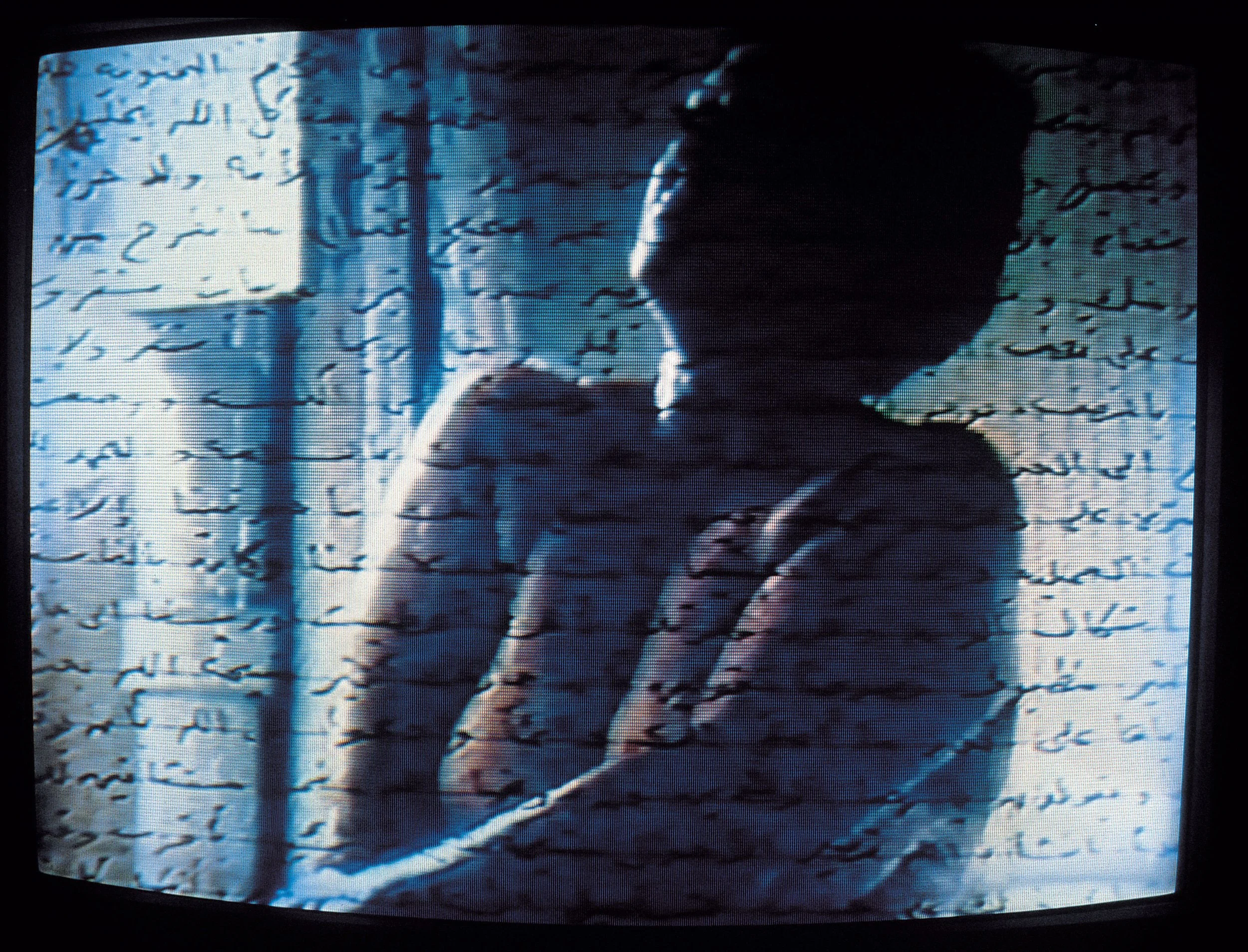
Mona hatoum measures of distance 1988- ammlung goetz muenchen
The Gulf has transformed this arrangement but has not entirely escaped it. Regional museums, foundations and collectors have created new centres of power, yet their acquisitions and exhibitions may still rely on reputations established in London, Paris, Berlin or New York. The Western institution is no longer the only gatekeeper, but its approval continues to influence which regional histories are considered important.
Meanwhile, the local public is often treated as an abstraction. A recent study centred on Mathaf: Arab Museum of Modern Art in Qatar observed limited public familiarity with the museum and with Arab artists, even in a country that has invested substantially in cultural institutions.[8] Infrastructure alone does not create an audience. A museum can possess a major collection while remaining socially distant from the people living around it.
This produces a strange condition: Arab art may be internationally visible and locally unread. It can appear in biennials, auctions and museum collections while remaining absent from schools, public conversation and everyday cultural life.
The work travels more successfully than its meaning.
Arab Artists Are Not Innocent
It is too easy to blame only Western curators and collectors. Artists possess agency. They observe what is selected, funded and published. They recognise patterns. Some resist them. Some manipulate them intelligently. Others reproduce them because the formula works.
An artist discovers that one series about domestic life receives little attention, while a second series involving borders, religious imagery or political conflict is immediately invited abroad. The lesson is clear. The next proposal becomes more legible. The statement becomes more geopolitical. The personal anecdote becomes a national condition.
Over time, a career can be built around the performance of permanent injury. The artist becomes the professional representative of exile, censorship, war or gender oppression. Even after living abroad for decades, the biography remains attached to the original crisis because the crisis gives the work its market position.
This does not mean the trauma is invented. It means trauma can become professionally organised.
The art world likes to imagine that commercial strategy belongs only to galleries and collectors, while artists remain pure producers of expression. This is sentimental. Artists make decisions within economies. They understand demand. They repeat successful motifs, adjust scale, refine statements and cultivate institutional relationships. Arab artists are no more innocent of careerism than artists anywhere else.
Precarity, however, matters. Many artists work without stable income, public funding, functioning institutions or freedom of expression. Repeating a successful visual language may be a survival strategy rather than an intellectual failure. The criticism should therefore be directed not only at individuals but at the system that makes complexity financially risky and recognisable identity professionally efficient.
Still, the artist cannot be released from responsibility altogether. At some point, repetition becomes consent. A cultural stereotype does not become radical simply because it is produced by someone who belongs to the culture being stereotyped.
Self-representation can still be self-exoticisation.
The Foreign Audience Is Not Only Foreign
The phrase “foreign audience” does not refer simply to Europeans and Americans. The foreign gaze now operates inside the region as well.
Luxury developments, cultural festivals, hotels, government initiatives and private foundations often commission art that communicates national identity to tourists, investors and international media. The demand is for work that feels contemporary but remains visibly local. Heritage must be recognisable. Tradition must appear modernised. Identity must be transformed into a photogenic experience.
The formula is familiar: take a craft, symbol, garment, architectural feature or calligraphic element; enlarge it; fabricate it in polished metal; place it in a monumental lobby; describe it as a dialogue between heritage and modernity.
Such projects may be technically impressive, but the cultural argument is often thin. The artwork does not investigate heritage. It certifies that heritage is present.
The collective GCC developed a sharp response to this visual language. Works such as Ceremonial Achievements in Flowers use the aesthetics of official celebrations, ribbon-cuttings, floral displays, wellness campaigns and bureaucratic announcements. The humour depends on familiarity with Gulf institutional culture. Rather than performing an easily consumed, timeless Arab identity, GCC examines the newly manufactured language through which Gulf states present modernity, authority and achievement.
The group demonstrates that regional specificity does not require folklore. A work can be deeply local while addressing air-conditioned conference rooms, administrative rituals and the strange optimism of government PowerPoint presentations.
The local is not always old. It may be a podium, a hotel carpet or an artificial flower arrangement.
The Right to Be Irrelevant
What would Arab art that was not made for foreign audiences look like?
There is no single answer, and prescribing one would reproduce the same problem. It would not necessarily be more traditional, more Arabic, more political or more “authentic.” Authenticity is another demand imposed on artists expected to represent a culture.
It could be abstract or figurative, intellectual or vulgar, historical or technologically experimental. It could address class cruelty in Beirut, bureaucratic language in Riyadh, domestic taste in Doha, adolescent boredom in Amman, architectural vanity in Dubai, coastal development in Alexandria or the social hierarchies of a family lunch. It could contain jokes that do not translate. It could refuse subtitles. It could be aesthetically excessive, emotionally petty, formally rigorous or politically indirect.
Most importantly, it would not carry the obligation to explain the Arab world.
Artists from the region need the right to be irrelevant to geopolitics. They need the right to make a failed painting without that failure being interpreted as the failure of Arab modernity. They need the right to become formalists, eccentrics, sensualists, minimalists, comedians and difficult intellectuals. They need the right to address their own neighbours rather than an imaginary curator arriving from Europe for three days.
This does not require isolation from foreign audiences. Art has always crossed borders, borrowed languages and changed through encounter. The foreign viewer is not the enemy. Translation is not betrayal. International recognition is not automatically corruption.
The problem is inequality. Western art is permitted to be universal without explaining its nationality. Arab art is repeatedly made particular and then praised for transcending its particularity. One begins as art. The other must escape its label.
The objective should not be to create an art that outsiders cannot understand. Incomprehensibility is not automatically resistance, and obscurity can become its own performance. The objective is to create conditions in which immediate understanding is not required.
The viewer may need to research, remain uncertain or accept that part of the work is not addressed to them. That experience is normal when Arab audiences encounter European art filled with Christian iconography, classical mythology, national history and references to earlier Western painting. Nobody demands that the artwork remove its complexity to make itself accessible to Beirut, Cairo or Doha.
Foreign audiences can be asked to work harder.
Beyond the Passport
The strongest Arab artists do not avoid identity. They refuse to let identity settle into an image.
They understand that a passport can be a document, a weapon, a privilege and a performance. They understand that Arabic writing can communicate, conceal, decorate and exclude. They understand that an archive can preserve history and manufacture it. They understand that a veil can express faith, fashion, coercion, privacy or nothing that a foreign curator expects.
Their work does not offer a clean opposition between a sophisticated artist and an ignorant foreign viewer. It implicates museums, states, markets, artists and audiences in the production of cultural meaning.
The question is therefore not whether Arab artists should stop making work about war, religion, exile, language or identity. That demand would be absurd. These subjects are not foreign inventions. They are part of lived history.
The question is why the international system remains so much more receptive to an Arab artist discussing a border than discussing colour; more interested in a veiled body than an ordinary one; more impressed by an archive of destruction than by an experiment in form.
As long as Arab identity remains a condition of entry, artists will continue to package it. Some will do so critically. Others will do so beautifully. A few will turn the packaging itself into the subject. But much of the work will remain trapped in the strange condition of being internationally visible and artistically predetermined.
Arab art does not need to become less Arab. It needs to stop arriving with its passport already open.
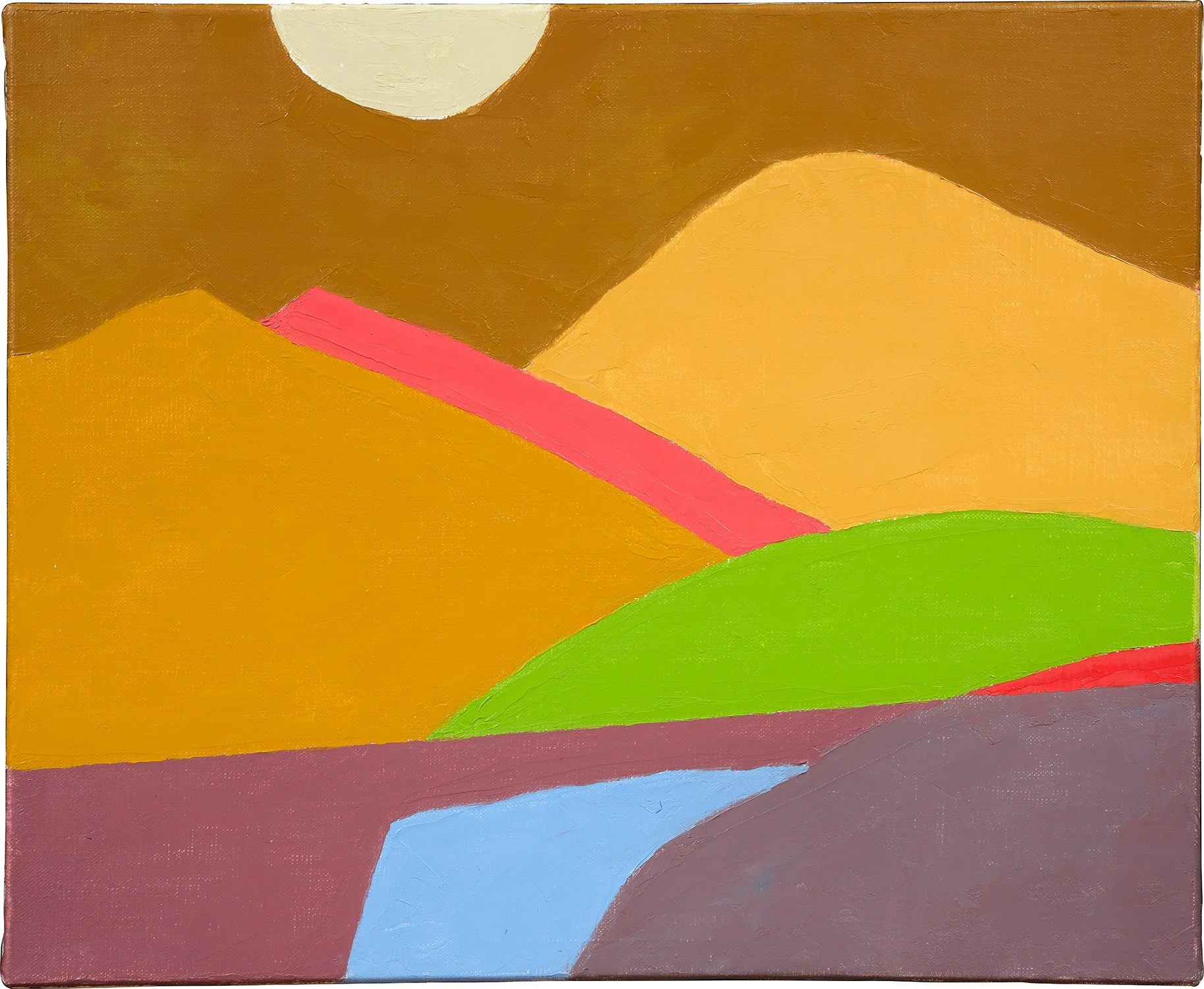
Etel Adnan - Untitled