
Iran–US tensions expose the GCC cultural economy to disrupted transport, uncertain insurance, delayed investment and weaker international travel. Saudi Arabia’s domestic audiences provide partial protection. Resilience depends on diversified logistics, resident expertise, credible cultural diplomacy, trusted sales infrastructure and reliable funding for institutions and practitioners.
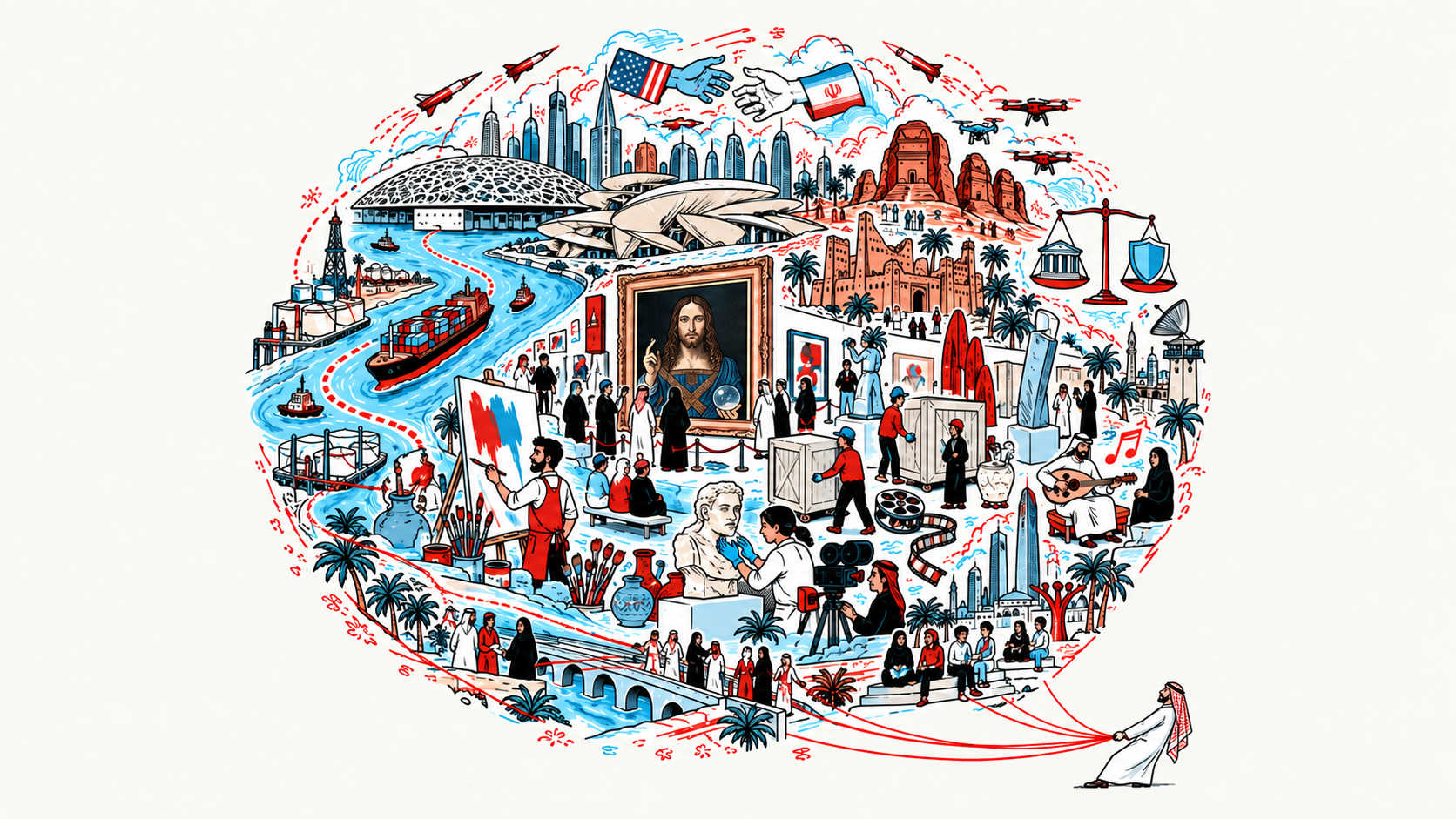
ow Iran–US tensions affect the GCC cultural economy
The GCC cultural economy includes the institutions, practitioners, businesses and audiences involved in producing, preserving, presenting and trading culture across Bahrain, Kuwait, Oman, Qatar, Saudi Arabia and the United Arab Emirates. Its exposure to geopolitical conflict extends well beyond the security of museums and heritage sites.
A museum can remain physically intact while its loans become uninsurable, its installation team cannot travel and its visitors postpone their journeys. A gallery can retain wealthy clients while losing the transport, payment or exhibition infrastructure needed to complete transactions.
These interruptions undermine the conversion of cultural investment into employment, public participation and recurring economic activity. Their effects can begin before direct damage occurs and continue after immediate security conditions improve.
Reuters reported on 14 October 2026 that Iranian restrictions and attacks had severely curtailed traffic through the Strait of Hormuz, although some oil continued to transit. The report situated those developments within the conflict that began with US and Israeli strikes on Iran on 28 February.
Reuters reporting on Strait of Hormuz shipping restrictions. [1]
For cultural institutions, this creates a practical distinction between regional risk and specific operational exposure. A shipping route, airport connection, storage facility or visiting specialist may become unavailable even while the institution itself remains open.
Art Dubai 2026 and Art Basel Qatar show why chronology matters
Art Dubai moved its planned April edition to a modified event held on 15–17 May 2026, with a preview on 14 May. Its subsequent closing announcement confirmed that the fair took place.
Art Basel Qatar’s inaugural edition, however, ran on 5–7 February, before the February escalation. It should not be described as a conflict-related postponement.
Art Dubai’s revised 2026 dates and special edition; Art Dubai official press releases. [3]
Art Basel Qatar’s inaugural February 2026 edition. [4]
The distinction matters because postponement, cancellation, reduced participation and successful delivery represent different outcomes. Each produces a different distribution of costs among organisers, galleries, artists, lenders and contractors.
Regional auctions and biennials should be assessed individually. General geopolitical deterioration does not establish that a particular event was cancelled or that every institution experienced the same disruption.
Why Gulf cultural investment remains exposed to geopolitical risk
Diriyah, AlUla, Louvre Abu Dhabi and Qatar Museums represent different approaches to cultural development. Their activities nevertheless depend, in varying proportions, on international loans, specialist expertise, construction supply chains, research partnerships and visitor mobility.
Their economic role also extends beyond cultural admissions. Museums, heritage districts and festivals support hospitality, urban development, destination identity and the attraction of skilled residents.
This creates a structural challenge: investment intended to diversify Gulf economies can remain dependent on the same transport networks, sovereign resources and international confidence that regional conflict disrupts.
Saudi PIF Diriyah development and the distinction between capital and culture
PIF describes Diriyah as a $63.2 billion integrated urban development. That figure covers a broader development programme; it is not a dedicated arts budget.
In May 2026, PIF announced a $490 million construction contract for the Saudi Arabia Museum of Contemporary Art in Diriyah. That commitment demonstrates that significant museum investment continued after hostilities began.
PIF’s Diriyah museum construction investment. [5]
Investment figures in context
$63.2 billion: announced value of the integrated Diriyah development.
$490 million: announced construction contract for its contemporary art museum.
Interpretation: neither figure establishes annual cultural operating expenditure, realised investment returns or immunity from future disruption.
The risk is therefore more complex than a straightforward halt in cultural spending. Governments may preserve flagship construction while institutions face higher operating costs, slower procurement or reduced access to expertise.
A completed building can coexist with a fragile professional ecosystem. Assessing Saudi Vision 2030 cultural investment and operating capacity requires examining both.
Strait of Hormuz disruption, art logistics and war-risk insurance
How shipping disruption reaches museums and galleries
Not every artwork entering the GCC travels through Hormuz. Fine art also moves by air and road, while major installations depend on separately sourced materials, crates, lighting systems, lifting equipment and fabrication components.
An exhibition’s exposure is consequently a chain of dependencies. Its vulnerability may lie in the artwork itself, the packaging supplier, the airport connection or the equipment required for installation.
In April 2026, The Art Newspaper reported one Chinese art logistics operator’s estimate that fine-art airfreight costs had increased by 70–300% during the conflict’s opening weeks. It also described Per Kirkeby works stranded in transit in Doha and an Abu Dhabi consignment bound for Art Basel Hong Kong delayed at sea.
These are attributed observations and specific incidents, rather than a representative GCC freight-price index.
Fine-art transport disruption and airfreight cost increases. [6]
The operational implication is to assess the complete movement: collection, packing, export, transit, customs clearance, storage, installation and eventual return. A replacement route is useful only if all those stages remain feasible.
Fine art insurance war-risk premiums are different from vessel insurance
On 22 July 2026, S&P Global reported Marsh’s assessment that additional Hormuz war-risk premiums had reached 7.5–10% of ship hull value, compared with 1–3% weeks earlier, alongside reduced underwriter appetite for spot coverage.
Those percentages concern vessels. They cannot be applied to a painting’s insured value to estimate its transport premium.
Hormuz vessel war-risk insurance premiums reported by Marsh. [7]
Insurance distinction
A percentage quoted against ship hull value is not a quotation for fine-art cargo cover. Institutions need written confirmation covering the actual artwork, itinerary, storage locations and handling arrangements. The reviewed evidence does not establish a standard GCC-wide increase in fine-art war-risk premiums.
For museums and galleries, availability can matter more than price. A policy may have exclusions, cancellation conditions or restrictions that make a proposed movement unsuitable despite an apparently affordable headline quotation.
Specialist fine-art insurance services include tailored war and terrorism solutions, but the terms must be established for the particular exposure.
Specialist fine-art insurance and war-risk protection. [8]
Budget for the total cost of delayed art transport
Consider a hypothetical exhibition with a freight allocation of $100,000. If revised quotations reach $180,000, the additional $80,000 could eliminate its operating margin.
That is a planning illustration, not a market benchmark. It shows why the institution must compare alternatives: reduce the loan list, extend existing loans with permission, exhibit locally held works or postpone.
Delay also creates secondary costs. These can include storage, renewed condition reporting, courier rescheduling and extended venue commitments. For sculptural lighting and large-scale installation commissions, missing components can leave installation crews idle or require a second mobilisation.
A practical fine-art shipping and exhibition continuity plan should therefore measure total delivered cost and disruption exposure.
Travel disruption and the dependence on international cultural talent
Travel disruption can affect a cultural programme before visitor demand changes. Conservators, lenders’ couriers, filmmakers and specialist installers may decline assignments because of employer policies, insurance conditions or unreliable connections.
British travel advice reviewed for the article warned of possible flight cancellations, airspace closures and regional disruption. Saudi warnings were geographically differentiated, rather than a blanket prohibition covering the whole country.
Saudi Arabia and UAE travel advice affecting cultural operations; UAE travel advice. [2]
An institution that requires one visiting specialist to open an exhibition has concentrated operational risk in a person. Remote participation can support talks, research and some curatorial decisions, but cannot replace every conservation treatment, condition assessment or rigging operation.
Continuity requires qualified resident counterparts, documented procedures and time for supervised transfer of responsibility.
Postponement also redistributes losses. Galleries may already have paid for production and transport; artists may depend on anticipated sales; freelancers may have reserved dates they cannot sell again. Preserving the event does not automatically preserve the livelihoods beneath it.
Art market geopolitics and the movement of high-value transactions
Do Gulf art purchases move offshore during conflict?
High-value art transactions can move more easily than institutions. A Gulf collector can purchase abroad, retain the work in professional storage and postpone importation. A seller can pursue a private sale or a later auction outside the region.
London, Zurich and Singapore may offer different combinations of advisory services, transactions and custody. However, the reviewed evidence does not establish that GCC demand for contemporary art above $1 million has measurably migrated to those three centres during this conflict.
Four variables must remain separate:
The buyer’s residence.
The transaction’s location.
The work’s beneficial ownership.
The location of physical custody.
A Gulf collector buying abroad may represent lost local commissions, handling revenue and exhibition activity without representing a disappearance of Gulf demand.
This distinction is central to art collection risk and offshore custody strategies.
Global art market figures do not measure GCC capital flight
The Art Basel and UBS Art Market Report 2026 estimates that global art sales increased 4% to $59.6 billion in 2025. Dealer sales rose 2%, public auction sales 9%, while reported private sales at auction houses declined 5%.
These are global, pre-war indicators. They do not establish conflict-driven changes in GCC market share.
Art Basel and UBS findings on the 2025 global art market. [9]
They also challenge the assumption that private sales automatically provide greater liquidity. Private transactions offer an additional channel, but still require willing buyers, acceptable pricing, trusted documentation and reliable settlement.
Domestic collectors can support galleries by purchasing works already nearby. Their resilience remains conditional on business income, liquidity and confidence.
Moreover, sovereign acquisitions, corporate commissions and private collecting can share exposure to the same public investment cycle. Counting several categories of buyers does not necessarily demonstrate diversified demand.
Saudi Vision 2030 cultural risk and state spending priorities
Defence expenditure does not translate mechanically into cultural cuts
Missile defence, infrastructure protection and emergency logistics can require urgent resources. Cultural programmes compete within that fiscal environment, but additional security spending does not automatically remove an equivalent amount from museum allocations.
Treasury budgets, PIF investment, project finance and institutional operating grants follow different decision processes.
Saudi Arabia’s original FY2026 budget projected expenditure of approximately SAR1.313 trillion, revenue of SAR1.147 trillion, and a deficit of about SAR165 billion, or 3.3% of GDP. Announced in December 2025, those figures predate the February escalation.
Saudi Arabia’s original FY2026 budget and fiscal deficit. [10]
Fiscal interpretation
The original 2026 deficit establishes a pre-existing budget constraint. It does not prove that cultural allocations were transferred to defence. The reviewed sources do not provide a verified accounting trail connecting a specific cultural reduction to missile-defence expenditure.
Higher oil prices are also an incomplete measure of fiscal benefit. Export volumes, infrastructure damage, shipping costs and security obligations influence the outcome.
For cultural businesses, financial pressure may first appear through delayed contracts and payments rather than a published budget cut.
Protecting cultural operations alongside major construction
A government can maintain a landmark museum project while smaller suppliers lose the cash required to remain in business. Production companies, independent galleries, educators and conservators often have less capacity to absorb delayed payment than major institutions.
This creates a sequencing risk. If professionals disperse before the building opens, the project loses part of the ecosystem required to make it function.
Cultural resilience therefore requires separate attention to construction commitments, annual operating support and the financial health of independent practitioners.
How geopolitical exposure differs across GCC cultural markets
The GCC is a network of distinct jurisdictions, routes and audiences. The following comparison identifies structural considerations; it is not a forecast of country-level losses.
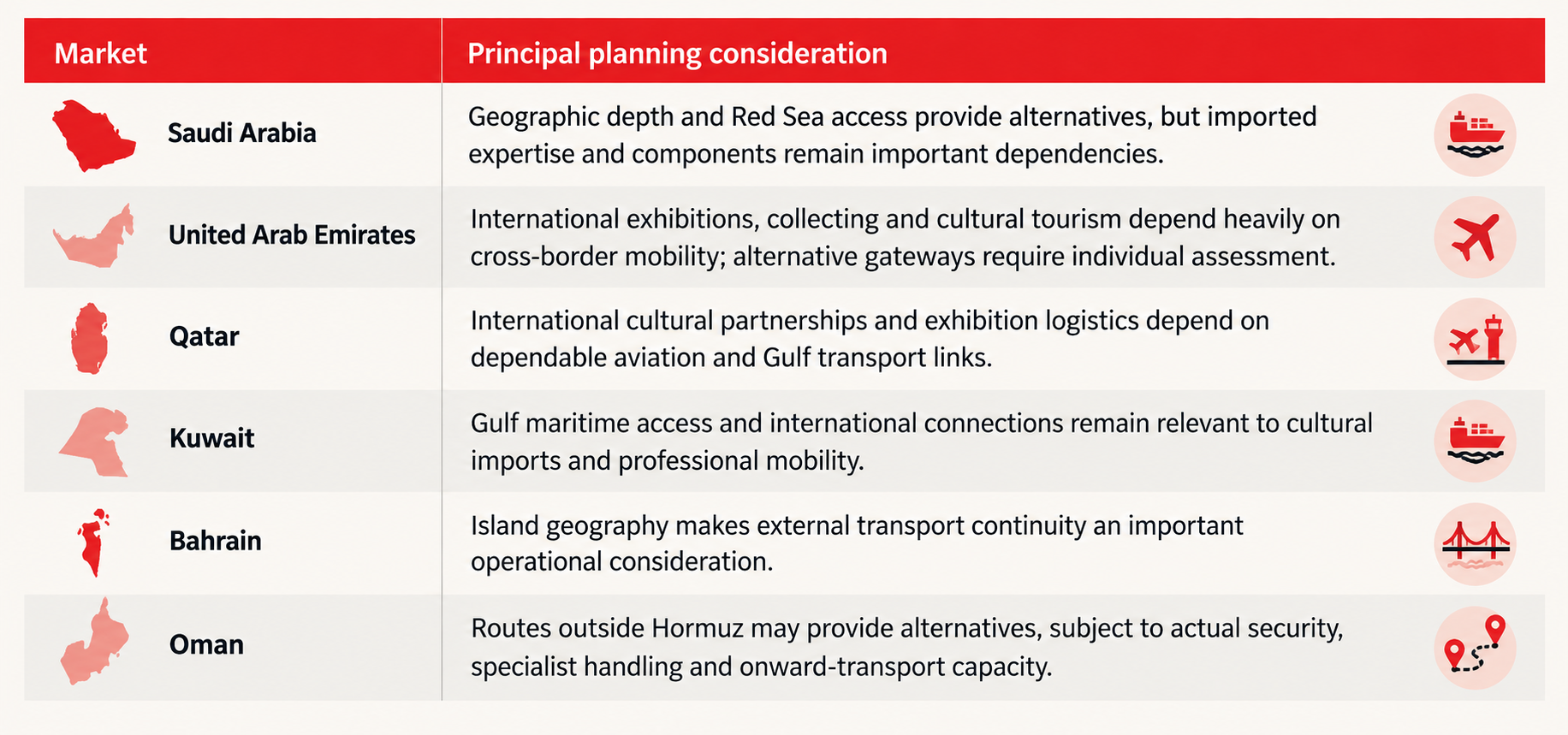
Moving a shipment away from one chokepoint can introduce other constraints. Western Saudi routes have different security and capacity considerations; Omani gateways require suitable storage and inland handling.
A port outside Hormuz is not automatically a qualified art-logistics hub.
Saudi Arabia’s cultural renaissance under Vision 2030
Quality of Life and Ministry of Culture priorities during disruption
Saudi cultural development combines national identity, public participation, economic diversification and international positioning. Those purposes overlap, but should not be measured through a single attendance or revenue target.
The Quality of Life Program provides a broad framework for participation and livability, while the Ministry of Culture’s specialised commissions develop sector capabilities.
Saudi cultural development and the Quality of Life Program; Saudi national culture overview. [11]
During geopolitical turbulence, coordination should preserve each sector’s purpose while adapting its operating model:
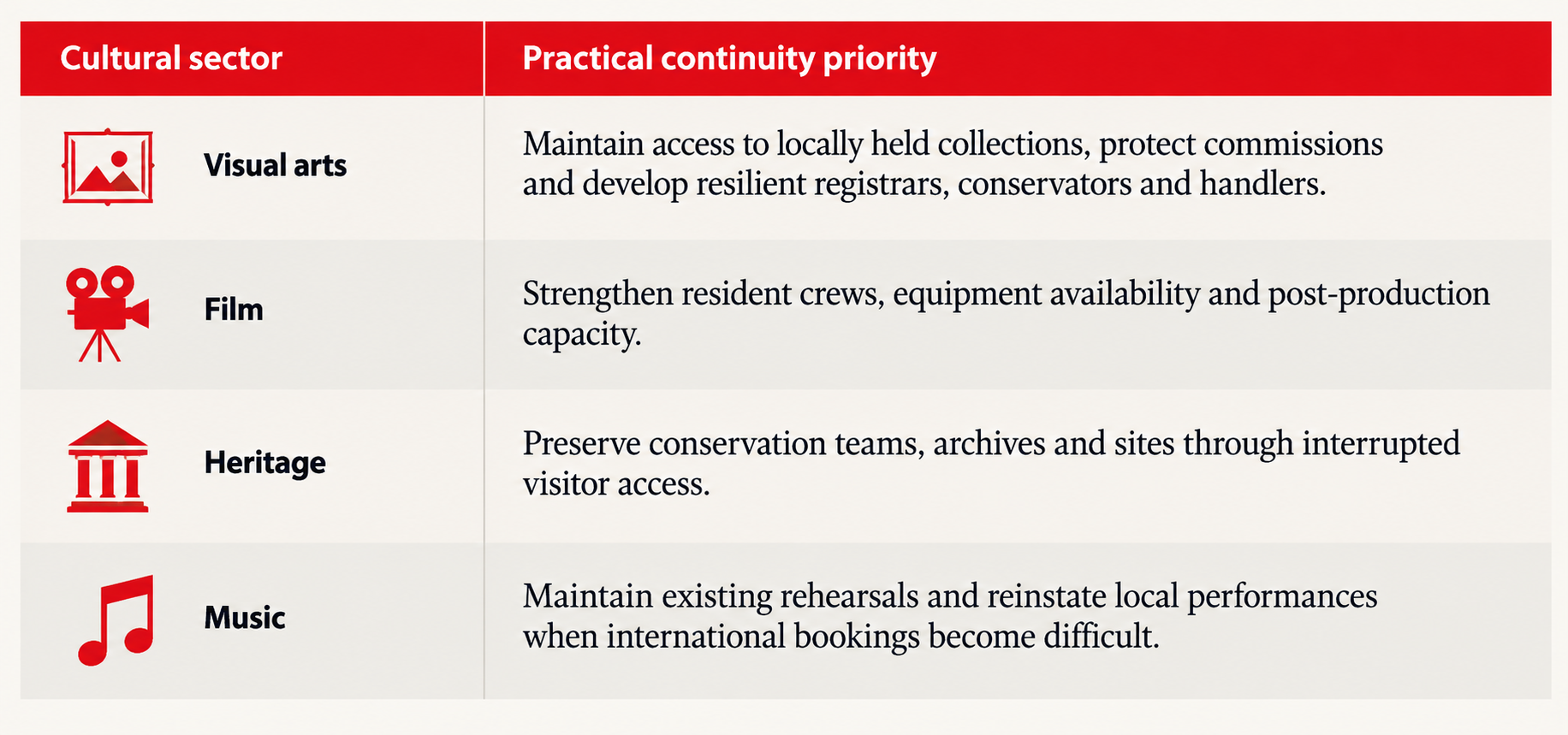
These are proposed priorities, not claims that all have been adopted as crisis measures.
AlUla cultural tourism and international partnerships
AlUla illustrates how destination development and cultural programming intersect. Its announced 2026 arts festival combined land art, design and a pre-opening museum collaboration with the Centre Pompidou.
AlUla Arts Festival’s 2026 cultural programme. [12]
International partnerships can expand artistic ambition while creating dependencies on specialist travel, loans and production. Institutions should design programmes so that interruption to one partnership does not suspend the entire public offer.
For destination managers, this also requires distinguishing cultural attendance from tourism yield. A successful festival does not, by itself, demonstrate that hotels, transport operators and local businesses have a sustainable revenue mix.
State subsidies and self-sustaining cultural demand
Public subsidy is appropriate for activities whose benefits exceed their commercial returns, including conservation, scholarship and broad public access.
The relevant question is whether funding builds lasting capability.
A production grant can leave a supplier with equipment, trained staff and repeat commissions. Alternatively, a substantial one-off budget may generate little continuing capacity if most skilled work is imported.
Likewise, subsidised attendance can introduce audiences to an institution without establishing that they will return.
Self-sustaining demand should therefore mean more diverse and repeatable support. Galleries need continuing collectors; suppliers need several viable commissioning relationships; museums need predictable public funding alongside appropriate earned income, donations and memberships.
Underlying funding concentration also deserves attention. Several nominally separate clients can remain dependent on the same state investment programme.
Saudi domestic tourism as a hedge against international disruption
Domestic audiences provide an important foundation for cultural continuity. They can support repeat attendance, educational activity, memberships and nearby tourism when international travel weakens.
However, visitor volume and spending are not interchangeable.
Official 2025 figures report 93.3 million domestic tourists and 29.3 million inbound tourists, alongside domestic spending of SAR127.1 billion and inbound spending of SAR176.6 billion.
Saudi Arabia’s 2025 domestic and inbound tourism statistics; Ministry of Tourism annual statistics announcement. [13]
Data callout: Saudi domestic versus inbound tourism
Domestic activity represented approximately 76% of the combined reported tourist count, but approximately 42% of combined spending.
These shares are calculated from the official totals. The figures describe national tourism activity, not unique museum visitors, cultural-sector revenue or AlUla-specific hotel performance.
Domestic engagement is therefore a partial hedge. It can sustain participation without replacing all the spending associated with international visitors.
Institutions can strengthen domestic cultural audiences and tourism resilience through affordable repeat access, school partnerships, Arabic interpretation and programmes aligned with local schedules.
For luxury destinations, domestic packages may support occupancy while lowering average revenue. Financial planning should model that trade-off rather than assume that one additional domestic visitor replaces one lost international visitor economically.
Geopolitical scenarios for Gulf museums, galleries and cultural tourism
These scenarios are conditional planning tools. No numerical probabilities are assigned.
Worst case: prolonged war and severe maritime restrictions
Sustained attacks and restrictions could make scheduled Hormuz freight commercially unavailable or unpredictable for extended periods. Airspace disruption and limited insurance capacity would compound the problem.
International galleries could reduce participation, lenders defer loans and foreign specialists decline travel. Western leisure demand for AlUla and Red Sea destinations could fall sharply, with the scale varying by source market and destination.
The effects would extend beyond event cancellations. Suppliers could fail, conservation work accumulate and artists lose commissions.
A pivot towards locally available collections and domestic programming could preserve activity. It could also coincide with tighter institutional control or reduced space for international debate. Censorship is a possible policy response, not an inevitable outcome of localisation.
The priorities would be to protect people and collections, pay for completed work, retain essential staff and communicate postponements with clear contractual terms.
Best case: diplomatic equilibrium and distributed cultural capacity
Sustained de-escalation could improve navigation, restore transport capacity and increase underwriting confidence. Potential GCC–Iran arrangements covering incident prevention, communication and non-attack commitments could contribute.
These are proposed mechanisms, not an assertion that a comprehensive agreement already exists.
Recovery would remain uneven. Insurers would need evidence of reduced exposure, lenders would assess transport reliability, and visitors would respond to security conditions and their own finances.
A stronger recovery would diversify collection storage, fabrication locations and professional capacity. Digital exhibitions and selected digital-native or NFT projects could expand participation where there is a credible audience and artistic purpose.
They would not, by themselves, solve problems of custody, demand or liquidity.
The Gulf could also strengthen its role as a meeting place for Arab, Iranian and Western cultural communities. That requires dependable access, trust and professional autonomy.
Planning case: repeated disruption and temporary stabilisation
Institutions should also prepare for alternating periods of relief and renewed tension. This scenario is useful because it tests flexibility without assuming either uninterrupted expansion or permanent shutdown.
Programme decisions should respond to observable conditions:
Written insurance availability for the intended movement.
Carrier acceptance and feasible routing.
Lender approval.
Access to essential staff and equipment.
Sufficient cash to meet committed obligations.
These criteria are more useful than a general judgement that regional tensions have improved.
Five core art strategies for GCC cultural resilience
1. Diversify art storage, transport routes and insurance exposure
Lead institutions: Culture ministries, customs authorities, museums and specialist insurers.
Begin with a shared assessment of collection concentrations, qualified storage and transport dependencies. The objective is to maintain operations if one route or facility becomes unavailable.
Storage facilities require appropriate environmental control, fire protection, security, conservation access and onward transport. Candidate locations outside immediate maritime chokepoints deserve examination, including western Saudi and Omani options, but geographic distance alone does not establish suitability.
Bonded storage and free-zone arrangements may reduce friction where legally available. Their tax and customs treatment must be assessed by jurisdiction, transaction and intended use.
Regional co-underwriting could improve procurement and standardise risk information. It cannot eliminate correlated war exposure. Any public guarantee should have defined limits and a disclosed fiscal cost.
Implementation: Identify major concentrations and obtain alternative-route assessments within 90 days. Test at least one alternative handling and storage arrangement within a year.
Measures: Collection value dependent on one facility; planned movements with confirmed alternative cover; time needed to activate contingency arrangements.
2. Develop resident cultural expertise through sustained training
Lead institutions: Ministry of Culture commissions, museums, universities and commissioning organisations.
Fund multi-year professional development linked to actual work. Priorities include conservation, registration, art handling, technical production, filmmaking and exhibition management.
International appointments should include paid resident counterparts, supervised responsibility and documented methods. Training needs opportunities for subsequent employment; workshop attendance alone is insufficient.
Citizens and regional professionals already living in the GCC should both contribute to stronger local capacity. Residencies should retain travel contingencies because regional practitioners also encounter mobility constraints.
A structured cultural workforce and residency development programme can reduce dependence on urgent international travel while sustaining exchange.
Measures: Essential roles with qualified resident cover; twelve-month trainee retention; repeat contracts awarded to competent local suppliers.
3. Build cultural diplomacy around continuing professional work
Lead institutions: Museums, universities and heritage organisations.
Establish recurring Gulf, Iranian and Western collaborations in conservation, archives, translation and shared maritime or urban histories.
Smaller professional programmes can maintain relationships between major diplomatic events. Their credibility depends on transparent selection, clear authorship and informed participation.
Artists should not be treated as representatives of their governments. Cultural dialogue becomes less credible when participation implies political endorsement.
Institutions must establish feasible arrangements for travel, payment and protected heritage material. Where physical exchange is unsuitable, joint research, digitisation and training can maintain cooperation.
Measures: Completed research, preserved material, continuing partnerships and paid opportunities for practitioners.
4. Strengthen digital provenance and private art sales infrastructure
Lead institutions: Gallery associations, market operators and collection managers.
Private-sales infrastructure should combine identity checks, ownership documentation, condition reports, secure payment and agreed custody.
Digital provenance is valuable when it records verified evidence and subsequent changes. Blockchain cannot establish the truth of an inaccurate initial entry. An NFT does not automatically transfer copyright, physical ownership or delivery rights.
When a fair or auction is postponed, trusted private-sale procedures can preserve introductions and complete suitable transactions with deferred delivery. They cannot guarantee demand, prices or immediate resale.
Practical digital art provenance and private-sale procedures should preserve artists’ contractual interests as well as buyer confidence.
Measures: Completed settlements, documentation completeness, disputes and transactions safely completed without immediate cross-border movement.
5. Protect operating cash and recurring cultural participation
Lead institutions: Ministries, major commissioners, institutional boards and fair organisers.
Reliable payment is a direct investment in cultural continuity. Protect completed-work invoices, align milestone payments with production costs and establish fair cancellation compensation.
Independent galleries, artists and suppliers need support alongside major institutions.
Art Dubai’s modified 2026 edition provides a practical precedent: its announced model linked gallery booth costs to success, sharing participation risk.
Art Dubai’s 2026 gallery participation risk-sharing model. [14]
The principle can inform other contracts: uncertain revenue should not leave the smallest participant carrying all upfront exposure.
Boards should also maintain recurring programmes, memberships and school relationships. Audience continuity and professional retention deserve attention alongside headline attendance.
Implementation: Prepare a rolling 13-week cash forecast within 30 days. Review payment delays, staffing and audience retention over the following quarter.
Measures: Overdue invoices, essential staff retained, repeat local attendance and revenue concentration by underlying payer.
A practical recovery sequence for the GCC cultural economy
Operational callout: recovery in three stages
Stabilise: Protect people, collections, essential services and payments.
Adapt: Redesign programmes around confirmed logistics, available expertise and realistic demand.
Invest: Commit expansion capital after testing the operating model against interrupted travel and lower external revenue.
The Gulf’s cultural renaissance has created institutions, professional relationships and artistic opportunities whose value extends beyond buildings and destination promotion.
Its durability now depends on whether those achievements can operate through disruption.
For Saudi Vision 2030, domestic participation provides a substantial foundation, but institutional capacity and diversified support determine how effectively that foundation protects the sector. Across the GCC, complementary capabilities offer opportunities for cooperation in storage, training, research and market infrastructure.
The practical test is continuity: whether an interrupted flight suspends an institution, a postponed fair threatens a gallery’s survival or a quieter tourism season eliminates an artist’s income.
Investment in conservation, contracts, training, trusted transactions and returning audiences determines how much cultural ambition survives those interruptions.
References
Sources are linked directly in the article and listed here for reference.
[S1] Google Search Central, AI Features and Your Website. https://developers.google.com/search/docs/appearance/ai-features
[S2] Google Search Central, Documentation Updates, May and June 2026 FAQ deprecation notices. https://developers.google.com/search/updates
[1] Reuters, Parisa Hafezi, Jonathan Saul and Phil Stewart, “Iran shifting tactics to step up attacks on shipping before US vote, officials say,” 14 October 2026, syndicated by Internazionale. https://www.internazionale.it/ultime-notizie-reuters/2026/10/14/iran-shifting-tactics-to-step-up-attacks-on-shipping-before-us-vote-officials-say
[2] UK Foreign, Commonwealth & Development Office, Saudi Arabia and United Arab Emirates travel advice. Retrieved versions carried September and October 2026 currency information respectively; advice and routes can change. https://www.gov.uk/foreign-travel-advice/saudi-arabia ; https://www.gov.uk/foreign-travel-advice/united-arab-emirates
[3] The National, “Art Dubai 2026 shifts to May with ‘more focused and flexible format’,” 19 March 2026; Art Dubai press-release archive, including its 17 May closing announcement. https://www.thenationalnews.com/arts-culture/2026/03/19/art-dubai-2026-shifts-to-may-with-more-focused-and-flexible-format/ ; https://www.artdubai.ae/press-releases/
[4] Art Basel, “Art Basel Qatar closes inaugural edition to exceptional local, regional, and international response,” February 2026. https://www.artbasel.com/stories/art-basel-qatar-closes-inaugural-edition-to-exceptional-local--regional--and-international-response
[5] Public Investment Fund, “Diriyah Company awards $490 million contract to build Saudi Arabia Museum of Contemporary Art,” 10 May 2026. Development value is not a cultural-sector budget or realised expenditure. https://www.pif.gov.sa/en/news-and-insights/newswire/2026/diriyah-company-awards-490-million-contract-to-build-saudi-arabia-museum-of-contemporary-art/
[6] Hokhang Cheung, The Art Newspaper, “US-Israel war on Iran disrupts art transport routes as prices surge,” 20 April 2026. Freight increases are attributed to an individual operator and routes, not a regional index. https://www.theartnewspaper.com/2026/04/20/us-israel-war-on-iran-disrupts-art-transport-routes-as-prices-surge
[7] S&P Global Energy, “Middle East shipping insurance costs rise on Hormuz risks: Marsh,” 22 July 2026. Reported percentages concern ship hull value and are not fine-art policy quotations. https://www.spglobal.com/energy/en/news-research/latest-news/shipping/072226-middle-east-shipping-insurance-costs-rise-on-hormuz-risks-marsh
[8] Marsh, Fine Art, Jewellery & Specie service information. This establishes specialist coverage capabilities, not guaranteed terms for a particular shipment. https://www.marsh.com/en/services/fine-art-jewellery-specie.html
[9] Art Basel and UBS, The Art Market Report 2026, by Clare McAndrew, Arts Economics; official findings on 2025 sales. Global data do not establish GCC-specific capital movements. https://www.artbasel.com/news/the-art-basel-and-ubs-global-art-market-report-2026
[10] Saudi Ministry of Finance, final FY2026 budget announcement, 2 December 2025. https://www.mof.gov.sa/en/mediacenter/News/Pages/News_02122025.aspx
[11] Vision 2030, Quality of Life Program Annual Report 2024; Saudi National Platform, Culture. These establish programme and institutional context, not the existence of the crisis-response recommendations in this article. https://www.vision2030.gov.sa/media/2klnw2y0/qol_annual_report_2024_en.pdf ; https://my.gov.sa/en/content/culture
[12] Experience AlUla, “AlUla Arts Festival marks fifth anniversary edition,” programme announcement, 25 November 2025. https://www.experiencealula.com/en/media/alula-arts-festival-2026
[13] DataSaudi, Tourism, 2025 activity; Saudi Press Agency, “Ministry of Tourism Releases 2025 Annual Statistical Report, Announcing Record SAR304 Billion in Total Tourism Spending,” 2026. Domestic shares are calculated using 93.3/(93.3+29.3) and 127.1/(127.1+176.6). https://datasaudi.sa/en/sector/tourism ; https://www.spa.gov.sa/en/N2615138
[14] Government of Dubai Media Office, Art Dubai special-edition announcement, 15 April 2026. https://mediaoffice.ae/en/news/2026/april/15-04/art-dubai-announces-key-details-of-special
FAQ Section
How do Iran–US tensions affect the GCC cultural economy?
Iran–US tensions can disrupt artwork transport, restrict insurance availability, delay specialist travel and weaken international attendance. They can also increase operating costs and pressure public spending. Exposure varies by country, institution and transport route, so risk assessments should examine specific dependencies rather than treat the GCC as one market.
How does geopolitical risk affect Saudi Vision 2030 cultural projects?
Geopolitical risk can raise construction and operating costs, delay procurement and complicate international partnerships. However, continued project commitments mean disruption should not automatically be described as a halt in investment. Assessments should distinguish capital expenditure, institutional operating budgets and the financial health of artists and suppliers.
Are Strait of Hormuz war-risk premiums the same as fine-art insurance premiums?
No. Reported vessel war-risk premiums are generally quoted against ship hull value. Fine-art insurance depends on the artwork, route, custody arrangements and policy terms. Museums and galleries need shipment-specific confirmation; a vessel premium cannot be applied directly to an artwork’s value.
Can Saudi domestic tourism replace international cultural tourism?
Domestic tourism can support attendance and recurring activity, but it does not necessarily replace international spending. Official 2025 figures indicate that domestic activity represented approximately 76% of the combined tourist count and 42% of combined spending. These national figures should not be treated as museum attendance or destination-specific revenue estimates.
How can Gulf museums and galleries become more resilient?
They can diversify storage and transport arrangements, develop qualified resident teams, maintain trusted sales and documentation systems, and protect operating cash. Recurring local audiences and continuing international professional partnerships add further support. Each institution should set clear decision triggers for insurance, transport, staffing and financial capacity.