
Beirut Is Not an Art Scene. It Is a Survival Scene.
Why Lebanon needs cultural infrastructure, not more openings, recycled artists, empty galleries, and resilience theatre
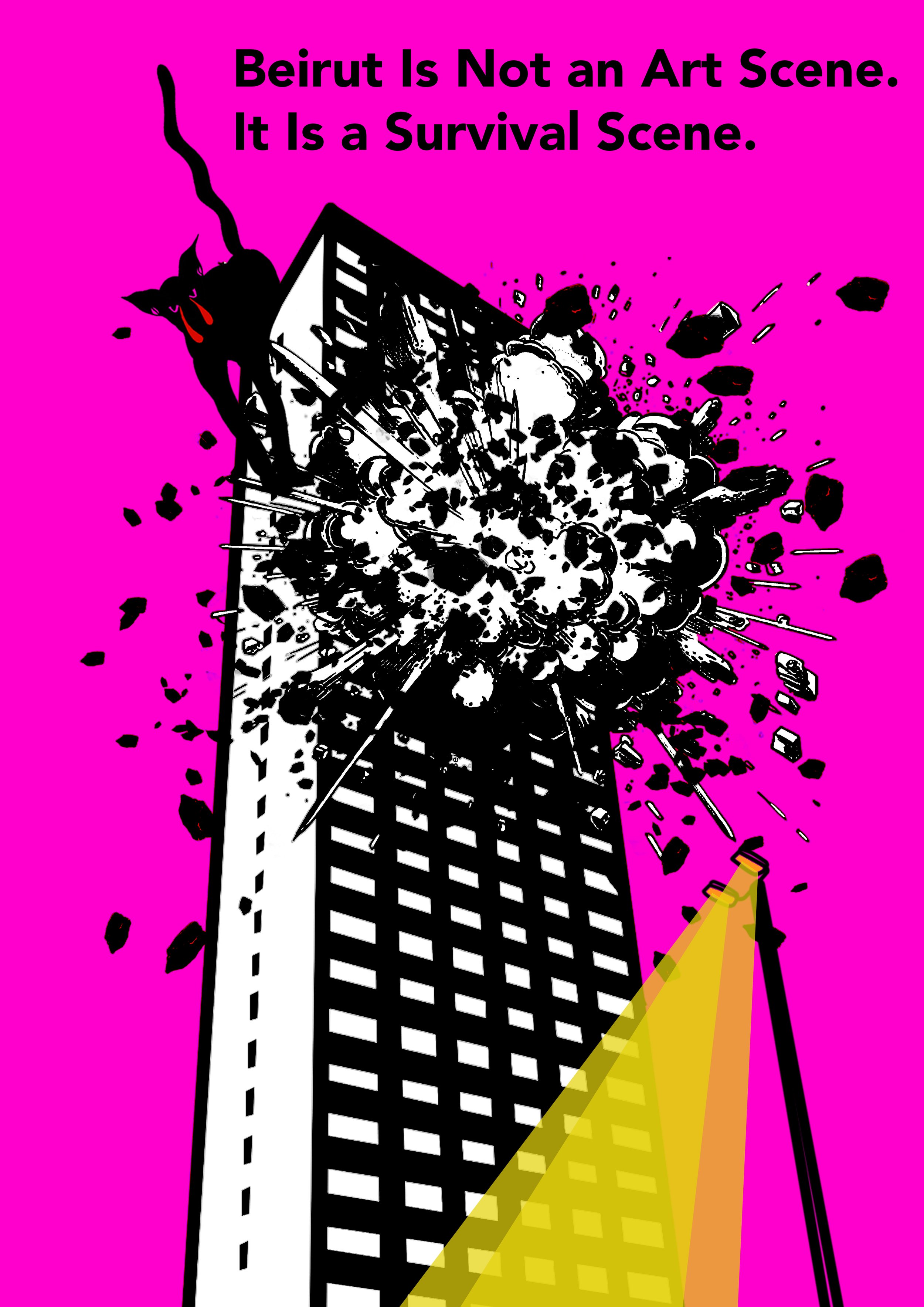
Illustration by Mohamad Makouk
Beirut is constantly described as having a vibrant art scene.
That sentence has been repeated so many times it now behaves like wallpaper. It covers the cracks without repairing the building.
Every few months, the city is declared alive again. A gallery opens. A museum reopens. A cultural event takes over the city. A festival announces dozens of exhibitions, performances, talks, screenings, and tours. Someone writes that Beirut is resilient. Someone else photographs a broken facade with warm light. The caption says the city refuses to die.
Of course it refuses to die. What else is it supposed to do? Send a resignation letter?
The problem with the way people speak about the Beirut art scene is that they confuse survival with health. They confuse activity with infrastructure. They confuse cultural endurance with cultural strategy. They confuse the fact that artists continue to produce with proof that the system around them is working.
It is not working.
Lebanon does not lack artists. Lebanon does not lack intelligence, memory, visual language, political tension, emotional density, or cultural material. It has more than enough of all that. What it lacks is structure. It lacks serious cultural policy, long-term institutional support, audience development, public art strategy, collection planning, conservation systems, artist development, curatorial investment, and galleries willing to do more than circulate the same approved names through the same small rooms.
This is why Beirut is not an art scene in the full sense of the word.
It is a survival scene.
And survival, let us be clear, is not a cultural model. It is what happens when every model has failed.
The romance of resilience has become exhausting
Lebanon has become very good at being admired for surviving.
The country collapses, and the artists continue. The currency collapses, and the galleries continue. The port explodes, and the museums repair themselves. War expands, and cultural workers turn into emergency responders, educators, archivists, therapists, fundraisers, and witnesses. The state fails, the banks fail, the infrastructure fails, the public sector fails, and somehow the artist is expected to remain poetic about it.
This is where the word “resilience” becomes suspicious.
Resilience may describe what people do under pressure, but it should never become the language used to excuse the pressure itself. When the cultural sector is forced to survive political crisis, economic collapse, displacement, destroyed infrastructure, and weak public support, calling it resilient can become a way of avoiding the real question: why is the sector constantly being abandoned and then praised for not disappearing?
The Beirut art scene is often celebrated for continuing despite everything. But “despite everything” is not a cultural plan. It is an indictment.
There is a difference between a city that supports culture and a city that consumes the exhaustion of its cultural workers as proof of its soul. Beirut too often does the second. It takes the artist’s fatigue and turns it into atmosphere. It takes institutional fragility and calls it flexibility. It takes emergency improvisation and calls it creativity.
This is not romantic. It is violent with better lighting.
Activity is not infrastructure
Beirut can produce a lot of cultural activity.
There are exhibitions, artist talks, screenings, design weeks, festivals, open studios, residencies, workshops, private collection visits, gallery walks, and institutional programs. On paper, this looks like movement. On Instagram, it looks like life. In press releases, it becomes proof that the city is still beating.
But activity is not infrastructure.
An event is not an ecosystem. An opening is not a policy. A festival is not a future. A crowded weekend does not mean artists are supported across the year. A citywide cultural program does not mean the city has a functioning cultural strategy. A gallery district does not mean the gallery system is healthy.
Infrastructure is slower, less glamorous, and much more important.
It means archives that are maintained. Collections that are researched. Artists who are developed before they become fashionable. Public art that is commissioned with thought, not placed like expensive furniture. Museums that are funded beyond emergency restoration. Galleries that publish, contextualize, and educate. Residencies that are not just temporary gestures. Cultural spaces that are not dependent on panic, donors, or the private heroism of exhausted individuals.
Lebanon has many cultural moments. It has far fewer cultural systems.
That distinction matters because moments disappear. Systems accumulate.
The gallery loop
One of the most uncomfortable things about the Beirut art scene is not that galleries are disappearing. It is that many remain visible without seeming culturally necessary.
There are exhibitions. There are openings. There are newsletters, Instagram posts, polite captions, familiar names, familiar faces, and familiar works appearing again and again under slightly different lighting. But the question remains: what is actually being introduced? Who is being discovered? What risk is being taken? What public is being built?
Too many galleries in Lebanon operate like closed circuits. They circulate the same artists, the same aesthetics, the same safe reputations, and the same collector-friendly language. The result is not continuity. It is repetition disguised as stability.
A serious gallery does not only hang work. It builds context. It develops artists. It takes positions. It writes, researches, argues, introduces, educates, invests, and sometimes loses money because culture is not built through minimum effort. A serious gallery does not wait for an artist to become sellable elsewhere before claiming them locally. It does not treat young artists as decorative inventory. It does not rely forever on the comfort of names already approved by collectors, institutions, or social circles.
But in Beirut, one often enters galleries that feel deserted, not only physically, but intellectually. The space is open. The lights are on. The works are installed. But the room feels abandoned by thought. There is no real mediation, no urgency, no argument, no sense that the exhibition had to happen. It could have been installed this month, last year, or ten years ago. Nothing would change.
This is where the word “scene” begins to collapse.
A scene implies movement. It implies friction, discovery, disagreement, renewal. It implies that artists are being pushed forward and that audiences are being challenged to look again. What Beirut often has instead is circulation: a small economy of familiar artists moving through familiar spaces for familiar people.
The problem is not that galleries need to sell. Of course they do. A gallery is not a monastery with better lighting. It has rent, salaries, shipping, framing, insurance, installation, storage, collectors to satisfy, artists to support, and a collapsing economy to survive.
But survival cannot become the only curatorial position.
When survival becomes the whole strategy, programming becomes defensive. Galleries stop discovering and start recycling. They stop building artists and start protecting inventory. They stop shaping taste and start following whatever taste still has money attached to it.
This creates a strange contradiction. Beirut is constantly described as culturally alive, yet many of its galleries feel as if they are waiting for someone else to animate them. The same names return. The same gestures return. The same post-war visual codes return. The same abstract melancholy, the same archive mood, the same tasteful ruin, the same safe rebellion. Everything looks serious, but very little feels dangerous.
The question is not whether Lebanese galleries are working hard. Many are. The question is whether the work is cultural or merely operational.
Keeping a space open is not the same as building an art scene. Mounting exhibitions is not the same as developing artists. Selling art is not the same as producing cultural value.
A gallery that does not introduce new voices eventually becomes a showroom for its own fear.
A gallery that refuses risk becomes a storage room with better manners.
And a city full of cautious galleries does not create an art scene. It creates an elegant waiting room.
How are these galleries surviving?
This is the question people ask quietly.
They ask it because some spaces feel empty. They ask it because programming looks thin. They ask it because the same artists keep returning. They ask it because serious audience development seems absent. They ask it because Lebanon is in crisis, purchasing power has collapsed for many people, and yet certain galleries continue to exist in a strange suspension between commerce, culture, private money, and symbolic presence.
The answer is not simple, and it should not be reduced to gossip.
Some galleries survive through loyal collectors. Some through family money. Some through international clients. Some through art advisory work. Some through private sales. Some through secondary market deals. Some through storage, framing, consultancy, design-adjacent services, or relationships with diaspora buyers. Some survive because art, in times of financial distrust, becomes one of the few objects that still promises symbolic and financial value. Some survive because merely having a gallery in Beirut still carries social capital.
There is nothing automatically scandalous about any of that.
But the question matters because survival without visible public engagement creates suspicion. When galleries appear deserted, repetitive, and underinvested, yet somehow remain open, the public is allowed to wonder what economy is actually being served.
Is the gallery building artists, or simply holding assets?
Is it creating culture, or maintaining status?
Is it developing audiences, or waiting for private buyers?
Is it contributing to Lebanese contemporary art, or merely using Lebanese contemporary art as a surface for social legitimacy?
These are not accusations. They are structural questions.
And a serious art scene should be able to survive structural questions.
The same artists, again and again
There is a comfort in showing artists who are already known.
Collectors recognize the names. Institutions know how to describe them. Journalists know where to place them. Gallerists know how to sell them. The risk is reduced. The room behaves. The exhibition becomes manageable.
But culture does not grow through manageability.
A healthy Beirut art scene should be introducing new artists, new positions, new visual languages, new forms of research, new conversations, new discomforts. It should not be a loop where the same names are treated as proof that the scene exists. Of course established artists matter. Of course continuity matters. Of course artists with long practices deserve sustained attention.
But when continuity becomes repetition, the scene begins to rot politely.
The question is not whether older or established artists should be shown. The question is whether they are being used to avoid the work of discovery.
Discovery takes time. It takes studio visits. It takes research. It takes curatorial intelligence. It takes financial risk. It takes a willingness to stand behind artists before anyone else has decided they are safe. It takes more than waiting for an artist to appear at an international fair, residency, biennial, or museum abroad before Beirut suddenly remembers to claim them.
Too often, the Lebanese art world wants the prestige of discovery without the labor of discovering.
That is not an art scene. That is cultural laziness wearing black.
The collector problem
Lebanon’s collectors matter. They have kept parts of the art market alive when institutions, banks, and public structures failed. Private collections have preserved works, supported artists, funded exhibitions, and maintained a level of continuity that the state did not provide.
But private collecting cannot replace cultural policy.
When collectors become the main force sustaining the art system, taste becomes concentrated. Risk becomes negotiable. Galleries begin programming around what can move. Artists begin sensing what is acceptable. Institutions court private support. Public culture becomes dependent on private appetite.
The collector becomes more than a buyer. The collector becomes a gatekeeper, a cultural authority, sometimes even a substitute museum.
This is dangerous, not because collectors are bad, but because no healthy cultural ecosystem should depend so heavily on private taste. A country needs public collections, transparent acquisition strategies, museum development, research departments, public commissions, conservation programs, and cultural policy. It needs structures that outlive individual preference.
Without that, art becomes another luxury sector pretending to be a public conversation.
The NGO vocabulary problem
There is another layer to the Lebanese art scene: the language of funding.
Because the cultural sector depends heavily on private and international support, art is often forced to speak in a vocabulary that funders understand. The words become familiar: memory, healing, resilience, trauma, community, archive, displacement, identity, repair, solidarity, participation, reconstruction.
These are not bad words. Many of them describe real conditions. Lebanon has suffered enough to earn every one of them.
But when the vocabulary becomes too predictable, art begins to sound like a grant application with lighting.
This is one of the great traps of Lebanese contemporary art. The country’s pain is real, but the language used to frame it can become formulaic. Artists and institutions learn how to package complexity into fundable themes. Curators learn how to make suffering legible. Donors learn what kind of Lebanese art feels responsible. The result is a cultural language that can be intelligent, moving, and necessary, but also strangely repetitive.
The wound becomes fluent.
And once the wound becomes fluent, the art world knows how to consume it.
The ruin economy
Beirut has been turned into visual material for too long.
Its broken buildings, bullet holes, abandoned cinemas, damaged staircases, cracked facades, decayed balconies, port wounds, and half-collapsed memories have been photographed, painted, filmed, exhibited, and used as atmosphere. Sometimes this work is profound. Sometimes it is necessary. Sometimes it is documentation. Sometimes it is mourning.
And sometimes it is ruin porn.
The problem is not representing destruction. The problem is styling destruction until it becomes beautiful enough to stop being urgent. Beirut has been photographed so poetically that one begins to wonder whether the image is helping the city or feeding on it.
This is especially relevant to art consultancy, public art, and cultural strategy in Lebanon. A city is not a mood board. It is not a background for someone else’s melancholy. It is not a texture to be extracted and used in branding. Cultural strategy must read a city as a living system, not as a collection of photogenic wounds.
Beirut is not a backdrop.
It is not a ruin waiting to be captioned.
It is a city that has been mismanaged, mythologized, abandoned, and aestheticized almost simultaneously.
Public art without public strategy
Lebanon also suffers from a misunderstanding of public art.
Too often, public art is treated as an object, not as a civic act. A sculpture is placed. A mural is painted. A donor is thanked. A ribbon is cut. Photos are taken. Then everyone moves on.
But public art is not decoration in a public place. It is a decision about memory, identity, access, visibility, and power.
Who chooses the artist? Who defines the narrative? Who maintains the work? Who is the public? What does the work do to the site? Does it create meaning, or does it simply occupy space? Is it part of an art strategy, or is it a visual bandage placed over a deeper absence?
Lebanon does not need more random cultural gestures. It needs public art strategy. It needs cultural planning. It needs commissions that understand site, history, community, material, maintenance, and long-term relevance. It needs art programs that are not added at the end of a project like a polite apology.
Art is not decoration. It is strategy.
This is not a slogan. It is the difference between culture that fills space and culture that gives space meaning.
Beirut keeps saying Lebanon, but it often means Beirut
Another problem is centralization.
Lebanon’s cultural conversation is still too Beirut-heavy. Beirut speaks as if it is the country. It is not. Tripoli, Saida, Tyre, Zahle, Baalbek, the Bekaa, the South, the North, the mountains, the camps, the coast, and the diaspora are not decorative footnotes to the capital’s anxiety.
There is increasing talk about decentralization, but the word is often used too easily. Real decentralization does not mean sending a workshop outside Beirut, taking photos, writing a report, and returning to the capital. Real decentralization means resources, continuity, local leadership, regional institutions, cultural spaces, education, programming, and visibility that does not depend on Beirut’s approval.
Lebanon’s cultural map is not small.
Its imagination has been centralized.
A serious Lebanese cultural infrastructure would not treat the rest of the country as outreach. It would understand that Lebanon’s cultural intelligence is distributed across territory, class, memory, dialect, religion, landscape, and migration. The future of Lebanese contemporary art cannot be built by Beirut alone, especially not a Beirut that is itself exhausted.
What Lebanon actually needs
Lebanon does not need another article praising its resilience.
It does not need another opening where the same people stand in the same corners saying the same things. It does not need another festival that disappears after four days and leaves behind a press release. It does not need another gallery pretending that survival is enough. It does not need another mural photographed as proof of hope. It does not need another ruin aesthetic. It does not need another cultural project built only to satisfy donor vocabulary.
Lebanon needs cultural infrastructure.
It needs serious art advisory frameworks for institutions, hospitality projects, corporate collections, public spaces, cultural districts, municipalities, and private collections. It needs collection strategies that do more than acquire attractive objects. It needs curatorial research that gives artworks context. It needs commissioning models that support artists from concept to production. It needs conservation, archives, publications, mediation, and education. It needs public art programs that understand the city before placing objects inside it. It needs galleries that behave like cultural engines, not waiting rooms. It needs collectors who understand that buying art is not the same as building culture.
Most of all, it needs seriousness.
Not heaviness. Not bureaucracy. Not academic fog. Seriousness.
The seriousness to ask why a work belongs in a place.
The seriousness to ask who is missing from the conversation.
The seriousness to ask why the same artists keep circulating.
The seriousness to ask why spaces are open but feel empty.
The seriousness to ask what kind of cultural value is being produced.
The seriousness to stop mistaking survival for success.
From survival scene to cultural system
The Beirut art scene is not dead. That would be too easy, and also untrue.
It is alive, but life alone is not enough. A body can be alive and still be exhausted. A city can be active and still be structurally weak. A gallery can be open and still contribute very little. A festival can be crowded and still leave no infrastructure behind. An artist can be brilliant and still be unsupported.
This is the contradiction of Lebanese contemporary art today.
There is talent everywhere, but not enough development.
There are spaces, but not enough vision.
There are collectors, but not enough responsibility.
There are events, but not enough continuity.
There are institutions, but not enough support.
There is activity, but not enough structure.
Beirut is not lacking art.
Beirut is lacking the conditions that allow art to matter beyond survival.
That is why the next phase of Lebanese cultural work cannot be built on romance. It has to be built on strategy. Art consultancy in Lebanon, public art strategy, cultural infrastructure, collection development, art commissioning, and curatorial planning are not luxuries. They are the tools through which culture stops improvising and starts accumulating power.
The goal is not to make Beirut look more artistic.
The goal is to make Lebanese art harder to ignore, harder to reduce, harder to exploit, and harder to recycle into the same exhausted story.
Because Beirut does not need the world to admire its survival.
It needs the structures to stop merely surviving.
And until that happens, let us call things by their proper names.
This is not an art scene.
It is a survival scene.
And survival is not enough.