
Can an Israeli Artist Be Patriotic Without Becoming Suspect?
Dissent, loyalty, censorship, and the strange politics of belonging in Israeli contemporary art
contemporary art museum israel
The passport enters before the artwork
Contemporary art enjoys thinking of itself as the room where complexity is allowed to breathe. In theory, it welcomes contradiction, ambiguity, layered identities, difficult histories, and unstable meanings. In practice, the room often becomes far less generous when the artist comes from a politically charged country. Suddenly the artwork is not only an artwork. It is evidence. It is testimony. It is an accusation. It is an apology. It is a diplomatic object wearing expensive lighting.
Few artistic contexts expose this tension as sharply as Israeli contemporary art. An Israeli artist does not enter the global art world as a neutral cultural producer. The artist enters with a passport that has already been interpreted. The work may be about motherhood, memory, drones, archaeology, language, domestic space, landscape, exile, satire, or abstraction. It hardly matters. The national context arrives first and pulls up a chair.
The question is not whether politics should be excluded from art. That would be childish. Art is always shaped by politics, funding, institutions, mobility, citizenship, censorship, access, collecting, and the narratives through which work is exhibited. The more serious question is whether artists are still allowed to be more complicated than the political categories assigned to them.
This is where the Israeli artist becomes a useful, uncomfortable case study. At home, criticism of the state can be framed as disloyalty. Abroad, visible attachment to Israel can be framed as complicity. The artist is squeezed between two moral demands. One audience may ask: why are you criticizing your own country? Another may ask: why are you still attached to it at all?
In that squeeze, patriotism becomes difficult to define. If patriotism means obedience, propaganda, military romance, and the refusal to question power, then contemporary art is right to distrust it. Nobody needs another bronze monument pretending to have feelings. But if patriotism can also mean attachment, responsibility, grief, historical burden, language, family, memory, and the desire for a country to become better than its worst actions, then the issue becomes more complicated.
The contemporary art world often praises dissent. Museums exhibit it. Biennials circulate it. Collectors acquire it. Foundations fund it. Curators write about it as if dissent were a moral skincare routine. The question is whether the art world values dissent because it is genuinely difficult, or because some forms of dissent have become easy to recognize, package, and reward.
In the Israeli case, this question becomes unavoidable. Which Israeli artists become internationally legible? Which kinds of criticism travel well? Which artists are punished locally for critique? Which artists become suspect internationally for national representation? And can an Israeli artist express any form of patriotic attachment without being treated as intellectually compromised?
This essay does not ask whether Israeli artists should defend or condemn the state. That is too small and too boring. It asks something deeper: can contemporary art still handle artists who love and criticize the same place?
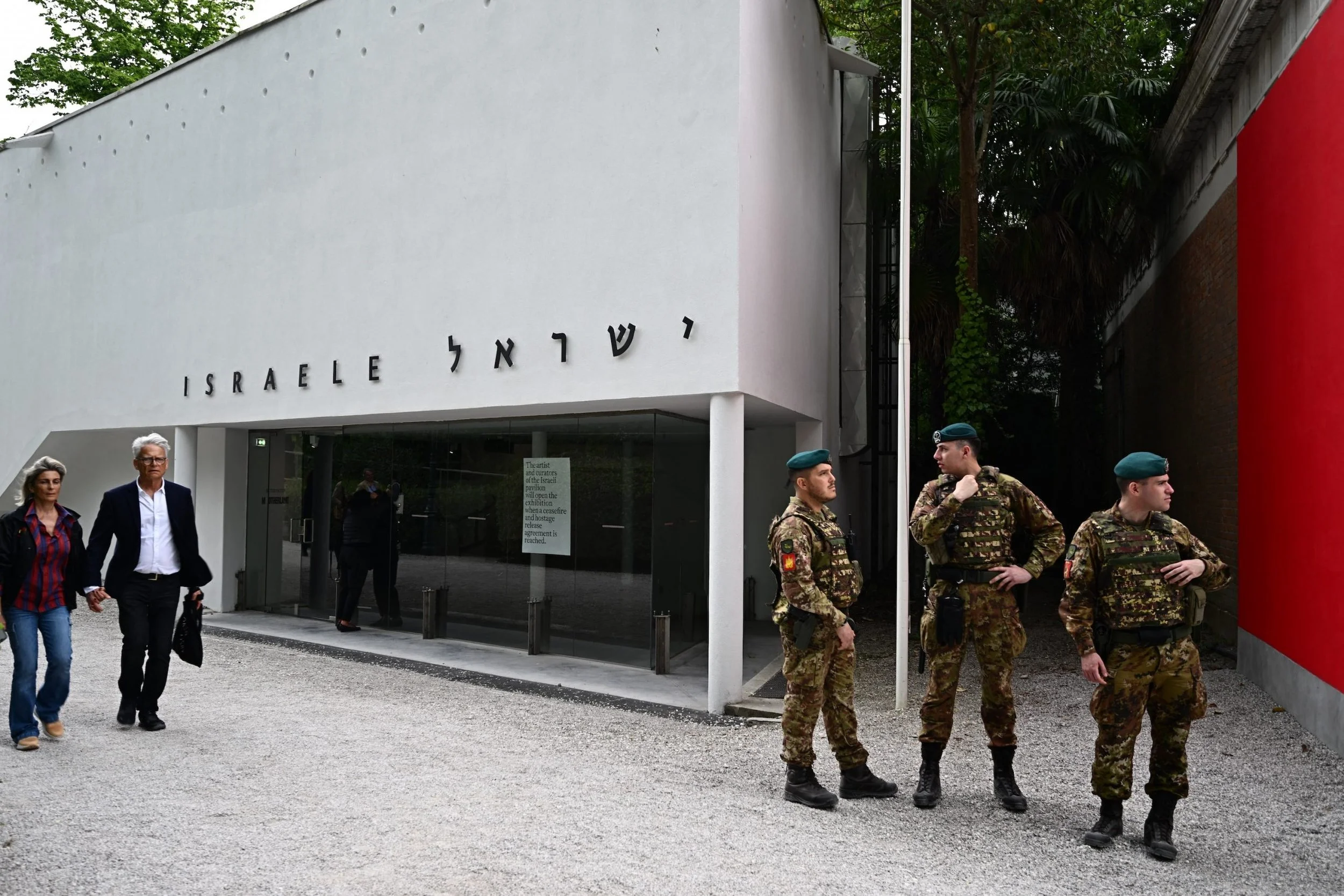
Italian soldiers stand guard in front of Israel's pavilion during the pre-opening of the Venice Biennale art show, on April 16, 2024 in Venice. Photo: GABRIEL BOUYS / AFP via Getty Images.
The Venice Biennale and the closed pavilion
The clearest recent example is Ruth Patir and the Israeli Pavilion at the 2024 Venice Biennale. Patir was selected to represent Israel with “(M)otherland,” an exhibition involving video, archaeology, technology, motherhood, fertility, and the symbolic pressure placed on the female body. Before the pavilion opened to the public, Patir and the curators announced that the exhibition would remain closed until there was a ceasefire in Gaza and an agreement for the release of hostages taken by Hamas on October 7. The exhibition existed, the pavilion was installed, and yet the door remained closed.
As an image, it was almost too perfect. A national pavilion, an international art stage, a war, a closed door, and a statement taped to glass. Venice, which has spent decades turning national representation into a refined Olympic sport for curators, suddenly had to confront the fact that national pavilions are not innocent containers. They are political instruments, even when the work inside is not propaganda.
The decision was praised by some and criticized by others. Some saw the closure as a meaningful gesture of solidarity with Israeli hostage families and those calling for change. Others argued that it did not go far enough, especially because thousands of artists and cultural workers had called for Israel to be excluded from the Biennale altogether. In other words, the artist could not win. Opening the pavilion would have been read by some as normalization. Closing it was read by others as insufficient. Refusing the pavilion might have been praised in one circle and condemned in another.
This is the impossible position of the Israeli artist in international cultural space. Patir was not simply presenting a body of work. She was expected to carry the symbolic burden of the state, the war, the hostages, Gaza, protest movements, boycott demands, the Biennale system, and the moral expectations of multiple publics. That is not artistic freedom. That is being turned into a diplomatic suitcase.
The Venice case matters because it shows how quickly national representation can swallow artistic intention. A work about motherhood and historical symbolism became inseparable from the politics of Israel’s presence at the Biennale. This does not mean the politics were irrelevant. A national pavilion is, by definition, political. But it does mean that the artist was placed inside a structure where the national frame became louder than the art itself.
The irony is that contemporary art often claims to resist nationalism while preserving one of the most theatrical national formats in the art world: the pavilion. Every two years, countries gather in Venice to pretend that art has transcended borders while literally installing itself inside them. It is elegant, expensive, and conceptually hilarious. The Israeli Pavilion controversy did not create that contradiction. It exposed it.
The state also knows how to be nervous
If the international art world can make the Israeli artist suspect for national representation, the Israeli state and local authorities have also shown how easily critical art can become suspect at home. The most obvious recent framework is the debate around cultural funding and loyalty.
In 2018, Israel’s “Culture Loyalty” bill advanced in the Knesset. The proposed law would have allowed the culture minister to withhold state funding from cultural institutions or works that violated specified principles, including denying Israel as a Jewish and democratic state, inciting violence or racism, supporting armed struggle or terrorism against Israel, or destroying state symbols. Supporters presented it as a way to ensure public money did not fund works considered hostile to the state. Critics saw it as political censorship and a threat to artistic freedom.
The reaction from artists was not subtle. Israeli artists protested the bill, and some burned their own artworks in Tel Aviv as an act of resistance. [4] Burning one’s own work is not exactly a polite letter to the editor. It is what happens when artists feel that the state is trying to turn funding into a loyalty test.
This is essential to the article’s argument because it proves that dissent is not simply rewarded. It depends where the dissent occurs and who is watching. An Israeli artist critical of state policy may be legible, even celebrated, in certain international circles. But within Israel, that same critical position can create institutional vulnerability, funding pressure, political attack, or censorship disputes.
The “Nakba Law,” passed in 2011, also belongs to this landscape. The law allows the finance minister to reduce state funding to institutions that mark Israel’s Independence Day as a day of mourning or that deny Israel’s existence as a Jewish and democratic state. The law is not only about money. It is about memory. It makes commemoration itself a potential funding risk.
For artists, curators, cultural institutions, and public art programs, this matters enormously. Memory is one of the central materials of contemporary art. If memory can trigger financial penalty, then cultural production becomes careful. The censorship may not always arrive as a ban. Sometimes it arrives as a budgetary shadow. The institution asks: can we afford to show this? The artist asks: can I afford to say this? The curator asks: can this exhibition survive its own wall text?
That is how cultural ecosystems become cautious. Not because everyone is censored every day, but because everyone begins to calculate.
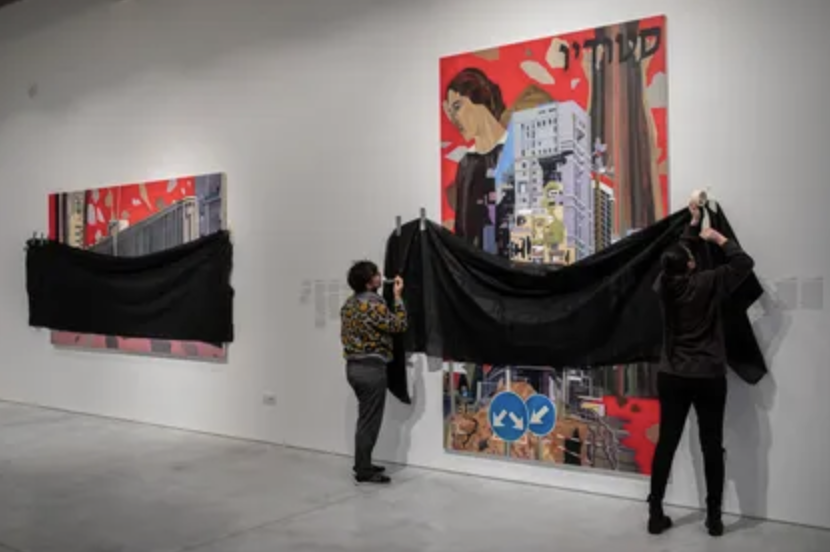
David Reeb’s controversy at the Ramat Gan Museum
David Reeb and the artwork that became a municipal crisis
David Reeb’s controversy at the Ramat Gan Museum of Israeli Art is one of the clearest cases of political pressure around contemporary art inside Israel. Reeb, an Israeli artist known for politically charged work, has long engaged with the occupation, protest, the Green Line, and the visual languages of power and violence. The Tel Aviv Museum of Art has described his practice in relation to political reality in Israel and demonstrations in places such as Bil’in and Nabi Salih.
In 2021 and 2022, Reeb’s 1997 painting “Jerusalem” became the center of a major controversy at the Ramat Gan Museum. The painting included a provocative phrase associated with Jerusalem and ultra-Orthodox imagery. After objections from the mayor of Ramat Gan, the work was removed. Dozens of participating artists then demanded that their works be removed in protest, and the museum eventually suspended operations during the dispute.
This case is not a footnote. It is a map of the entire problem. A political artwork entered a museum. A local political authority objected. The museum removed the work. Other artists resisted. The institution became unstable. The artwork became larger than itself.
The useful lesson here is not that every viewer must like Reeb’s painting. Viewers are allowed to dislike artworks. They are allowed to be offended, bored, irritated, confused, or spiritually exhausted. That is part of the public life of art. The issue is what happens after offense. In a serious cultural ecosystem, offense can lead to debate, counter-programming, public discussion, critical writing, or contextual framing. In a fragile ecosystem, offense leads to removal.
Removal is not an argument. It is panic with a ladder.
Reeb’s case shows the local cost of dissent. It also complicates the international fantasy that the critical Israeli artist is simply rewarded. In one context, critique may produce visibility. In another, it may produce institutional crisis. The artist is not moving through one art world. The artist is moving through several overlapping rooms, each with different rules, punishments, and moral expectations.
The artists the global art world knows how to read
The international art world has been very receptive to Israeli artists who work critically with nationalism, memory, militarization, occupation, identity, and the instability of historical narratives. This is not a criticism of those artists. Many are producing serious, necessary, and formally sophisticated work. The point is to examine what kind of Israeli art becomes legible internationally and why.
Yael Bartana is one of the most important examples. Born in Israel, Bartana represented Poland at the 2011 Venice Biennale with “…And Europe Will Be Stunned,” making her the first non-Polish national to represent Poland at the Biennale. Her work investigates national myth, collective identity, political imagination, Jewish memory, and the rituals through which communities invent themselves.
Bartana’s work is not simply “anti-Israel” or “pro-Israel.” That would be an insult to its intelligence. It is about how nations dream themselves into existence, how collective identities are performed, and how political fantasies are staged. The reason her practice matters here is that it shows how Israeli artists can become internationally powerful when they destabilize national identity rather than simply affirm it.
Miki Kratsman offers another model of critical legibility. His photography has documented Palestinian life, the occupied territories, and the everyday realities of conflict over decades. The Jewish Museum Berlin notes that, through his work as a press photographer, Kratsman had access to areas unavailable to the general public and focused for many years on Gaza, the West Bank, and Palestinian domestic spaces. His work is widely significant because it brings visibility to people and places often seen through military, journalistic, or ideological distance.
Dor Guez complicates the category of “Israeli artist” even further. Born in Jerusalem, with Christian Palestinian and Jewish Tunisian heritage, Guez works across photography, video, archival practice, installation, and scholarship. His practice examines the gaps between personal history and dominant national narratives, especially around Palestinian, Jewish, Arab, and minority identities within Israel and the region. Guez’s work is crucial because it resists the tidy containers that cultural systems love. He is not easily processed as one thing. This is exactly why he matters.
Omer Fast, born in Jerusalem and active internationally, has worked extensively with memory, testimony, war, and the instability of narrative. His 2011 work “5000 Feet Is the Best” was based on interviews with a former drone operator and explores drone warfare, perception, distance, and the moral abstraction of remote violence. [11] Fast’s work is not about patriotism in a direct sense, but it belongs to the broader discussion because it examines how military narratives are mediated, fictionalized, and psychologically processed.
These artists are different in background, medium, politics, and artistic method. They should not be turned into one category. But together, they show a pattern: Israeli contemporary art travels internationally when it can be framed through critique, fracture, memory, occupation, identity conflict, militarization, or the instability of national narratives.
Again, this does not make the work insincere. It does not mean these artists are performing for the market. It means the system has preferences. The global art world understands the Israeli artist as witness, critic, analyst, dissident, or complicated insider. It understands that script. It has wall text ready.
The harder figure is the Israeli artist who remains attached to the country without becoming a state artist. The artist who says: I criticize policy, I reject simplification, I know the violence of history, I understand power, but I also belong to this place. That sentence is less fashionable because it does not give the art world the clean opposition it prefers.
The acceptable Israeli artist
Every international art system has a preferred version of the politically difficult artist. The acceptable Iranian artist is often expected to speak about repression. The acceptable Lebanese artist is expected to process collapse, memory, ruins, and war, ideally with a poetic melancholy that photographs well. The acceptable Palestinian artist is expected to carry dispossession, resistance, exile, and witness, often under unbearable representational pressure. The acceptable Gulf artist is often read through soft power, wealth, spectacle, and state patronage. The acceptable Israeli artist is expected to be self-critical.
This does not mean the work is false. It means the reading is preloaded.
The international art world claims to value complexity, but it often needs artists from politically charged places to arrive with recognizable injuries. The artist becomes a spokesperson before becoming a practitioner. Their national context becomes a caption. Their biography becomes an interpretive shortcut.
For Israeli artists, this creates a particular kind of pressure. If they criticize the state, they are legible abroad but may be attacked at home. If they express attachment to Israel, they may be legible at home but treated with suspicion abroad. If they try to hold both positions, they risk pleasing nobody, which may be the most honest place an artist can stand.
The phrase “patriotic Israeli artist” sounds suspicious in certain cultural rooms because patriotism is often confused with propaganda. That suspicion is not entirely irrational. States do use culture. National museums can become myth machines. Public art can become official decoration. Cultural diplomacy can become soft power with better wine. Any serious art consultancy, cultural strategy practice, or public art advisor must understand this.
But the reverse is also true. Dissent can become a commodity. Critique can become an aesthetic. Political discomfort can be packaged, collected, and exhibited by institutions that benefit from appearing morally alert. A museum can display dissent without changing anything about its own power. A collector can buy political art and feel ethical by acquisition. A biennial can stage radicality while depending on the same financial structures it pretends to critique.
So the question is not whether patriotism is pure or dissent is pure. Neither is pure. The question is when patriotism becomes propaganda, and when dissent becomes branding.
That is the real argument.

New 'City of Heroes' mural in Ofakim
Patriotism is not always obedience
A serious discussion of patriotism must begin by admitting why the art world distrusts it. Patriotism has often been used to silence criticism, discipline minorities, glorify military power, erase inconvenient histories, and demand emotional loyalty from people who are being harmed by the very systems asking for loyalty. Artists have good reasons to mistrust the flag.
But patriotism is not always obedience. Sometimes patriotism is the refusal to abandon a place to its worst forces. Sometimes it is the insistence that a society should be judged by what it claims to value. Sometimes it is mourning. Sometimes it is anger. Sometimes it is the knowledge that one’s language, family, history, and grief are tied to a place too deeply to be discarded for the comfort of ideological purity.
The opposite of love is not criticism. The opposite of love is indifference.
This matters because the most devastating criticism often comes from those who remain attached. A person who does not care can leave. A person who cares argues. The artist who criticizes their country may be doing so not because they hate it, but because they refuse to let it become smaller than its own possibility.
In Israel, this position is especially difficult because patriotism is entangled with trauma, statehood, security, occupation, Jewish historical memory, Palestinian dispossession, religious symbolism, military service, diaspora, and global scrutiny. It is almost impossible to speak about national attachment without stepping into a field of pain.
That does not mean the artist should avoid it. It means the art world should stop pretending that attachment is automatically less intelligent than critique.
An artist can love a place and still expose its violence. An artist can criticize a state and still belong to a people. An artist can reject nationalism and still be attached to language, landscape, memory, or family. An artist can engage with Israeli identity without becoming an official brochure for Israel. The inability to hold these distinctions is not moral clarity. It is intellectual laziness.
And contemporary art, which has spent decades telling everyone it is smarter than literal thinking, should be embarrassed when it falls into that trap.
The collector, the museum, and the politics of legitimacy
The question of Israeli patriotism in contemporary art is not only about artists. It is also about institutions. Museums, galleries, collectors, biennials, art advisors, foundations, and public cultural bodies decide which forms of speech are supported, acquired, protected, contextualized, or quietly avoided.
A museum that exhibits a critical Israeli artist is making a decision. A collector who acquires work about occupation is making a decision. A biennial that maintains a national pavilion during war is making a decision. A ministry that attaches funding to loyalty is making a decision. A gallery that avoids certain artists because the topic is “too complicated” is making a decision.
Cultural strategy is made of these decisions.
This is where the issue becomes directly relevant to Core Art Strategies and to serious art consultancy. Art is not decoration. It enters spaces carrying political, historical, symbolic, and financial weight. Whether the client is a museum, hotel, corporate headquarters, public authority, real estate developer, private collector, cultural foundation, or hospitality project, the same questions apply: what does this work represent, who is allowed to speak, what histories are being included, what risks are being managed, and what kind of cultural value is being produced?
The Israeli case is extreme, but the lesson is global. In public art, national identity can become monumental too quickly. In collection development, political work can become a trophy of moral seriousness. In art advisory, difficult artists can be flattened into fashionable narratives. In cultural programming, complexity can be turned into marketable controversy.
The role of serious cultural strategy is not to make art safe. Safe art is often dead on arrival. The role is to understand the conditions under which art becomes meaningful, risky, manipulative, decorative, transformative, or empty.
A sculpture is not automatically public memory. A political artwork is not automatically brave. A patriotic artwork is not automatically propaganda. A dissident artwork is not automatically profound. Context does the hard work.
Public art and the problem of national feeling
Public art makes the question of patriotism physical. It places symbols, bodies, materials, and narratives into shared space. Unlike a gallery exhibition, where the audience chooses to enter, public art enters the audience’s life. It occupies a square, a lobby, a street, a plaza, a hotel atrium, a cultural district, a memorial site, or a civic building. It becomes part of the visual argument of a place.
In a country shaped by conflict, public art cannot be neutral. Even abstraction can become political depending on where it is placed, who funds it, and what it avoids. This is why public art strategy matters. Without strategy, public art becomes either propaganda or furniture. One tells people what to feel. The other gives them nothing to feel at all.
Israel is not alone in this. Every country with traumatic history struggles with public symbols. Lebanon does. Palestine does. Germany does. The United States does. Gulf countries do. Ukraine does. Russia does. France does. Everyone does, though some pretend more elegantly.
A serious public art program must ask: who is the public, what is the site, what histories are active here, what forms of attachment exist, what pain is being carried, who is excluded, what is being commemorated, what is being avoided, and what will this work mean in ten years when the press release has died?
The patriotic artwork fails when it becomes instruction. The critical artwork fails when it becomes posture. The best public art does not tell people what to think. It makes the space harder to ignore.
That is the difference between cultural strategy and decoration.
Who gets to be complex?
The central problem is not whether Israeli artists are oppressed, privileged, rewarded, censored, celebrated, or attacked. The answer is: depending on the artist, the institution, the audience, and the context, all of the above can be true.
Ruth Patir was given one of the most visible platforms in the art world, yet the platform became almost impossible to occupy normally. David Reeb has been exhibited by major institutions, yet his work was also removed from a museum after political pressure. Yael Bartana has received international recognition for work on national identity, but that recognition also confirms how strongly the global art world values Israeli artists who destabilize nationalism. Miki Kratsman has received institutional attention for photographic work on occupation, yet the subject itself carries ethical and political burdens no exhibition can fully resolve. Dor Guez is internationally visible, yet his practice constantly reveals the inadequacy of national categories. Omer Fast is not reducible to Israeli politics, yet his work on military testimony shows how conflict travels through image, memory, and narration.
The point is not to flatten these artists into proof of one argument. The point is to show that Israeli contemporary art lives inside a dense system of pressures. Some pressures come from the state. Some come from international institutions. Some come from the market. Some come from activists. Some come from collectors. Some come from audiences. Some come from history itself, which, as usual, has terrible timing and refuses to leave the room.
The serious question is: who gets to be complex?
Can an Israeli artist be more than the state? Can a Palestinian artist be more than the wound? Can a Lebanese artist be more than collapse? Can an Iranian artist be more than repression? Can a Gulf artist be more than soft power? Can any artist from a politically charged place be read first as an artist, and only then as a national symptom?
The answer should be yes.
But the art world often behaves as if the answer is: only when convenient.
The real test of contemporary art
The real test of contemporary art is not whether it welcomes dissent. It already does, at least when dissent arrives in forms it understands. The real test is whether it can welcome contradiction that does not flatter its existing worldview.
An Israeli artist who criticizes Israel is not automatically brave. They may be, but bravery depends on context and consequence. An Israeli artist who expresses attachment to Israel is not automatically complicit. They may be, but attachment is not the same as propaganda. A museum that exhibits political work is not automatically courageous. A collector who buys dissent is not automatically ethical. A state that funds culture is not automatically generous. A state that demands loyalty from culture is not protecting identity. It is admitting fear.
The art world needs better questions.
Instead of asking whether an artist is patriotic or critical, ask what kind of attachment the work reveals. Instead of asking whether the work is dissenting, ask what the dissent costs. Instead of asking whether the artist represents Israel, ask how the work complicates representation itself. Instead of treating national identity as a verdict, treat it as one layer in a larger structure of meaning.
This is not neutrality. Neutrality is often just fear with a cleaner shirt. This is precision.
Precision matters because art becomes weak when it is forced into slogans. It becomes even weaker when institutions pretend slogans are analysis.
Conclusion: the artist should remain inconvenient
Can an Israeli artist be patriotic without becoming suspect?
The honest answer is: not easily.
At home, patriotism may not protect the artist if the work criticizes too directly. Abroad, critique may not protect the artist if the work remains attached to Israel. The artist is asked to perform moral balance for audiences addicted to certainty.
But perhaps the artist’s task is not to become acceptable. Perhaps the artist’s task is to remain inconvenient.
To love without obeying. To criticize without abandoning. To belong without becoming decorative. To dissent without becoming a market category. To refuse both the state’s demand for loyalty and the art world’s demand for preferred dissent.
The role of art is not to make patriotism respectable. It is not to make dissent fashionable. It is not to flatter the state, the museum, the collector, the curator, the activist, or the market.
The role of art is to make the room harder to lie in.
Sometimes the lie is loyalty. Sometimes the lie is dissent. Sometimes the lie is neutrality. Sometimes the lie is the idea that contemporary art is above politics.
It is not.
Contemporary art is politics with better shoes.
The Israeli artist simply exposes the problem more clearly than most. The passport enters before the artwork. The audience has already prepared its verdict. The institution wants complexity, but not too much. The market wants courage, preferably collectible. The state wants culture, preferably well behaved. The public wants clarity, preferably immediate.
And the artist, if the artist is serious, gives none of them exactly what they want.
That is not failure.
That is the work.
Author Note
This essay is part of Core Art Strategies’ ongoing writing on contemporary art, art consultancy, cultural strategy, public art, collection development, art advisory, and the political life of cultural infrastructure.